Christopher Luxon’s intention to build a relationship with the Opportunity Party raises questions about his campaign stance. Whether that relationship becomes necessary to govern depends on the final count.
By Webfit News | 8 November 2026
Christopher Luxon’s intention to build a relationship with the Opportunity Party raises questions about his campaign stance.
Christopher Luxon’s intention to build a relationship with the Opportunity Party raises questions about his campaign stance. Whether that relationship becomes necessary to govern depends on the final count.
By Webfit News | 8 November 2026
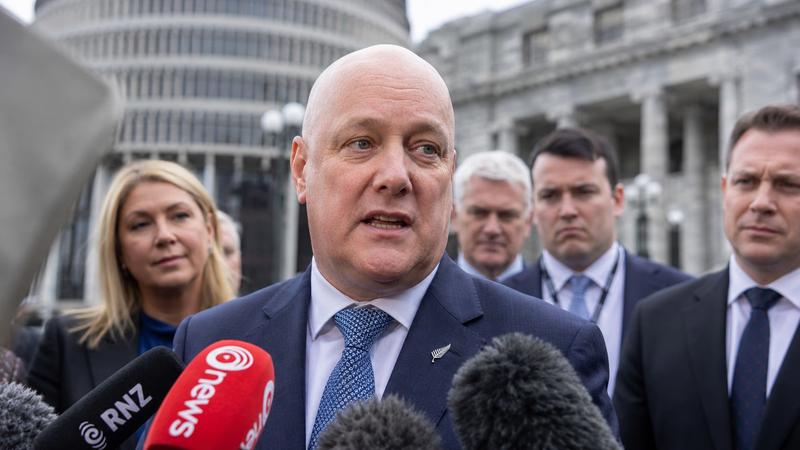
Christopher Luxon wants to build a relationship with the Opportunity Party, according to RNZ’s election coverage, opening a conversation with a party he repeatedly ruled out working with before polling day.
The timing matters. National and its existing partners have a narrow route back to government on preliminary results. Special votes could change that calculation.
Building a relationship, however, does not establish that coalition negotiations are underway. Nor does Opportunity’s arrival in Parliament automatically give it the power to choose the next prime minister.
The immediate question is what Luxon is keeping open and how far he is prepared to move from his campaign position.
The numbers explain the approach
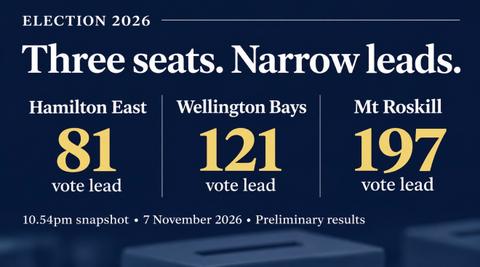
The Electoral Commission’s preliminary allocation gives National 42 seats, ACT 13 and New Zealand First 12.
Together, they hold 67 seats in a projected 131-seat Parliament, where 66 would constitute an outright majority.
Opportunity has seven projected seats after receiving 5.96 percent of the party vote. Labour has 36, the Greens 16 and Te Pāti Māori five.
Those figures remain preliminary. But they explain why Luxon can see a path back to office while still having reason to establish contact with another potential partner.
If the existing coalition’s numbers and support hold, it can govern without Opportunity.
If the count changes, the value of that relationship could change with it.
There is also a less dramatic possibility: National and Opportunity could cooperate on particular policies even if they never negotiate a governing arrangement.
For now, these are possibilities rather than evidence of an agreement.
Opportunity cannot simply replace New Zealand First
Seven seats sound decisive in a close election. Their usefulness depends on which other parties are willing to work together.
National, ACT and Opportunity would have 62 seats on the preliminary allocation, below the 66 needed for an outright majority.
Opportunity therefore cannot simply replace New Zealand First in that combination and produce the same result.
The arithmetic is also difficult for Labour. Labour, the Greens and Opportunity would reach 59 seats. Adding Te Pāti Māori would bring that grouping to 64.
These calculations do not establish that any of those combinations would agree to govern together. They show why describing Opportunity as the confirmed kingmaker gets ahead of the evidence.
Its bargaining position could strengthen after special votes. At this stage, the existing National-led combination still has the numbers to return, subject to the final count and political agreement.
Luxon has a campaign position to explain
Before the election, Luxon’s objections to Opportunity centred on policy, particularly taxation.
He repeatedly rejected working with the party. Reporting during the campaign recorded that his opposition extended to a confidence-and-supply arrangement.
Establishing a working relationship does not necessarily reverse that position. Leaders can talk, maintain contact and cooperate in Parliament without forming a government together.
But if the conversation moves towards securing Opportunity’s support to remain in office, voters deserve a clear explanation.
Has National changed its position? Has Opportunity offered different terms? Or have the election results made an earlier commitment harder to maintain?
Compromise is part of MMP. Explaining what changed is part of political accountability.
The distinction will become more important if either party begins discussing budgets, ministerial roles or commitments to support a government.
A relationship could mean several different things
A coalition is only one possible outcome of discussions between parties.
Under a coalition agreement, parties agree to govern together, with ministers potentially drawn from more than one party.
A confidence-and-supply agreement can allow a party to support a government on confidence votes and funding while remaining outside the coalition.
Parties can also negotiate support for individual bills without promising to keep a government in office.
These arrangements carry different responsibilities and different consequences for voters.
The useful questions are therefore specific: Would Opportunity support Luxon as prime minister? Would it support the government’s budgets? Would it seek ministerial positions? Which policies would either side accept, change or abandon?
Until those questions have answers, a relationship remains a starting point.
Opportunity’s challenge is to show what its support would achieve
Opportunity leader Qiulae Wong has kept open the possibility of working with either major party.
Luxon’s approach brings that position closer to a practical test.
Entering Parliament gives Opportunity a platform and a voice in legislation. Supporting a government would create an additional responsibility: demonstrating what voters gained from the arrangement.
Any agreement would need clear commitments, realistic timeframes and an explanation of how disagreements would be handled.
For households concerned about housing, public services and living costs, those details will matter more than an introductory meeting.
Opportunity also faces a familiar challenge for smaller parties. It must show it can compromise without losing the identity that persuaded people to vote for it.
National faces the corresponding test of explaining any concessions to voters who were told the parties would not work together.
Special votes still stand between the parties and certainty
The Electoral Commission estimates approximately 399,365 special votes remain to be checked and counted.
Official results are scheduled for Friday, 27 November. Ordinary votes are also being recounted as part of the official process.
Changes to party support and close electorate results could affect both the distribution of seats and the size of Parliament.
Until the political outcome is resolved, the incumbent government remains in office under caretaker conventions. Routine administration continues, while significant decisions generally require restraint, delay or consultation.
Luxon’s outreach gives him another conversation to pursue while that process unfolds.
The next meaningful development will be whether National or Opportunity identifies terms for cooperation. That is when voters will be able to judge what the relationship actually means, and what either party is prepared to give up to make it work.
Source: RNZ’s Election 2026 coverage, Electoral Commission preliminary results and Cabinet Office government-formation guidance.
Was this article useful?