Selected shipments included:
- 626 tonnes of salmon and other seafood.
- 350 tonnes of cherries.
- 190 tonnes of milk powder.
- 160 tonnes of health supplements.
Together, those categories account for 1,326 tonnes. They are examples of products carried, rather than a complete breakdown of the route’s freight.
The airline has not provided a total shipment value or a full breakdown by direction, so the figures should not be read as a measure of export earnings.
They do, however, show why this connection matters beyond the airport. Seafood producers, fruit growers and manufacturers depend on reliable transport to reach customers overseas. For perishable goods, delivery speed can be particularly important.
Air New Zealand chief commercial officer Scott Wilkinson said the flights carried the work of New Zealand farmers, fishers and businesses alongside their passengers.
From business trips to family connections
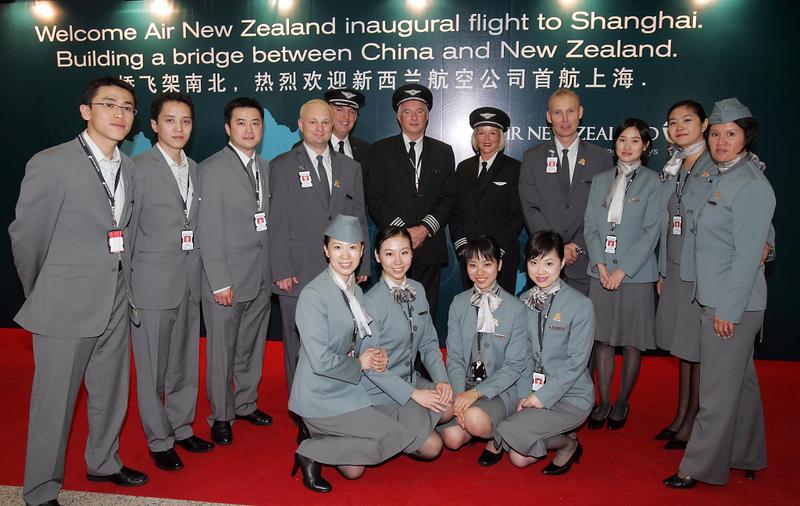
Two members of the original Shanghai-based cabin crew, Eda Lin and Karen Lu, are still flying with the airline.
Both joined in 2006, ahead of the service’s launch.
Eda recalled travelling to Auckland for five weeks of training. Visits to the Bay of Islands and New Zealand farms helped crew develop first-hand knowledge they could later share with passengers.
She has also noticed a change in who travels.
In the early years, passengers were mainly tourists and business travellers. Today, many have family living in New Zealand.
That shift gives the anniversary a meaning beyond passenger totals. The route now supports established connections between households in both countries, as well as holidays, education and business travel.
For Karen, a Chinese New Year flight in 2010 remains a highlight. Crew performed a haka at the aircraft door, creating what she described as a memorable cultural exchange with passengers.
A gateway beyond Auckland and Shanghai
The service also connects passengers with destinations beyond the two cities.
Air New Zealand’s alliance with Air China, established in 2015, provides access to more than 30 destinations across China through Beijing and Shanghai, according to the airline.
Chinese visitors can connect through Auckland to Air New Zealand’s domestic network, helping distribute travel beyond the international gateway.
That creates opportunities for regional accommodation providers, attractions, hospitality businesses and transport operators. The anniversary release does not quantify how much spending the Shanghai route generates for those businesses.
Wilkinson said China remained an important market, with the airline targeting growth where it saw strong customer demand and opportunities to support New Zealand.
How the route developed
The first Auckland–Shanghai flights operated on a 313-seat Boeing 777. Mandarin-speaking cabin crew, Chinese-influenced meals and Chinese-language entertainment were included from the beginning.
The service grew over the following years:
- 2006: Auckland–Shanghai launched with three weekly flights.
- 2013: Daily services began.
- 2014: The Boeing 787-9 Dreamliner made its first Shanghai flight.
- 2015: The Air New Zealand–Air China alliance received approval.
- 2020: Dedicated cargo operations helped maintain trade links during the pandemic.
- 2026: The route reached its 20th anniversary.
The pandemic period demonstrated a different role for the connection. In March 2020, a dedicated Shanghai cargo flight carried products including honey and seafood, helping maintain trade while passenger travel was restricted.
What changes for summer travellers?
Air New Zealand’s current daily service will increase to 10 weekly return services between 23 January and 20 February 2027.
The additional flights are scheduled for Tuesdays, Thursdays and Saturdays. Travellers should confirm operating times when booking, as schedules can change.
The increase is temporary, rather than a permanent move to 10 weekly services.
Twenty years after launch, Auckland–Shanghai serves several needs at once: bringing families together, carrying visitors into New Zealand and moving local products into an overseas market.
The next test is how effectively the additional summer capacity serves that demand, both in the cabin and in the cargo hold.
Source: Air New Zealand’s Auckland–Shanghai anniversary media release and published Chinese New Year flight information.