1. First, what actually happened in the election?
According to the Electoral Commission’s completed preliminary count, the projected distribution of seats is:
|
Political party
|
Projected seats
|
|
National
|
42
|
|
Labour
|
36
|
|
Green Party
|
16
|
|
ACT
|
13
|
|
New Zealand First
|
12
|
|
Opportunity Party
|
7
|
|
Te Pāti Māori
|
5
|
|
Total
|
131
|
Labour received approximately 29.36% of the party vote, narrowly ahead of National on 29.21%.
Yet National is projected to have 42 MPs compared with Labour’s 36.
This is not necessarily a counting mistake. It is a consequence of how electorate seats and proportional representation interact under MMP.
Importantly, these are preliminary results. They are not the final, legally declared election outcome.
2. Why does New Zealand have two votes?
Unlike countries where voters simply choose one candidate, New Zealand gives most voters two separate choices.
The party vote: This is the vote for the political party you want represented in Parliament. It largely determines how many seats each qualifying party receives.
The electorate vote: This is the vote for the individual candidate you want representing your local area.
For example, someone living in Auckland might give their party vote to Labour but choose a National candidate as their local MP.
Both votes are valid and serve different purposes.
This distinction is essential to understanding the election result.
3. Isn’t Parliament supposed to have only 120 MPs?
Yes. New Zealand’s Parliament normally has 120 seats.
Under MMP, those seats are divided between electorate MPs and list MPs.
In the 2026 election, there are 71 electorates. Each electorate elects one local MP.
The remaining places are normally filled by list MPs, selected from political parties’ published candidate lists.
But there is an important rule: a candidate who wins an electorate keeps that seat even if their party has received very few party votes.
That rule can increase Parliament’s size beyond 120.
And that is exactly what the preliminary results suggest has happened this year.
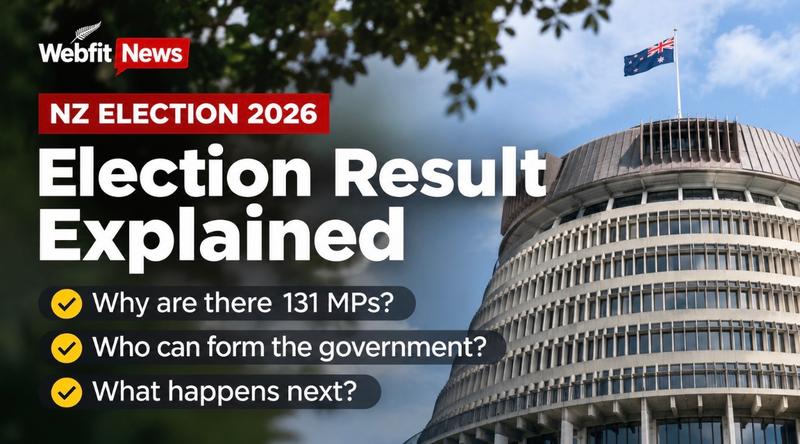
4. What is an overhang, and why are there 131 seats?
An overhang occurs when a party wins more electorate seats than its share of the nationwide party vote would normally entitle it to receive.
Imagine a party receives enough party votes to qualify for three seats.
However, its candidates win five electorates.
Those five winning candidates do not lose their seats simply because their party received fewer party votes.
Instead, the party keeps all five electorate seats.
The additional two seats are called overhang seats.
These are added to Parliament rather than taken away from other parties.
In the 2026 preliminary result, the projected overhang is 11 seats.
That produces:
120 normal seats + 11 overhang seats = 131 MPs.
It is an unusually large overhang by New Zealand’s historical standards.
The previous Parliament had 123 MPs following the 2023 election.
The important point is that 131 is not a permanent new size for Parliament. It is the provisional outcome of this election’s seat-allocation rules and may change when the official results are calculated.
5. Why does National have 42 seats when Labour received more party votes?
This is one of the most important questions arising from the result.
Under ordinary proportional allocation, a party with a larger share of the party vote would generally expect to receive at least as many seats as a party with a smaller share.
But electorate results complicate that calculation.
National’s electorate victories mean it can retain seats won by its individual candidates, even where those victories exceed its proportional entitlement.
Labour, meanwhile, receives its allocation through a combination of electorate MPs and list MPs.
The result is that National is projected to hold 42 seats while Labour has 36, despite Labour’s narrow party-vote lead.
This does not mean National received more party votes.
It means that the final number of MPs depends on both the party vote and the electorate results, including the overhang rules.
6. How many seats are needed to form a government?
This is where the election becomes particularly interesting.
In a normal 120-seat Parliament, a majority requires 61 MPs.
But if Parliament has 131 MPs, a majority requires 66.
That changes the political calculations considerably.
Based on the preliminary projections:
National + ACT + New Zealand First
42 + 13 + 12 = 67 seats
Labour + Greens + Te Pāti Māori
36 + 16 + 5 = 57 seats
Opportunity Party
7 seats
The National-ACT-New Zealand First grouping therefore has a projected majority of just one seat above the 66-seat threshold.
That is an extremely narrow margin.
It also assumes those parties can reach an agreement to govern together.
Having enough seats mathematically does not automatically mean a government has been formed.
7. Could the Opportunity Party decide who becomes Prime Minister?
Potentially, yes.
The Opportunity Party is projected to enter Parliament with seven MPs, making it an important player in coalition discussions.
Its significance could grow if the final results change the balance between the major political blocs.
For example, if National, ACT and New Zealand First lose enough seats to fall below a majority, they may need support from another party.
That could give the Opportunity Party considerable negotiating influence.
However, it would be premature to declare any party the kingmaker.
The final arithmetic, the willingness of parties to negotiate, and the agreements they can reach will determine the outcome.
The Opportunity Party’s seven seats give it potential influence, not an automatic right to choose the next Prime Minister.
8. What role does Te Pāti Māori play?
Te Pāti Māori is central to understanding the unusually large Parliament projected in this election.
The party is projected to hold five electorate seats despite receiving less than 1% of the nationwide party vote.
Under MMP, winning an electorate allows a party to enter Parliament without meeting the usual 5% party-vote threshold.
This is why electorate victories can be particularly important for smaller parties.
Māori electorates operate within New Zealand’s parliamentary electoral system, and their winning candidates become MPs just like winners of general electorates.
The Māori electorate results therefore affect not only local representation but also the overall parliamentary arithmetic.
9. What about the approximately 399,000 special votes?
This is another reason the election cannot yet be treated as settled.
The Electoral Commission estimates that approximately 399,000 special votes remain to be processed as part of the official count.
Special votes can include ballots cast by people voting outside their electorate, overseas voters and people whose enrolment circumstances require additional checks.
These votes are not simply added to the preliminary count immediately.
Officials must verify eligibility and complete the required checks before including valid votes in the official results.
And because the two major political groupings are so close, even a relatively small shift in the distribution of seats could have major consequences.
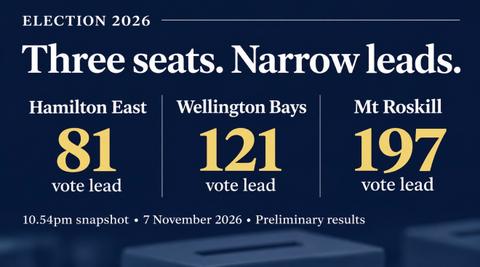
Special votes can also change the outcome of closely contested electorates.
That matters because an electorate changing hands can affect the overhang and potentially the overall size of Parliament.
In other words, the final result might change not only which party receives a seat, but also how many MPs Parliament contains.
10. Why can’t a winner simply be announced now?
New Zealand’s election process has two important stages.
The first is the preliminary count, released on election night.
The second is the official count, which includes checking and recounting ordinary votes, processing special votes and finalising electorate and party results.
Until that work is completed, the projected parliamentary numbers remain subject to change.
Political parties may begin discussions immediately, but the final result provides a firmer basis for deciding which agreements are viable.
There is also a constitutional distinction between winning the most seats and forming a government.
A Prime Minister must be able to command the confidence of the House of Representatives.
That can be achieved through a coalition or through support agreements with other parties.
It is not necessarily the leader of the party with the largest party vote who becomes Prime Minister.
11. What happens to the government while everyone waits?
New Zealand does not simply operate without a government while the votes are finalised.
The existing government continues in a caretaker capacity under established constitutional conventions.
This provides continuity while election results are confirmed and political negotiations take place.
The caretaker arrangements also place expectations on how significant decisions are handled during a period of political uncertainty.
Once a leader can demonstrate sufficient parliamentary support, the process of forming and appointing the next government can proceed.
12. When will New Zealand know the final result?
The Electoral Commission has scheduled the official election results for Friday, 27 November 2026.
Those results will provide a clearer picture of:
- The final party-vote percentages and seat allocations.
- Which candidates have won closely contested electorates.
- The confirmed number of overhang seats.
- The total size of the new Parliament.
- Which political groupings can command a parliamentary majority.
However, the release of official results does not necessarily mean a new government will be announced on the same day.
Coalition negotiations can take additional time.
13. What does all this mean for ordinary New Zealanders?
For most people, the immediate practical impact is uncertainty about which political parties will govern and which policies will ultimately be implemented.
Election promises relating to the cost of living, housing, healthcare, education, taxation and immigration may depend on the outcome of coalition negotiations.
A party might campaign on a particular policy but later need to compromise to secure enough parliamentary support.
This is a normal feature of MMP.
For voters, it is important to distinguish between an election promise, a coalition agreement and an actual government policy.
They are not the same thing.
The bottom line: New Zealand has voted, but the political outcome is not final
The 2026 election has highlighted how complex New Zealand’s electoral system can become when party votes, electorate victories and overhang seats interact.
The preliminary figures point to a 131-member Parliament, with National, ACT and New Zealand First holding a narrow combined majority of 67 seats.
Labour, the Greens and Te Pāti Māori have a combined 57, while the Opportunity Party’s seven MPs could become influential if the final result changes the balance.
But the most important number is not necessarily 131, 67 or 57.
It is 27 November, the date when the Electoral Commission expects to declare the official results.
Until then, New Zealand has a provisional election outcome, not a settled parliamentary majority or a newly negotiated government.
Webfit News will continue following the official results, changes in parliamentary seat projections and developments in government formation as New Zealand waits for its next government to take shape.