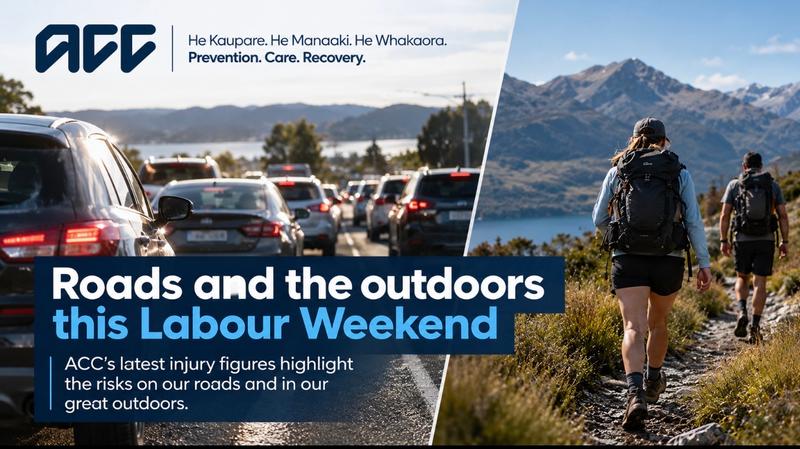
Separate ACC figures show that 9,228 injury claims involving tramping and camping were recorded across 2025, costing $9.8 million in recovery support.
Together, the figures highlight an uncomfortable reality: some of New Zealand’s most anticipated holiday activities also carry risks that can change lives in an instant.
Auckland Recorded the Highest Number of Road Injury Claims
Of the 286 road injury claims recorded during Labour Weekend 2025, Auckland accounted for 80 claims, the highest number among the regions listed in ACC’s breakdown.
The cost of supporting those injuries reached $328,089.
Waikato recorded 43 claims, while Canterbury had 30.
Bay of Plenty reported 23 claims but a comparatively high recovery cost of $180,666.
Labour Weekend 2025: Regional Road Injury Claims
|
Region
|
Injury claims
|
Recovery support cost
|
|
Auckland
|
80
|
$328,089
|
|
Waikato
|
43
|
$114,625
|
|
Canterbury
|
30
|
$149,249
|
|
Bay of Plenty
|
23
|
$180,666
|
|
Wellington
|
18
|
$67,176
|
|
Northland
|
17
|
$25,789
|
|
Manawatū-Whanganui
|
17
|
$15,067
|
|
Otago
|
9
|
$90,495
|
National total: 286 claims, approximately $1.1 million in recovery support costs.
The eight regions in the published breakdown account for 237 claims. The national total includes claims beyond those individually listed.
The figures also reveal an important distinction.
A region with fewer injuries can still face substantial recovery costs, depending on the nature of the injuries and the support required.
For example, Otago recorded nine claims but $90,495 in costs, while Manawatū-Whanganui recorded 17 claims and $15,067.
These figures should not be interpreted as a ranking of which regions have the most dangerous roads. They represent injury claims over one holiday period, without adjusting for population, traffic volumes or distances travelled.
The Real Cost Goes Beyond $1.1 Million
ACC Injury Prevention Leader James Whitaker says the financial cost is only one part of the picture.
The consequences of a crash can extend well beyond the injured person, affecting family members, friends, colleagues and entire households.
“Because most crashes and related injuries on New Zealand roads are preventable, any injury on our roads is one injury too many,” Whitaker said in pre-recorded comments supplied to media.
He said the human cost is much greater than the money spent on recovery.
“The impacts are felt by the injured person, their friends, their whānau, and their workmates too.”
A road injury may mean weeks away from work, cancelled plans, ongoing rehabilitation or long-term changes to everyday life.
For some families, a holiday journey can become the beginning of a difficult recovery.
Expect Delays, and Do Not Drive Tired
With many people expected to travel during the long weekend, ACC is encouraging motorists to plan ahead and allow additional time for their journeys.
Whitaker says patience is essential, particularly when traffic builds on major routes.
“Be patient, and if you’re feeling tired, stop, have a break, and enjoy New Zealand’s small towns.”
NZ Transport Agency Waka Kotahi (NZTA) Head of Driving Regulation Chris Rodley says road safety depends on everyone making responsible decisions.
He is urging drivers to ensure passengers wear seatbelts or appropriate child restraints, avoid driving under the influence of alcohol or drugs, and adjust their speed to the conditions.
Drivers should also avoid fatigue and distractions.
One simple recommendation is to put mobile phones on Do Not Disturb before starting a journey.
Motorists are encouraged to check NZTA’s Journey Planner for current information about roadworks, closures, delays and travel conditions.
The Other Labour Weekend Risk: New Zealand’s Great Outdoors
For many New Zealanders, Labour Weekend is also the unofficial beginning of the warmer outdoor season.
Families head to campsites, friends organise tramping trips, and walkers return to some of the country’s most popular trails.
But ACC’s annual injury figures show how quickly an outdoor adventure can go wrong.
During 2025, ACC recorded 9,228 camping and tramping injury claims, with recovery support costs totalling $9.8 million.
Most involved soft-tissue injuries, including sprains and strains.
What the Outdoor Injury Data Shows
|
Injury category
|
ACC claims in 2025
|
|
Soft-tissue injuries
|
7,816
|
|
Lacerations, punctures and stings
|
615
|
|
Fractures and dislocations
|
483
|
The most commonly affected body areas included:
- Knees: 2,486 claims
- Ankles: 1,886 claims
- Lower back and spine: 770 claims
People aged 25 to 29 accounted for 882 claims, followed by those aged 30 to 34 with 874 claims and those aged 50 to 54 with 806 claims.
These are annual figures for 2025, not injuries recorded during Labour Weekend alone.
Why Even Experienced Trampers Can Make Dangerous Decisions
The New Zealand Mountain Safety Council (MSC) is drawing attention to a less obvious outdoor risk: the mental shortcuts people make when deciding what to do.
MSC Chief Executive Mike Daisley says people often rely on automatic judgments to save time and effort.
Those shortcuts may be harmless in everyday life but can become dangerous in the outdoors.
“Mental shortcuts are the subconscious decisions we make to save us time and energy in everyday life. These don’t usually cause us any problems, but in the outdoors, defaulting to mental shortcuts can lead to poor decisions and unnecessary risks,” Daisley said.
A group might continue walking despite deteriorating weather because the destination appears close.
Someone may attempt a river crossing because they have successfully crossed similar rivers before.
Others might underestimate a track because it looks short on a map.
MSC is encouraging trampers to understand these decision-making traps through its free Mental Shortcuts in the Outdoors video series.
Rivers, Weather and the Decision to Turn Back
River crossings are another concern as New Zealand enters the warmer outdoor season.
Daisley warns that people can make poor decisions when confronted with flooded streams or rivers, particularly when they are tired, wet or eager to reach their destination.
The council recommends identifying river crossings before leaving, checking forecasts for rain and carrying enough equipment to change plans or wait safely if conditions deteriorate.
ACC also recommends sturdy footwear with good grip, warm clothing, a rain jacket, a head torch, sufficient food and water, and an emergency communications device.
Groups should stay together, choose tracks suited to everyone’s abilities and tell someone where they are going and when they expect to return.
For those planning a tramp, MSC’s free Plan My Walk tool can help with preparation and route planning.
Webfit News Analysis: The Most Dangerous Holiday Decision May Be Rushing
The road and outdoor injury figures involve different activities, but they share an important theme.
Many incidents occur in situations where people feel pressure to keep moving.
On the road, a driver may push through fatigue to reach a destination on time.
On a walking track, a group may continue despite worsening conditions because turning back feels disappointing.
At a river, someone may take a chance because waiting would disrupt the day’s plans.
Not every injury is preventable, and the ACC figures do not establish that rushing caused the recorded incidents.
But the safety advice from ACC, NZTA and MSC points towards a common principle: allowing enough time and being willing to change plans can reduce unnecessary risk.
There is also a financial dimension.
The $1.1 million in road injury recovery costs and $9.8 million in annual outdoor injury support represent significant expenditure.
Yet neither figure fully captures the disruption to people’s lives.
The greater loss may be the family gathering missed, the work someone cannot return to or the physical activity they can no longer enjoy.
As New Zealand heads into Labour Weekend, the message is not to avoid travelling or exploring the outdoors.
It is to make sure the journey is worth remembering for the right reasons.
A long weekend gives us an extra day to enjoy. It should never become a reason to take an unnecessary risk.
Sources and Acknowledgements
Primary source: Accident Compensation Corporation (ACC), $1 Million in Road Injuries Over One Long Weekend, October 2026.
Additional source: ACC, A Word of Warning Before Heading Outdoors for the Long Weekend, October 2026.
Road safety guidance: NZ Transport Agency Waka Kotahi (NZTA), including comments from Head of Driving Regulation Chris Rodley.
Outdoor safety guidance: New Zealand Mountain Safety Council (MSC), including comments from Chief Executive Mike Daisley.
Audio commentary: James Whitaker, ACC Injury Prevention Leader, supplied pre-recorded media audio.
Data: ACC motor vehicle injury claims from Labour Weekend 2025 and camping and tramping injury claims for the 2025 calendar year.