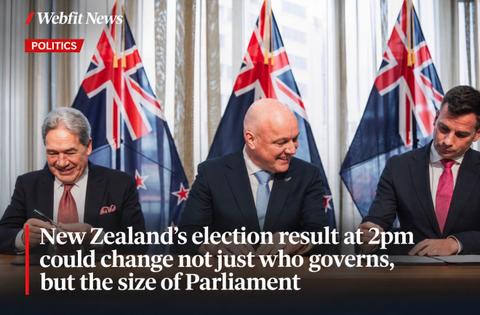
On election night, National and its existing coalition partners collectively held 67 seats, enough to continue governing without Opportunity.
However, the official count changed the parliamentary balance.
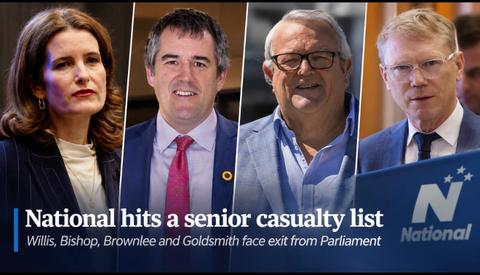
National lost Wairarapa and Hamilton East to Labour, reducing its total representation from 42 to 40 MPs. The Green Party gained an additional seat, while the other parties retained their preliminary parliamentary allocations.
Preliminary versus official election results
|
Political party
|
Party leader
|
Preliminary seats
|
Official seats
|
Change
|
|
National
|
Christopher Luxon
|
42
|
40
|
-2
|
|
Labour
|
Chris Hipkins
|
36
|
36
|
0
|
|
Green Party
|
Chlöe Swarbrick and Marama Davidson
|
16
|
17
|
+1
|
|
ACT
|
David Seymour
|
13
|
13
|
0
|
|
New Zealand First
|
Winston Peters
|
12
|
12
|
0
|
|
Opportunity
|
Qiulae Wong
|
7
|
7
|
0
|
|
Te Pāti Māori
|
|
5
|
5
|
0
|
|
Total
|
|
131
|
130
|
-1
|
|
Outright majority required
|
|
66
|
66
|
0
|
The existing coalition now has 65 seats in a 130-seat Parliament, one short of an outright majority.
Opportunity has not gained a single additional seat since election night. Yet its political influence has increased considerably because of the changes elsewhere in Parliament.
Understanding the 65–65 parliamentary deadlock
For New Zealanders unfamiliar with coalition negotiations, the current situation can be understood by dividing Parliament into three groups.
Existing governing coalition
|
Party
|
Seats
|
|
National
|
40
|
|
ACT
|
13
|
|
New Zealand First
|
12
|
|
Total
|
65
|
Current opposition bloc
|
Party
|
Seats
|
|
Labour
|
36
|
|
Green Party
|
17
|
|
Te Pāti Māori
|
5
|
|
Total
|
58
|
Independent negotiating party
|
Party
|
Seats
|
|
The Opportunity Party
|
7
|
Total parliamentary seats: 130
Seats required for an outright majority: 66
Neither the existing coalition nor the traditional opposition bloc has enough seats to form a majority government independently.
However, Opportunity’s seven seats do not offer both sides an equally straightforward route to power.
Scenario 1: Luxon reaches an agreement with Opportunity
If National successfully negotiates an arrangement involving Opportunity and its existing coalition partners, the combined parliamentary numbers would look like this:
|
Party
|
Seats
|
|
National
|
40
|
|
ACT
|
13
|
|
New Zealand First
|
12
|
|
Opportunity
|
7
|
|
Combined total
|
72
|
|
Majority required
|
66
|
|
Seats above majority threshold
|
6
|
This would provide sufficient parliamentary support for a National-led government to continue.
However, Opportunity would not necessarily have to become a formal coalition partner. It could negotiate a confidence and supply agreement or another parliamentary support arrangement while retaining some political independence.
For Luxon, this represents the most straightforward route to an outright majority under the current election results.
It is also the scenario that directly contradicts his pre-election position.
Scenario 2: Opportunity supports a Labour-led government
If Qiulae Wong decides to support Chris Hipkins and the other opposition parties, the numbers would be different.
|
Party
|
Seats
|
|
Labour
|
36
|
|
Green Party
|
17
|
|
Te Pāti Māori
|
5
|
|
Opportunity
|
7
|
|
Combined total
|
65
|
|
Majority required
|
66
|
|
Shortfall
|
1
|
Even with Opportunity’s full support, a Labour-led grouping would remain one seat short of an outright majority.
To establish a government, it would need an additional parliamentary support arrangement, potentially involving abstentions or cooperation from another party.
This is an important distinction. Opportunity holds considerable negotiating influence, but it cannot independently deliver an outright parliamentary majority to Labour.
Scenario 3: Opportunity stays outside government
Another possibility is that Opportunity chooses not to formally join either political bloc.
The party could retain its seven MPs as an independent parliamentary group while negotiating support on confidence, government funding and individual pieces of legislation.
For example, if Opportunity’s seven MPs abstained on a confidence vote, with all other MPs voting along their respective blocs, the result could look like this:
|
Parliamentary grouping
|
Votes
|
|
National, ACT and NZ First
|
65
|
|
Labour, Greens and Te Pāti Māori
|
58
|
|
Opportunity abstentions
|
7
|
Under such circumstances, a National-led minority government could command parliamentary confidence without Opportunity formally joining the coalition.
However, passing ordinary legislation could require further negotiations, depending on how Opportunity and the other parties decide to vote.
Such an arrangement would allow Wong to retain greater independence while potentially exercising considerable influence over government policy.
All possible governing scenarios at a glance
|
Governing arrangement
|
Seats
|
Outright majority?
|
|
Existing coalition
|
65
|
No
|
|
Existing coalition with Opportunity
|
72
|
Yes
|
|
Labour, Greens and Te Pāti Māori
|
58
|
No
|
|
Opposition bloc with Opportunity
|
65
|
No
|
|
Minority government with agreed abstentions
|
Variable
|
Not required if confidence is established
|
These scenarios explain why Opportunity has become so important to government formation despite holding only seven parliamentary seats.
Why Luxon’s reversal matters
Political compromise is an established feature of New Zealand’s MMP electoral system. Parties regularly modify or abandon elements of their election manifestos during coalition negotiations.
However, Luxon’s commitment regarding Opportunity was different.
It concerned not simply an individual policy, but which political parties National would be prepared to work with after the election.
Such commitments can directly influence how people vote.
A voter may support one political party partly because its leader has promised not to bring another party into government. Once the election is over, that voter cannot reconsider their ballot if the commitment changes.
In an analysis published by RNZ on Friday, executive editor John Hartevelt suggested that National’s firm rejection of Opportunity was a political strategy aimed at keeping the smaller party below the five percent parliamentary threshold.
That interpretation raises questions about whether pre-election coalition commitments should be understood as firm promises or as political positioning intended to influence electoral outcomes.
National’s precise strategic intentions cannot be established solely from that commentary. What is clear is that the position Luxon communicated before the election differs from the one he is adopting now.
Could Luxon have anticipated this situation?
The possibility of an inconclusive election result was not something that emerged unexpectedly on Friday.
Under MMP, political parties rarely know before an election whether they will have sufficient parliamentary representation to govern with their preferred partners.
The possibility that National might require additional support was therefore foreseeable, even though the final distribution of seats was not known.
National can reasonably argue that the official election results have created new political circumstances and that its responsibility is to explore the formation of a functioning government.
At the same time, voters are entitled to question why Opportunity was ruled out so categorically when the parliamentary arithmetic could eventually require its involvement.
The political challenge for Luxon is explaining that distinction.
Could National still regain its majority without Opportunity?
The official results have left two particularly significant electorate contests open to possible judicial recounts.
|
Electorate
|
Declared winner
|
Party
|
Winning margin
|
|
Wairarapa
|
Kieran McAnulty
|
Labour
|
81 votes
|
|
Hamilton East
|
Georgie Dansey
|
Labour
|
173 votes
|
Because National’s parliamentary representation includes an electorate overhang, regaining either electorate could increase both its total number of MPs and the overall size of Parliament.
|
Potential outcome
|
Coalition seats
|
Parliament size
|
Majority required
|
|
Official results remain unchanged
|
65
|
130
|
66
|
|
National regains one electorate
|
66
|
131
|
66
|
|
National regains both electorates
|
67
|
132
|
67
|
These hypothetical calculations assume all other electorate results and party-vote seat entitlements remain unchanged.
Under those circumstances, National regaining even one electorate could restore the existing coalition’s outright majority.
However, a close result does not guarantee a successful recount. Until any judicial recount changes the declared outcome, the official results remain in effect.
Does a hung Parliament mean another election?
Not necessarily.
New Zealand does not automatically return to the polls simply because no political grouping holds an outright parliamentary majority.
Political parties can negotiate formal coalitions, confidence and supply agreements or other arrangements that allow a government to command the confidence of Parliament.
Until a new government is established, the incumbent administration continues operating under the caretaker convention.
Another election remains a possibility if no viable governing arrangement can ultimately be established, but it is not an automatic consequence of the current deadlock.
The bigger question for New Zealand voters
The 2026 election has exposed an important distinction between a political leader’s preferred governing arrangement and the government that parliamentary numbers ultimately allow.
For Qiulae Wong, the coming negotiations represent an opportunity to secure policy commitments and establish her party’s political identity.
For Christopher Luxon, they represent both a route to remaining prime minister and a test of his political credibility.
For voters, the issue extends beyond either leader.
Political compromise is necessary under MMP, but so is accountability for commitments made during an election campaign.
There is a difference between telling voters that a particular coalition is undesirable and promising that it will not happen.
Luxon must now reconcile that promise with the parliamentary reality delivered by New Zealand voters.
The numbers explain why his position has changed. They do not erase what he told the country before the election.
Webfit News Political Analysis | New Zealand Election 2026
Sources: Electoral Commission official election results, New Zealand’s constitutional conventions and RNZ political analysis by John Hartevelt, published on 27 November 2026.
Parliamentary scenarios are based on the official election results declared on 27 November 2026 and remain subject to any subsequent judicial recounts or negotiated support arrangements.