What exactly is New Zealand changing?
Immigration New Zealand currently provides five general methods through which eligible resident visa holders can demonstrate their commitment to the country when applying for a Permanent Resident Visa.
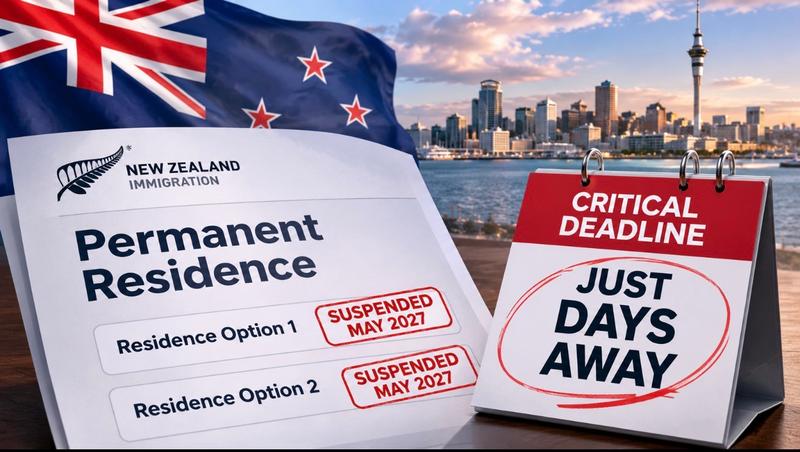
Two of those methods will be suspended from May 30, 2027.
The affected options are:
- Demonstrating commitment through a qualifying investment in New Zealand.
- Demonstrating commitment through establishing or purchasing a qualifying New Zealand business.
Both were introduced under earlier immigration settings.
INZ says relatively few people now use these options and that their suspension will bring permanent residence requirements into closer alignment with the country’s current investment immigration policies.
The announcement comes as New Zealand continues to reshape its immigration system, with separate changes affecting skilled workers, business investors, international students and family visa applicants.
Today’s decision, however, is much narrower than those wider reforms.
The difference between a Resident Visa and a Permanent Resident Visa
One of the most common sources of confusion among migrants is the assumption that a Resident Visa and a Permanent Resident Visa are the same thing.
They are not.
A New Zealand Resident Visa generally allows its holder to live, work and study in the country indefinitely, subject to applicable visa conditions.
However, it normally includes travel conditions that restrict how long the holder can continue leaving and returning to New Zealand as a resident.
A Permanent Resident Visa removes those travel restrictions, allowing its holder to travel overseas and return to New Zealand indefinitely.
|
Feature
|
Resident Visa
|
Permanent Resident Visa
|
|
Live indefinitely in New Zealand
|
Yes, subject to visa conditions
|
Yes
|
|
Work in New Zealand
|
Generally yes, subject to conditions
|
Yes
|
|
Study in New Zealand
|
Generally yes, subject to conditions
|
Yes
|
|
International travel
|
Subject to travel conditions
|
Indefinite travel rights
|
|
Requirement to demonstrate commitment
|
Applicable when progressing to permanent residence
|
Already satisfied at approval
|
|
New Zealand citizenship
|
Separate application process
|
Separate application process
|
For most migrants, the journey involves obtaining residence first, satisfying the relevant requirements and subsequently applying for permanent residence.
Today’s announcement concerns that second stage.
It does not remove the Skilled Migrant Category, Green List residence pathways or partnership-based residence categories.
First affected option: the $1 million investment route
Under the existing general permanent residence rules, eligible resident visa holders can demonstrate their commitment to New Zealand by maintaining an acceptable investment of at least NZ$1 million for a minimum of 24 months after receiving residence.
The option has been particularly relevant to residents whose professional, commercial or family commitments require them to spend considerable periods overseas.
Rather than relying on the standard physical presence requirement, eligible applicants could demonstrate their connection to New Zealand through financial investment.
However, this was never a mechanism through which someone without a resident visa could simply invest $1 million and automatically obtain permanent residence.
Applicants were already required to satisfy the relevant residence and investment conditions.
From May 30, 2027, this older investment-based method will be suspended.
People relying on it must establish whether they will complete their qualifying investment period before the deadline or whether the transitional arrangements will apply to their circumstances.
Second affected option: establishing a New Zealand business
The other affected method allows eligible resident visa holders to demonstrate their commitment by establishing or purchasing a business in New Zealand.
The existing requirements include operating the business for at least 12 months before applying for permanent residence.
The business must also be trading successfully and contributing to New Zealand.
Where an applicant purchases a share in an existing business, the current general commitment rules require at least 25 percent ownership.
Applicants may be required to provide certified business accounts and confirmation from a New Zealand chartered accountant regarding the business’s trading position.
Simply registering a company with the Companies Office has never been sufficient to meet these requirements.
From May 30, 2027, the establishment of a business will no longer be available as this particular method of demonstrating commitment.
The change is relevant to resident visa holders who have invested their time and resources into establishing businesses but have not yet obtained permanent residence.
It does not prevent migrants from owning or operating businesses in New Zealand, provided their immigration status permits those activities.
November 30: the deadline that affected migrants cannot afford to overlook
Although the suspension takes effect next May, Immigration New Zealand has identified November 30, 2026, as an important date under its transitional arrangements.
People who are already pursuing one of the affected options but will not complete the required qualifying period by May 30, 2027, may be eligible to apply for a Second or Subsequent Resident Visa.
However, INZ says the eligible investment must have been made by November 30, 2026, and applicants must satisfy the remaining requirements, including the relevant qualifying period.
This distinction could be particularly important for residents who have already committed substantial financial resources but will not reach their eligibility date until later in 2027 or beyond.
|
Important date
|
Significance
|
|
27 November 2026
|
Immigration New Zealand announces the suspension
|
|
30 November 2026
|
Eligible investment deadline under the announced transitional arrangements
|
|
30 May 2027
|
Suspension of the two older permanent residence options
|
The transitional arrangement should not be interpreted as an extension guaranteeing permanent residence under the old rules.
A Second or Subsequent Resident Visa is not the same as a Permanent Resident Visa. Applicants will need to establish what immigration options remain available to them after completing their qualifying period.
The announcement also does not provide a detailed breakdown of every possible business ownership or investment scenario.
People approaching either deadline should seek clarification directly from Immigration New Zealand or a licensed immigration adviser before making further financial commitments.
Which permanent residence options will remain available?
The three other general methods of demonstrating commitment to New Zealand are not affected by today’s announcement.
1. Spending sufficient time in New Zealand
For many migrants, this remains the most straightforward method.
Applicants must generally have spent at least 184 days in New Zealand as a resident during each of the two 12-month periods immediately preceding their Permanent Resident Visa application.
The days do not have to be consecutive.
Importantly, spending 368 days in New Zealand across two years does not necessarily satisfy the requirement if those days are unevenly distributed.
Consider two hypothetical applicants:
|
Physical presence
|
Applicant A
|
Applicant B
|
|
First 12-month period
|
200 days
|
300 days
|
|
Second 12-month period
|
190 days
|
100 days
|
|
Total
|
390 days
|
400 days
|
|
Meets the physical presence test
|
Yes
|
No
|
Despite spending more total days in New Zealand, Applicant B does not meet the requirement of at least 184 days in each period.
Other Permanent Resident Visa eligibility requirements would still need to be satisfied.
The distinction is particularly relevant to migrants who travel frequently for overseas employment, business or family commitments.
2. New Zealand tax residence
Eligible applicants can also demonstrate their commitment through New Zealand tax residence.
Under the existing rules, this involves being recognised as a New Zealand tax resident during the relevant two-year period and spending at least 41 days in New Zealand as a resident during each of those years.
Evidence of tax residence must be provided through Inland Revenue.
Tax residence is a separate legal concept from immigration residence. Paying some New Zealand tax or possessing an IRD number does not automatically satisfy this requirement.
People with tax obligations or tax residence in multiple countries should obtain appropriate professional advice before relying on this option.
3. Establishing a base in New Zealand
Another remaining option is demonstrating that an applicant has established a genuine base in New Zealand.
This involves specific physical presence requirements for the applicant and, where applicable, family members included in the original residence application.
Applicants must also demonstrate qualifying employment or home ownership under INZ’s established-base criteria.
For internationally mobile residents, this may provide another avenue worth investigating.
However, owning a property in New Zealand or having family members living here does not automatically establish eligibility. The full immigration requirements must be satisfied.
Who will be affected and who will not?
The consequences of today’s announcement depend primarily on a person’s current immigration status and the method they intend to use when applying for permanent residence.
|
Current situation
|
Effect of today’s announcement
|
|
Already holds a Permanent Resident Visa
|
No direct change
|
|
Resident Visa holder using the 184-day physical presence method
|
Method remains available
|
|
Resident Visa holder relying on New Zealand tax residence
|
Method remains available
|
|
Resident Visa holder relying on an established base
|
Method remains available
|
|
Resident Visa holder relying on the older $1 million investment option
|
Directly affected
|
|
Resident Visa holder relying on the business establishment option
|
Directly affected
|
|
Accredited Employer Work Visa holder
|
No direct change to the visa from this announcement
|
|
International student
|
No direct change to student visa eligibility
|
|
Post Study Work Visa holder
|
No direct change from this announcement
|
|
Skilled Migrant Category applicant
|
Category is not being suspended by this decision
|
|
Green List residence applicant
|
Pathway is not being suspended by this decision
|
|
Partnership-based residence applicant
|
Category is not being suspended by this decision
|
|
Prospective overseas investor
|
Should examine current dedicated investor visa requirements
|
|
New Zealand citizen
|
Not affected
|
Separate immigration reforms may affect some of these groups, but they should not be confused with today’s permanent residence announcement.
Does New Zealand still want overseas investors?
The suspension of the older options does not signal an end to investment-based immigration.
New Zealand continues to operate dedicated visa programmes aimed at attracting overseas capital, experienced business owners and investment that supports economic activity.
These programmes operate under substantially different requirements.
Active Investor Plus Visa
New Zealand’s Active Investor Plus Visa offers two investment categories.
|
Category
|
Minimum qualifying investment
|
Investment period
|
|
Growth
|
NZ$5 million
|
3 years
|
|
Balanced
|
NZ$10 million
|
5 years
|
The Growth category focuses more heavily on direct business investment and qualifying managed funds, while the Balanced category offers a broader range of acceptable investments.
Applicants must also meet the programme’s physical presence requirements, investment conditions and other immigration criteria.
These are dedicated investor residence arrangements, rather than the older $1 million method used by people who already hold residence.
Comparing the amounts without understanding that distinction could give prospective migrants a misleading impression of what is required.
Business Investor Work Visa
New Zealand also operates a Business Investor Work Visa designed for experienced businesspeople who intend to purchase and actively operate an eligible existing New Zealand business.
Its two principal routes are:
|
Business investment
|
Residence pathway
|
|
NZ$1 million or more
|
Standard three-year pathway
|
|
NZ$2 million or more
|
Potential 12-month fast-track pathway
|
Applicants must satisfy additional requirements relating to business experience, available funds, employment creation, business operations and time spent in New Zealand.
The fast-track route also carries ongoing business-related obligations.
Neither investment amount represents an automatic guarantee of residence.
These current visa programmes remain separate from the two commitment options being suspended in May 2027.
Skilled migrants should not confuse this with the Green List changes
Today’s announcement follows several significant immigration policy developments during 2026.
In August, New Zealand introduced additional Skilled Migrant Category residence pathways aimed at experienced workers, tradespeople and technicians.
Earlier this month, Immigration New Zealand also announced changes to the Green List taking effect from March 8, 2027.
Seventeen occupations are scheduled to move out of the Tier 2 Green List Work to Residence pathway because they are covered by newer Skilled Migrant Category options.
Those changes come with their own eligibility requirements and transitional arrangements.
For affected workers, the removal of an occupation from one residence pathway does not necessarily mean residence is no longer available. Other routes may exist, depending on qualifications, earnings and work experience.
It is important, therefore, to distinguish between three separate immigration developments.
|
Immigration change
|
Relevant date
|
What it concerns
|
|
Skilled Migrant Category reforms
|
24 August 2026
|
Obtaining residence through skills and work experience
|
|
Green List changes
|
8 March 2027
|
Changes to selected occupational residence pathways
|
|
Permanent residence commitment changes
|
30 May 2027
|
How existing residents demonstrate commitment when seeking permanent residence
|
Each announcement affects a different part of the immigration system.
For a migrant worker currently pursuing skilled residence, today’s decision alone does not require abandoning an existing residence plan.
What this means for international students
For international students, particularly those considering New Zealand as a study destination, immigration announcements can influence major financial and educational decisions.
Tuition fees, accommodation costs and the prospect of future employment are often considered together when families evaluate overseas education opportunities.
However, today’s announcement does not change student visa eligibility or automatically remove post-study work opportunities.
International graduates seeking longer-term settlement must still qualify independently for an appropriate residence category.
That may involve skilled employment, relevant qualifications, occupational registration, work experience or other applicable requirements.
Studying in New Zealand does not automatically guarantee a work visa, residence or eventual permanent residence.
Students considering substantial educational investments should examine the complete pathway from their proposed qualification to employment and residence rather than relying on assurances that a particular course guarantees permanent settlement.
What this means for migrants currently overseas
The announcement is also relevant to people living in India, China, the Philippines, Fiji, South Africa and other countries who are considering New Zealand as a future destination.
For those without New Zealand residence, the first question remains which initial visa category they may qualify for.
Someone pursuing employment-based migration will face different requirements from someone purchasing a business or making a substantial financial investment.
A prospective migrant cannot use the remaining 184-day commitment method to obtain an initial Resident Visa simply by spending time in New Zealand on a visitor or student visa.
That physical presence must be accumulated while holding the appropriate residence status.
Similarly, purchasing a property, registering a company or transferring funds into a New Zealand bank account does not automatically confer immigration rights.
People planning to relocate should establish their eligibility before making irreversible financial decisions.
Resident visa holders travelling overseas should check their travel conditions
One practical issue that can be overlooked by migrants already living in New Zealand is the expiry date of their resident visa travel conditions.
A person can generally remain in New Zealand indefinitely on a Resident Visa, even after their travel conditions expire.
However, leaving New Zealand without valid travel conditions can result in the loss of their resident visa.
A resident who is already overseas when their travel conditions expire may also lose their residence status.
This becomes particularly important for people who will not qualify for permanent residence before an upcoming overseas trip.
Depending on their circumstances, they may be able to apply for a variation of travel conditions or another residence-class visa.
With the Christmas and New Year holiday period approaching, resident visa holders planning international travel should check their visa documentation before departure.
The relevant date may be recorded as the expiry date of travel conditions, rather than the expiry of permission to remain in New Zealand.
Why the Government is making the change
Immigration New Zealand says the two affected commitment methods were introduced well before the country’s current investment immigration settings and are now used by relatively few applicants.
The Government’s stated rationale is to align permanent residence requirements more closely with its contemporary approach to investment migration, economic growth and confidence in the immigration system.
Current dedicated investor programmes place greater emphasis on the scale, nature and ongoing management of investment.
Business investor programmes also impose specific expectations relating to business performance and employment.
However, the November 27 announcement does not disclose how many resident visa holders are currently relying on the two older methods or how many people may need transitional assistance.
Without those figures, the overall impact cannot yet be quantified.
For affected migrants, even a relatively small policy change can carry substantial consequences where personal savings, business investments and family settlement plans are involved.
What affected migrants should establish now
For people who already hold New Zealand residence and are working towards permanent residence, the immediate priority is to identify which commitment method applies to their circumstances.
In particular, affected residents should establish:
- When their current Resident Visa was granted.
- When their travel conditions expire.
- How many days they have spent in New Zealand during each relevant 12-month period.
- Whether they are relying on the investment or business commitment option.
- Whether they will complete the qualifying period by May 30, 2027.
- Whether their investment meets the November 30 transitional deadline.
- Whether an alternative commitment method may be available.
- Whether upcoming international travel could affect their residence status.
Supporting documents, including business accounts, investment records, tax documentation and travel histories, may become particularly important.
Given the proximity of the November 30 deadline, people directly affected should obtain individual clarification promptly.
However, the announcement should not be interpreted as a reason to rush into an investment or business transaction without confirming eligibility.
Permanent residence is not being closed
The central message from today’s announcement is that New Zealand is suspending two specific methods of demonstrating commitment, not ending permanent residence for migrants generally.
For people who have obtained residence through skilled employment and continue living and working in New Zealand, the standard physical presence method remains available.
For existing permanent residents, today’s announcement does not remove their immigration status.
For overseas investors and business owners, dedicated immigration programmes continue to operate, although they carry distinct and often substantial eligibility requirements.
The people who need to pay closest attention are existing residents relying on the two older commitment methods, particularly those whose qualifying periods extend beyond May 2027.
With only three days between today’s announcement and the investment deadline identified in the transitional arrangements, clarity will be particularly important for those already financially committed.
For everyone else considering New Zealand as a place to study, work, establish a business or raise a family, the announcement is a reminder that immigration planning requires understanding the precise visa category involved, rather than relying on broad headlines about residence.
Sources: Immigration New Zealand’s announcement dated 27 November 2026, Permanent Resident Visa eligibility criteria, residence commitment requirements, Active Investor Plus Visa guidance, Business Investor Visa guidance and Skilled Migrant Category policy announcements.
This article provides general information based on immigration settings as at 27 November 2026. It does not constitute individual immigration or legal advice. Readers should consult Immigration New Zealand or a licensed immigration adviser for guidance on their circumstances.