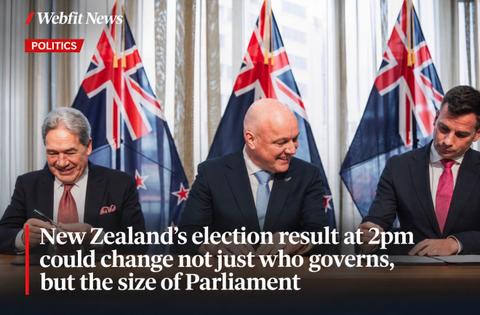
But beyond the political consequences lies a question that deserves considerably more attention: how much additional public money would another general election require?
If a second election were to cost the same as the first, the combined expenditure could reach $360 million.
That figure is not an official forecast. It is one of several possible financial scenarios examined by Webfit News using historical Electoral Commission expenditure and the reported cost of the 2026 election.
The rising cost of democracy: 2014 to 2026
New Zealand’s general elections have become considerably more expensive over the past decade.
Electoral Commission reports provide an insight into how expenditure has evolved alongside population growth, higher staffing costs, changing voting habits, technological requirements and inflation.
|
Election year
|
Expenditure or budget
|
Status
|
|
2014
|
$39 million
|
Actual expenditure
|
|
2017
|
$49.58 million
|
Actual expenditure
|
|
2020
|
$99 million
|
Budgeted expenditure
|
|
2023
|
$134 million
|
Actual expenditure
|
|
2026
|
$180 million
|
Reported expenditure
|
Sources: Electoral Commission statutory reports for the 2020 and 2023 general elections, and RNZ reporting dated 27 November 2026.
The reported cost of the 2026 election is approximately 4.6 times the expenditure recorded in 2014.
Even compared with the most recent election in 2023, the reported increase amounts to approximately $46 million.
|
Comparison
|
Nominal increase
|
|
2014 to 2017
|
27.1%
|
|
2017 actual expenditure to 2020 budget
|
99.7%
|
|
2020 budget to 2023 actual expenditure
|
35.4%
|
|
2023 to 2026 reported expenditure
|
34.3%
|
|
2014 to 2026 reported expenditure
|
361.5%
|
These figures have not been adjusted for inflation. They also compare expenditure reported under different accounting scopes, with the 2020 figure representing a budget rather than final actual spending.
The increase should therefore not be interpreted as a direct measure of declining efficiency.
Nevertheless, the figures demonstrate the growing financial scale of administering nationwide elections.
Where does the election money actually go?
A general election involves considerably more than printing ballot papers and opening polling stations.
The Electoral Commission’s statutory report on the 2023 election provides a detailed breakdown of the $134 million spent delivering that election.
|
Expenditure category
|
Actual cost
|
Share of total
|
|
Temporary election workforce
|
$50.76 million
|
37.9%
|
|
Permanent staff
|
$12.90 million
|
9.6%
|
|
Temporary offices and voting places
|
$19.54 million
|
14.6%
|
|
Permanent offices
|
$2.02 million
|
1.5%
|
|
Paper, printing and postage
|
$16.82 million
|
12.6%
|
|
Public information advertising
|
$11.90 million
|
8.9%
|
|
Computers and telecommunications
|
$8.07 million
|
6.0%
|
|
Travel
|
$2.68 million
|
2.0%
|
|
Storage
|
$2.48 million
|
1.8%
|
|
Other expenditure
|
$6.84 million
|
5.1%
|
|
Total
|
$134 million
|
100%
|
Source: Electoral Commission, Report on the 2023 General Election, Table 2. Figures are rounded.
People-related expenditure alone accounted for approximately $63.66 million, or almost 48 percent of the election’s total cost.
Temporary staff, voting venues, paper, printing and postage collectively accounted for approximately $87.1 million.
That represents roughly 65 percent of the entire election expenditure.
This is particularly significant when considering another election because many of these costs are associated with the physical delivery of voting services and could recur.
Could New Zealand simply reuse everything from November?
Some election resources may be reusable.
Existing technology, operational plans, training material, equipment and parts of the Electoral Commission’s infrastructure could potentially be used again.
However, a new election would still require its own voting arrangements and an updated list of candidates and parties.
|
Election resource
|
Potential requirement for another election
|
|
Ballot papers
|
New printing required
|
|
Electoral rolls
|
Updated and checked
|
|
Temporary election workers
|
Re-engagement or recruitment
|
|
Voting locations
|
Renewed availability and property arrangements
|
|
Public information campaigns
|
Updated for the new election
|
|
IT infrastructure
|
Potentially reusable, with operational changes
|
|
Staff training
|
Refresher training or new recruitment
|
|
Postal services
|
New distribution requirements
|
|
Overseas voting
|
New election arrangements
|
|
Vote counting and verification
|
Repeated for the new ballots
|
The extent of possible savings would depend on when another election was held, which contracts remained active and whether staff and voting locations were still available.
Chief Electoral Officer Karl Le Quesne told RNZ that the cost of another election was difficult to establish without knowing its timing and service requirements.
Consequently, there is no confirmed figure for how much a second election would cost.
The financial scenarios: From $225 million to $396 million
To illustrate the potential scale of additional expenditure, Webfit News has modelled five scenarios using the reported $180 million cost of the November election as a reference.
These are sensitivity calculations, not official budget estimates or forecasts.
|
Second election scenario
|
Additional expenditure
|
Combined election expenditure
|
|
25% of first election cost
|
$45 million
|
$225 million
|
|
50% of first election cost
|
$90 million
|
$270 million
|
|
75% of first election cost
|
$135 million
|
$315 million
|
|
100% of first election cost
|
$180 million
|
$360 million
|
|
120% of first election cost
|
$216 million
|
$396 million
|
The lower scenarios illustrate what expenditure could look like if significant savings were achievable through the reuse of existing resources.
The higher scenarios illustrate the financial consequences if most operational costs had to be incurred again or if compressed preparation time created additional expenses.
A second election could ultimately cost less or more than these examples.
What matters is that even an election costing half as much as the first would represent an additional $90 million in public expenditure.
What if the biggest election expenses had to be repeated?
A second financial model provides another perspective.
Using the 2023 expenditure breakdown, approximately 65 percent of election costs were associated with temporary staff, temporary premises, paper, printing and postage.
Applying that proportion to the reported 2026 election cost produces an illustrative figure of $117 million.
The remaining 35 percent represents another $63 million.
If all expenditure in the first group had to be repeated, while varying proportions of the remaining costs were incurred again, the following scenarios would emerge.
|
Illustrative scenario
|
Repeated operational costs
|
Other repeated costs
|
Additional election cost
|
|
All operational costs, no other costs
|
$117m
|
$0
|
$117m
|
|
All operational costs, 25% of other costs
|
$117m
|
$15.75m
|
$132.75m
|
|
All operational costs, 50% of other costs
|
$117m
|
$31.5m
|
$148.5m
|
|
All operational costs, 75% of other costs
|
$117m
|
$47.25m
|
$164.25m
|
|
All expenditure repeated
|
$117m
|
$63m
|
$180m
|
Webfit News illustrative financial model based on the historical expenditure mix. The actual 2026 expenditure breakdown has not been confirmed, and the assumption that these operational costs would recur in full is not an Electoral Commission forecast.
This model demonstrates why reusing computers, training material and administrative infrastructure would not necessarily eliminate a substantial proportion of the election bill.
The biggest expenses are associated with delivering voting services to people across the country.
What does that mean for the ordinary New Zealander?
The official results show that 2,931,604 votes were cast in the November election.
Using the reported $180 million expenditure, the average administrative cost works out at approximately $61.40 for every vote cast.
If another election were held with similar participation, the equivalent expenditure would depend on the final budget.
|
Additional election expenditure
|
Equivalent cost per vote at November turnout
|
|
$45 million
|
$15.35
|
|
$90 million
|
$30.70
|
|
$117 million
|
$39.91
|
|
$135 million
|
$46.05
|
|
$180 million
|
$61.40
|
|
$216 million
|
$73.68
|
These are analytical averages, not charges imposed on individual voters.
They provide a way of understanding the scale of public expenditure relative to the number of people participating.
If both elections cost $180 million each and recorded the same turnout, the combined expenditure would be approximately $122.80 per November-election participant, or $61.40 per voting participation across the two elections.
Lower voter turnout, higher election expenditure
Another interesting feature of the historical data is that rising election expenditure has coincided with declining voter turnout.
|
General election
|
Enrolled voter turnout
|
Expenditure or budget
|
|
2020
|
82.2%
|
$99 million budget
|
|
2023
|
78.2%
|
$134 million actual
|
|
2026
|
77.2%
|
$180 million reported
|
Turnout among enrolled voters has fallen by five percentage points since 2020.
That does not mean increased expenditure caused lower participation. Nor does it establish that election services have become less effective.
Electoral expenditure reflects numerous factors unrelated to turnout, including wage increases, legislative requirements, security measures, property costs and the availability of voting services.
However, the figures raise a legitimate public policy question about how future elections can be delivered efficiently while maintaining accessibility, integrity and public participation.
Another bill: Public funding for political advertising
Election administration is not the only financial consideration.
For the 2026 general election, Parliament provided $4,145,750, including GST, for allocation to political parties for eligible advertising.
The Electoral Commission distributes this funding under the broadcasting allocation framework.
Another election would raise questions about whether additional advertising funding would be required and how Parliament would authorise it.
Political parties would also potentially incur fresh campaign expenses of their own, including advertising, travel, campaign material and staffing.
Those privately financed expenses should not be confused with taxpayer-funded election administration.
Nor should the existing broadcasting allocation automatically be added to the reported $180 million figure without confirming how that figure was calculated.
These are separate financial considerations that would need to be clarified in any new election budget.
Could Parliament need emergency funding?
A further complication concerns how the Electoral Commission would obtain the funding required to organise another election.
Election expenditure is authorised through government appropriations, with funding arrangements generally planned around the electoral cycle.
A second election held unexpectedly could require additional funding decisions.
University of Otago law professor Andrew Geddis has raised the possibility that Parliament may need to consider emergency appropriation legislation, including funding arrangements for another election campaign.
This creates an unusual constitutional situation.
Even if political parties are unable to agree on a permanent government, Parliament may still need to address the financial requirements of holding another election.
Whether additional legislation would be required would depend on existing appropriations, available reserves and the circumstances of the new election.
Are there alternatives to spending millions on another election?
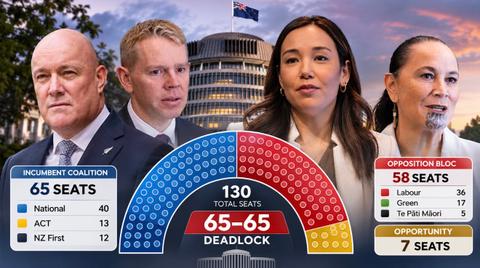
The official election result leaves several possible parliamentary arrangements.
|
Political party
|
Official seats
|
|
National
|
40
|
|
Labour
|
36
|
|
Green Party
|
17
|
|
ACT
|
13
|
|
New Zealand First
|
12
|
|
Opportunity
|
7
|
|
Te Pāti Māori
|
5
|
|
Total Parliament
|
130
|
|
Outright majority required
|
66
|
While the existing coalition no longer holds an outright majority, another election is not the only constitutional option.
|
Potential arrangement
|
Combined seats
|
Parliamentary position
|
|
National + ACT + NZ First
|
65
|
Requires additional support or abstentions
|
|
National + ACT + NZ First + Opportunity
|
72
|
Outright majority
|
|
Labour + Greens + Te Pāti Māori + Opportunity
|
65
|
Requires additional support or abstentions
|
|
Labour + Greens + NZ First + Te Pāti Māori
|
70
|
Mathematical majority
|
|
National + Labour
|
76
|
Mathematical majority
|
|
Minority government
|
Depends on support arrangements
|
Possible if confidence is established
|
The final two majority combinations are mathematical examples, not confirmed coalition proposals.
Political compatibility, previous commitments and negotiated agreements would determine whether any arrangement could become viable.
The existence of these possibilities demonstrates why another election would not automatically follow the breakdown of a particular set of negotiations.
Could a judicial recount change the situation without another election?
Two electorate results remain particularly significant.
|
Electorate
|
Declared winner
|
Winning margin
|
|
Wairarapa
|
Kieran McAnulty, Labour
|
81 votes
|
|
Hamilton East
|
Georgie Dansey, Labour
|
173 votes
|
Both were provisionally held by National on election night.
Because National’s representation includes an electorate overhang, regaining either seat through a judicial recount could restore the existing coalition’s outright majority if other electoral allocations remain unchanged.
|
Hypothetical recount outcome
|
Coalition seats
|
Parliament size
|
Majority required
|
|
Official results unchanged
|
65
|
130
|
66
|
|
National regains one electorate
|
66
|
131
|
66
|
|
National regains both electorates
|
67
|
132
|
67
|
A judicial recount is a legally established safeguard, not a mechanism for political parties to obtain a preferred result.
It must establish the correct electoral outcome regardless of the political consequences.
A recount could confirm the existing results, identify small differences or potentially change the successful candidate.
No reversal should be assumed.
Applications for judicial recounts close on Wednesday, December 2.
The economic consequences beyond the election budget
The direct administrative cost would represent only one part of the wider financial picture.
An extended period of government formation could also affect decisions involving businesses, infrastructure and public policy.
|
Area
|
Potential consequence of extended uncertainty
|
|
Businesses
|
Delayed decisions dependent on future regulation or taxation
|
|
Infrastructure
|
Uncertainty about proposed projects and funding priorities
|
|
Healthcare
|
Delayed decisions involving new funding commitments
|
|
Housing
|
Uncertainty surrounding proposed policy reforms
|
|
Investment
|
Some investors may defer decisions pending policy clarity
|
|
Public sector
|
Significant new decisions may be constrained by caretaker conventions
|
|
Political parties
|
Additional campaign expenditure and fundraising
|
|
Households
|
A longer wait for proposed cost-of-living measures
|
These consequences cannot currently be assigned a reliable dollar value.
Routine government services continue under the caretaker convention, and not every business or public sector decision would be delayed.
There is also no basis for attributing every change in economic confidence, financial markets or exchange rates to the political situation.
Nevertheless, the wider economic implications deserve consideration alongside the direct election expenditure.
Would another election necessarily solve the problem?
Not necessarily.
A fresh election would provide New Zealanders with another opportunity to decide how Parliament should be constituted.
However, MMP could produce another closely divided Parliament.
Political parties might gain or lose representation, voter turnout could change, and different governing combinations could emerge.
Another nationwide vote would not guarantee that one political bloc secured an outright majority.
That is why the potential financial cost must be considered alongside the constitutional purpose of another election: establishing a Parliament from which a government capable of commanding confidence can emerge.
The unanswered question: What would taxpayers actually have to fund?
Before another election could be organised, several financial questions would need clear answers.
How much of the November election infrastructure could be reused? How many temporary workers would need to be recruited again? Would existing voting locations remain available? Would political parties receive a new broadcasting allocation? And how much additional funding would Parliament need to approve?
Until those questions are answered, any precise figure for a second election remains speculative.
New Zealand has already committed substantial public resources to conducting the November election. The Electoral Commission’s responsibility is to administer the electoral process accurately, independently and efficiently, whatever political outcome voters produce.
Another election, if constitutionally necessary, would be part of that democratic responsibility rather than simply an avoidable expense.
But the financial implications are substantial.
At half the reported cost of the November election, the combined expenditure would reach $270 million. At the same cost, it would reach $360 million.
For now, neither figure represents an approved government budget.
New Zealanders have delivered their electoral verdict. Political leaders are working to determine whether that result can produce a functioning government.
If those efforts ultimately fail, the country could face not only another nationwide campaign but also a significant additional financial commitment.
Webfit News | Election 2026 | Data and Political Analysis
Sources: Electoral Commission reports on the 2020 and 2023 general elections; Electoral Commission 2026 official results; 2026 Broadcasting Allocation Decision; RNZ reporting dated 27 November 2026; New Zealand constitutional conventions.
Methodology: All projected expenditure scenarios and per-vote calculations are original illustrative calculations by Webfit News. Historical figures are expressed in nominal New Zealand dollars. Differences in inflation, accounting scope, legislation and election delivery requirements should be considered when comparing election years.
No second general election has been announced as of 28 November 2026.