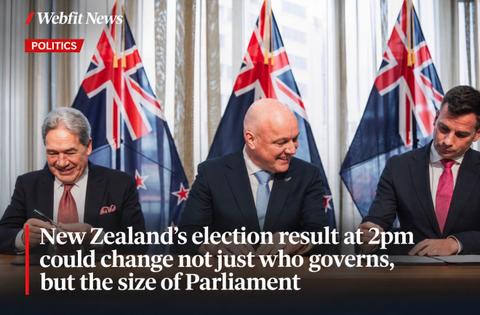
New Zealand’s political conversation has moved beyond who won the election. It is now about what each party is prepared to give up to form a government.
Four leaders, 72 seats and one difficult agreement
Friday’s official election results reduced the existing coalition’s parliamentary representation from 67 seats to 65, leaving it one seat short of an outright majority.
Opportunity’s seven MPs could resolve that problem, but bringing four political parties together presents a different challenge altogether.
|
Political party
|
Leader
|
Official seats
|
|
National
|
Christopher Luxon
|
40
|
|
ACT
|
David Seymour
|
13
|
|
New Zealand First
|
Winston Peters
|
12
|
|
Existing coalition
|
|
65
|
|
Opportunity
|
Qiulae Wong
|
7
|
|
Potential four-party majority
|
|
72
|
|
Majority required
|
|
66
|
On paper, the four parties would have a comfortable majority.
Politically, however, Luxon must find an arrangement that accommodates four separate electoral mandates, competing policy priorities and potentially conflicting demands over ministerial responsibilities.
Opportunity signals room for compromise on climate policy
One of Saturday’s more encouraging developments for government formation concerns Opportunity’s climate policy position.
Reporting published by Newswire indicates that broadly maintaining New Zealand’s existing climate commitments could satisfy one of Opportunity’s minimum negotiating conditions.
The clarification suggests Wong may not require the incoming government to introduce an entirely new climate policy framework.
Protecting existing commitments could instead provide a starting point for negotiations.
However, differences remain. ACT has previously questioned New Zealand’s continued participation in the Paris Agreement, while Opportunity considers climate commitments an important part of its policy platform.
Whether the parties can find common ground on this issue could provide an early indication of how difficult the wider negotiations will become.
Winston Peters’ future emerges as a major sticking point
The most sensitive disagreement may not involve legislation, taxation or government spending.
It concerns Winston Peters himself.
Wong has maintained that Opportunity would not enter a coalition or confidence and supply agreement with a government in which Peters continues as Foreign Minister.
For Luxon, that creates an awkward political situation.
New Zealand First holds 12 parliamentary seats, almost twice Opportunity’s representation. Peters is also one of New Zealand’s most experienced coalition negotiators and has held significant ministerial responsibilities across successive governments.
Asking him to relinquish the Foreign Affairs portfolio could introduce another layer of difficulty into negotiations.
Equally, Wong could face questions about her own political credibility if she abandons a condition she has publicly maintained.
As of midday Saturday, no agreement concerning the Foreign Affairs portfolio had been publicly confirmed.
What Opportunity wants in exchange for its support
Beyond ministerial appointments, Opportunity has identified five policy priorities for entering a coalition or confidence and supply agreement.
Several could have direct consequences for ordinary New Zealanders.
|
Policy area
|
Opportunity’s negotiating priority
|
Why it matters
|
|
Supermarket competition
|
Address the dominance of the two major supermarket groups
|
Grocery affordability and consumer choice
|
|
Healthcare
|
Establish a 10-year cross-party health plan
|
Long-term healthcare planning and accessibility
|
|
Climate policy
|
Protect existing climate commitments
|
Environmental and investment certainty
|
|
Commercial fishing
|
End bottom trawling
|
Marine conservation and fishing industry practices
|
|
Political accountability
|
Regulate lobbying and cap political donations
|
Transparency and political influence
|
These remain negotiating positions rather than confirmed government policies.
Their eventual inclusion in a governing agreement will depend on the concessions National, ACT and New Zealand First are prepared to make.
For households struggling with grocery costs or difficulties accessing healthcare, the outcome of these discussions could be considerably more important than which politician receives a ministerial portfolio.
Can Luxon afford to lose either Peters or Seymour?
The official election results reveal an important limitation in National’s negotiating position.
Opportunity cannot simply replace ACT or New Zealand First and provide Luxon with an outright parliamentary majority.
|
Potential governing arrangement
|
Total seats
|
Majority status
|
|
National + ACT + NZ First
|
65
|
Short by 1
|
|
National + ACT + Opportunity
|
60
|
Short by 6
|
|
National + NZ First + Opportunity
|
59
|
Short by 7
|
|
National + ACT + NZ First + Opportunity
|
72
|
Majority
|
|
Labour + Greens + Te Pāti Māori + Opportunity
|
65
|
Short by 1
|
Under these combinations, all four parties are required to establish a National-led majority government.
This means Peters and Seymour retain considerable negotiating influence despite the attention surrounding Opportunity’s emergence as a potential kingmaker.
Wong can provide the additional parliamentary support Luxon requires, but she cannot independently replace either of his existing coalition partners.
Similarly, Opportunity’s seven MPs would not give a Labour-led grouping an outright majority.
Other arrangements involving parliamentary support or abstentions remain possible.
Seymour suggests negotiations could take weeks
ACT leader David Seymour has indicated that preparations for government formation negotiations are underway.
Speaking to Newstalk ZB on Friday, Seymour said arrangements were being made for meetings with Luxon and that he hoped to meet Wong.
Saturday’s reporting by 1News indicated that Seymour considered an agreement within days possible, although a period of several weeks was more likely.
The involvement of an additional political party makes the process potentially more complicated than the negotiations following the 2023 general election.
On that occasion, it took 40 days from election day for National, ACT and New Zealand First to sign their coalition agreements.
There is no guarantee that the current negotiations will follow a similar timeframe.
A formal four-party meeting had not been independently confirmed by Webfit News at the time of publication.
Could Opportunity hold the balance of power without joining the government?
Wong has left open the possibility of an alternative arrangement under which Opportunity remains outside a formal coalition.
This could allow the party to maintain its political independence while enabling a National-led minority government to operate.
For example, if Opportunity’s seven MPs agreed to abstain on a parliamentary confidence motion, the voting numbers could look like this:
|
Parliamentary grouping
|
Votes
|
|
National, ACT and NZ First supporting the government
|
65
|
|
Labour, Greens and Te Pāti Māori opposing the government
|
58
|
|
Opportunity abstaining
|
7
|
|
Total MPs
|
130
|
In this hypothetical scenario, a confidence motion could pass by 65 votes to 58.
Opportunity would not necessarily need to hold ministerial positions or support every piece of government legislation.
Such an arrangement could give Wong greater independence while requiring ministers to negotiate support for individual policies.
It could also provide a possible route around some of the disagreements over ministerial appointments.
However, the stability of such a government would depend heavily on the terms of the agreement.
Two electorates could change everything again
While political leaders prepare for negotiations, there remains another uncertainty that could significantly alter the parliamentary balance.
National lost two closely contested electorates in Friday’s official results.
|
Electorate
|
Labour winner
|
National runner-up
|
Winning margin
|
|
Wairarapa
|
Kieran McAnulty
|
Mike Butterick
|
81 votes
|
|
Hamilton East
|
Georgie Dansey
|
Ryan Hamilton
|
173 votes
|
Applications for judicial recounts close on Wednesday, December 2.
Because National’s parliamentary representation includes electorate overhang seats, regaining either electorate could restore the existing coalition’s outright majority, assuming all other electoral allocations remain unchanged.
|
Possible recount outcome
|
Coalition seats
|
Parliament size
|
Majority required
|
|
No change
|
65
|
130
|
66
|
|
National regains one electorate
|
66
|
131
|
66
|
|
National regains both electorates
|
67
|
132
|
67
|
These are hypothetical scenarios, not predictions of recount outcomes.
Nevertheless, they illustrate why the coming days could be particularly important for both government formation and Opportunity’s negotiating position.
Will New Zealand have a new government before Christmas?
With December approaching, New Zealanders may reasonably wonder how long the political uncertainty will continue.
There is currently no confirmed deadline for completing government formation negotiations.
The existing administration continues operating under the caretaker convention, ensuring public services and routine government functions continue while political discussions take place.
Another election remains a constitutional possibility if no viable government can ultimately be formed, but it is neither automatic nor inevitable.
The parties still have several options available, including a formal coalition, confidence and supply agreements and negotiated abstention arrangements.
What has changed since yesterday?
|
Political development
|
Latest known position
|
|
Luxon’s refusal to work with Opportunity
|
Reversed
|
|
Opportunity’s climate demands
|
Further clarified
|
|
Peters’ Foreign Affairs portfolio
|
Remains unresolved
|
|
Negotiation meetings
|
Arrangements underway
|
|
Four-party governing agreement
|
Not confirmed
|
|
Judicial recount deadline
|
2 December 2026
|
|
Formation of a new government
|
Timing uncertain
|
The real political test is now underway
Until Friday, Christopher Luxon’s biggest challenge was whether the official election results would preserve his coalition’s majority.
That question has been answered.
His next challenge is considerably more complicated: convincing three smaller parties with different priorities to support a workable government.
Winston Peters has 12 seats. David Seymour has 13. Qiulae Wong has seven. Each brings something Luxon needs, and each has political commitments to protect.
For ordinary New Zealanders, the success of these negotiations should ultimately be measured not by who receives which ministerial position, but by whether the resulting government can deliver meaningful improvements in healthcare, household affordability, economic stability and public services.
Luxon has already changed one of his firmest pre-election positions. The coming negotiations will reveal whether Peters, Seymour and Wong are prepared to make compromises of their own.
Twenty-one days after New Zealand went to the polls, the country knows the composition of its Parliament. It is still waiting to discover the composition of its next government.
Webfit News | New Zealand Election 2026
Sources: RNZ political reporting.
Developing story: Based on information available as of 12:47 pm on 28 November 2026. Negotiating positions and hypothetical governing arrangements should not be interpreted as confirmed agreements.