There is no confirmed leadership challenge from within National’s caucus, and Prebble’s comments represent his personal political assessment rather than an official position of ACT.
Three potential successors named
Prebble’s intervention has brought three senior National politicians into the public leadership discussion.
|
Politician
|
Party
|
Status
|
|
Erica Stanford
|
National
|
Suggested by Prebble
|
|
Mark Mitchell
|
National
|
Suggested by Prebble
|
|
Chris Bishop
|
National
|
Suggested by Prebble
|
None of the three has been confirmed as mounting a leadership challenge.
Nevertheless, the naming of potential successors introduces another dimension to an already complicated period of government formation.
National won more seats but received fewer party votes than Labour
One of the more unusual features of the 2026 election is the difference between National’s parliamentary representation and its share of the nationwide party vote.
|
Election indicator
|
National
|
Labour
|
|
Official party vote share
|
28.35%
|
29.88%
|
|
Parliamentary seats
|
40
|
36
|
|
Difference in seats
|
+4
|
|
|
Party vote advantage
|
|
+1.53 percentage points
|
Labour received a greater share of the party vote, but National secured more parliamentary seats because of its electorate victories and the resulting overhang under MMP.
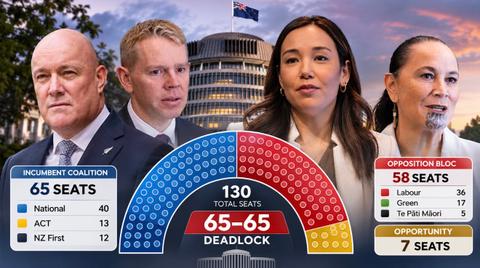
National remains the largest party in Parliament by seat count. However, its existing governing arrangement no longer holds an outright majority.
That leaves Luxon attempting to secure another term as prime minister while managing renewed questions about his leadership.
Would replacing Luxon solve the parliamentary deadlock?
Not by itself.
A change of National Party leader would not automatically change the distribution of parliamentary seats.
|
Political party
|
Official seats
|
|
National
|
40
|
|
ACT
|
13
|
|
New Zealand First
|
12
|
|
Existing coalition
|
65
|
|
Opportunity
|
7
|
|
Potential combined majority
|
72
|
|
Outright majority required
|
66
|
Whether National is led by Luxon or another senior MP, the party would still need additional parliamentary support under the current allocation.
A leadership change could potentially alter the tone, relationships and approach to coalition negotiations, but it would not eliminate the underlying numerical problem.
Opportunity would continue to hold significant negotiating influence.
Could Luxon resign as prime minister without another election?
Yes. New Zealanders elect members of Parliament rather than directly electing their prime minister.
A governing party can change its leader during a parliamentary term without automatically triggering a general election.
New Zealand has experienced several such transitions.
|
Year
|
Outgoing prime minister
|
Successor
|
|
1997
|
Jim Bolger
|
Jenny Shipley
|
|
2016
|
John Key
|
Bill English
|
|
2023
|
Jacinda Ardern
|
Chris Hipkins
|
In each case, a leadership transition occurred without an immediate general election.
The current situation is more complicated because negotiations to establish the next government have not concluded.
Any prospective prime minister would still need to demonstrate that their administration could command parliamentary confidence.
Luxon faces pressure on two fronts
National’s immediate challenge is bringing together four parties with different political priorities.
Opportunity leader Qiulae Wong has maintained her opposition to Winston Peters retaining the Foreign Affairs portfolio under a formal governing agreement.
There are also policy differences involving climate commitments, supermarket competition, healthcare planning and environmental regulation.
At the same time, Saturday’s intervention from Prebble has revived public discussion about whether Luxon remains the right person to lead National through those negotiations.
A former political leader calling for his resignation does not establish that National’s MPs share that view.
The distinction is important, particularly during a period when speculation can move faster than confirmed political developments.
What happens next?
|
Development
|
Current position
|
|
Christopher Luxon’s leadership
|
He has confirmed his intention to remain leader
|
|
Prebble’s resignation call
|
Reported Saturday afternoon
|
|
Internal National leadership challenge
|
Not confirmed
|
|
Opportunity’s support
|
No final agreement announced
|
|
Existing coalition’s majority
|
One seat short
|
|
Judicial recount deadline
|
2 December 2026
|
|
Formation of the next government
|
Timing remains uncertain
|
Possible judicial recounts in Wairarapa and Hamilton East could also change the parliamentary balance, further complicating the political calculations over the coming days.
A leadership debate before a government has even been formed
Three weeks after New Zealanders went to the polls, the country is confronting two distinct political questions: which parties will form the next government, and who will lead it?
For now, Luxon remains National leader and caretaker prime minister.
Prebble’s intervention does not change that position. Nor does it establish that a leadership contest is imminent.
However, it adds another layer of public scrutiny at a time when Luxon is already being required to reconsider major pre-election commitments and negotiate with a party he previously ruled out.
Before National can celebrate another term in government, it must first secure the parliamentary support necessary to govern.
Whether Luxon can achieve that while maintaining confidence in his own leadership will be one of the defining political questions of the coming weeks.
Webfit News | New Zealand Election 2026
Sources: Newstalk ZB reporting published at 1:03 pm on 28 November 2026, Electoral Commission official election results, Reuters and 1News.
Developing story. Information reflects publicly available reporting as of 3:42 pm on 28 November 2026.