The development adds another layer of uncertainty to an election that has already produced difficult political circumstances for both of New Zealand’s major parties.
What happened on Friday afternoon?
The Electoral Commission released the official election results at 2pm on Friday, November 27.
Although Labour secured the largest share of the nationwide party vote and overturned National’s preliminary leads in Wairarapa and Hamilton East, the final parliamentary allocation did not provide Labour with a straightforward route back into government.
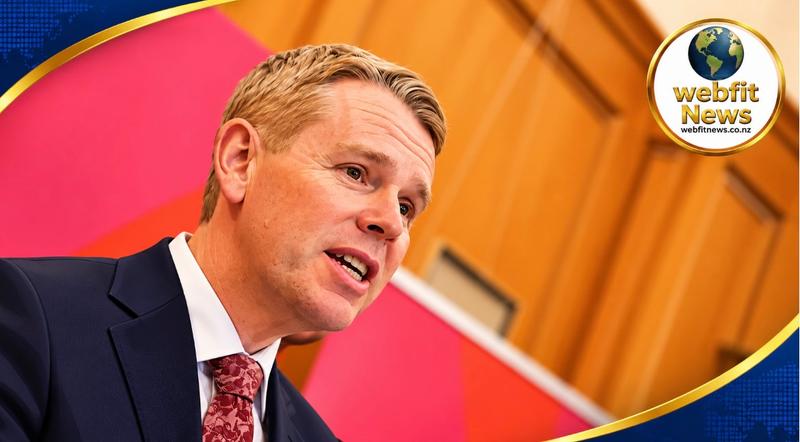
According to RNZ, discussions involving senior Labour MPs took place before Hipkins addressed the media two hours later.
Rather than announcing his departure, Hipkins deferred his decision until the government formation process had concluded and Labour had an opportunity to regroup.
His public position leaves open the possibility of either continuing as leader or stepping aside.
Hipkins has not publicly confirmed that he intended to resign on Friday. The account of his near-resignation is based on reporting citing sources familiar with the discussions.
Winning the popular vote but missing out on government
One of the most unusual aspects of the 2026 election is that Labour received more party votes than National but secured fewer parliamentary seats.
Labour versus National: Official election results
|
Election indicator
|
Labour
|
National
|
|
Party votes
|
863,238
|
819,012
|
|
Party vote share
|
29.88%
|
28.35%
|
|
Electorate seats
|
22
|
40
|
|
List seats
|
14
|
0
|
|
Total parliamentary seats
|
36
|
40
|
Source: Electoral Commission official election results, 27 November 2026.
Labour received 44,226 more party votes than National, with a lead of 1.53 percentage points.
Yet National secured four more parliamentary seats because its electorate victories exceeded its proportional party-vote entitlement, creating an overhang under New Zealand’s Mixed Member Proportional electoral system.
The result illustrates the distinction between winning the largest share of the party vote and securing sufficient parliamentary support to form a government.
For Hipkins, it presents a complicated political outcome: Labour increased its electoral support, but those gains have not translated into a clear route back into office.
How Labour performed under Hipkins
Hipkins became Labour leader and prime minister in January 2023 following Jacinda Ardern’s resignation.
He has since led Labour through two general elections.
|
Election indicator
|
2023
|
2026
|
|
Labour party vote share
|
26.91%
|
29.88%
|
|
Parliamentary seats
|
34
|
36
|
|
Government formed by Labour
|
No
|
Not established
|
|
Change in party vote share
|
|
+2.97 percentage points
|
|
Change in parliamentary representation
|
|
+2 seats
|
Labour has improved its parliamentary representation since the 2023 election and regained its position as the party receiving the largest share of the party vote.
However, its inability to establish a governing majority under the current political arrangements has brought Hipkins’ leadership into renewed focus.
This creates a difficult assessment for Labour’s caucus. The party must consider its improved electoral performance alongside the fact that Hipkins has now led two election campaigns without securing another term in government.
Why Labour cannot simply form a government with Opportunity
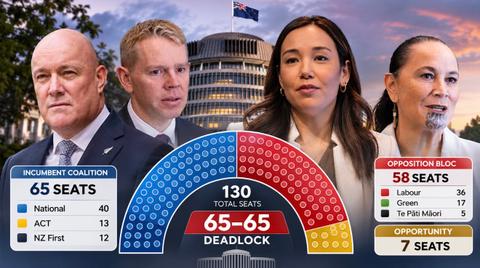
The official results have produced a Parliament of 130 MPs, with 66 seats required for an outright majority.
Official parliamentary composition
|
Political party
|
Seats
|
|
National
|
40
|
|
Labour
|
36
|
|
Green Party
|
17
|
|
ACT
|
13
|
|
New Zealand First
|
12
|
|
Opportunity
|
7
|
|
Te Pāti Māori
|
5
|
|
Total
|
130
|
|
Outright majority required
|
66
|
Even if Opportunity supported a Labour-led administration alongside the Greens and Te Pāti Māori, the combined parties would still be one seat short.
|
Potential governing arrangement
|
Combined seats
|
Outright majority
|
|
Labour + Greens + Te Pāti Māori
|
58
|
No
|
|
Labour + Greens + Te Pāti Māori + Opportunity
|
65
|
No
|
|
National + ACT + NZ First
|
65
|
No
|
|
National + ACT + NZ First + Opportunity
|
72
|
Yes
|
|
Labour + Greens + NZ First + Te Pāti Māori
|
70
|
Mathematically possible
|
|
National + Labour
|
76
|
Mathematically possible
|
The final two combinations represent parliamentary arithmetic rather than confirmed political arrangements.
Hipkins has ruled out a grand coalition with National, while Opportunity has indicated that it will initially negotiate with National as the party holding the largest number of parliamentary seats.
Other arrangements involving abstentions or external parliamentary support remain constitutionally possible.
Nevertheless, the current political positions of the parties leave Labour without an immediately available majority.
Tuesday’s Labour caucus meeting takes on greater significance
Labour’s parliamentary caucus is scheduled to meet on Tuesday, December 1.
Following the reports about Hipkins’ near-resignation, that meeting will attract greater attention.
The party will need to consider its response to the election result, its position during government formation negotiations and its future direction.
However, there has been no confirmation that Tuesday’s meeting will involve a formal leadership challenge or an immediate leadership election.
Labour deputy leader Carmel Sepuloni has publicly expressed support for Hipkins and emphasised the importance of caucus unity.
The immediate question is whether that support will translate into a longer-term commitment to his leadership once the government formation process concludes.
What happens if Hipkins decides to stay?
One of the most important details in this developing story is that Labour has an established process for reviewing its leadership following a general election.
According to the party’s leadership rules, its MPs must hold a leadership endorsement vote within three months of an election.
That means the issue cannot remain unresolved indefinitely.
|
Leadership requirement
|
Labour’s rules
|
|
Post-election leadership vote
|
Within three months of a general election
|
|
Support required for incumbent leader
|
60% of votes cast, plus one
|
|
2026 general election date
|
7 November
|
|
Three-month point
|
7 February 2027
|
Based on Labour’s current parliamentary allocation of 36 MPs, Hipkins would require 23 supporting votes if every caucus member participated.
The actual threshold would depend on the number of votes cast and the applicable party procedures.
For Hipkins, therefore, remaining leader would eventually require more than publicly expressing a willingness to continue. He would need to retain sufficient support within his parliamentary caucus.
What happens if Hipkins resigns?
A voluntary resignation would trigger a different leadership process.
Labour’s rules allow its parliamentary caucus seven days to endorse a replacement with the support of two-thirds of votes cast.
If all 36 Labour MPs participated, a candidate would require 24 votes to meet that threshold.
If the caucus could not reach the required agreement, the decision would move to a wider leadership election involving party members and affiliated unions.
Who would decide Labour’s next leader?
|
Voting group
|
Share of leadership election vote
|
|
Labour parliamentary caucus
|
40%
|
|
Labour Party members
|
40%
|
|
Affiliated unions
|
20%
|
|
Total
|
100%
|
This is an important distinction.
A resignation without an agreed successor could potentially trigger a broader leadership contest, while an agreed transition within caucus could allow the party to appoint a new leader more quickly.
The timing of any leadership decision could therefore influence not only who succeeds Hipkins but also how that person is selected.
Who could succeed Hipkins?
Although political speculation has naturally turned towards possible successors, there is currently no confirmed leadership contest.
Several prominent Labour politicians have already addressed questions about the position.
|
Politician
|
Current reported position
|
|
Carmel Sepuloni
|
Publicly supports Hipkins’ leadership
|
|
Kieran McAnulty
|
Has again ruled out seeking the leadership
|
|
Michael Wood
|
Has previously ruled out a leadership bid
|
|
Chris Hipkins
|
Will consider his future after government formation
|
McAnulty, who retained Wairarapa by just 81 votes in the official count, has cited family commitments when explaining why he does not want the leadership role.
Sepuloni has also rejected suggestions of an immediate leadership challenge, reiterating her support for Hipkins.
None of these statements establishes who would ultimately succeed Hipkins if he decided to step down.
Why another election complicates Labour’s leadership decision
The possibility of another general election has not been entirely excluded from the current political discussion.
Opportunity leader Qiulae Wong has acknowledged that a further election could become necessary if government formation negotiations ultimately fail, although several alternative parliamentary arrangements remain available.
For Labour, changing its leader before that uncertainty is resolved could create additional organisational demands.
A new leader could potentially be required to prepare a campaign, establish a leadership team and communicate the party’s priorities within a relatively short period.
Retaining Hipkins during government formation would provide continuity, but it would leave the longer-term leadership question unresolved.
The possibility of another election therefore provides important context for the reported advice of senior Labour MPs that the party maintain stability for now.
No second general election has been announced.
Both major party leaders are facing scrutiny
The latest revelations concerning Hipkins come just one day after former ACT leader Richard Prebble publicly called for Christopher Luxon to resign.
The circumstances are different.
Luxon has confirmed his intention to remain National leader and is pursuing a governing agreement involving Opportunity and his existing coalition partners.
Hipkins has deferred a decision about his future while acknowledging Labour’s difficult parliamentary position.
|
Political issue
|
Christopher Luxon
|
Chris Hipkins
|
|
Party vote share
|
28.35%
|
29.88%
|
|
Parliamentary seats
|
40
|
36
|
|
Immediate priority
|
Establish parliamentary confidence
|
Assess Labour’s position and future direction
|
|
Leadership position
|
Intends to remain leader
|
Decision deferred
|
|
Confirmed internal leadership challenge
|
None announced
|
None announced
|
The 2026 election has therefore created uncertainty not only over the composition of New Zealand’s next government but also over the longer-term leadership of its two largest political parties.
The important dates ahead
|
Date
|
Development
|
|
27 November 2026
|
Official election results released; Hipkins reportedly considers resignation
|
|
29 November 2026
|
Reports emerge of senior MPs’ intervention
|
|
1 December 2026
|
Scheduled Labour caucus meeting
|
|
2 December 2026
|
Judicial recount application deadline
|
|
3 December 2026
|
Scheduled return of the election writ, subject to recounts
|
|
By February 2027
|
Required post-election Labour leadership endorsement process
|
Government formation negotiations and any judicial recounts could influence the timing of subsequent political decisions.
Labour has gained votes, but its leadership question remains
Chris Hipkins entered the 2026 election seeking to return Labour to government.
The party emerged with more votes, a higher vote share and two additional parliamentary seats compared with 2023.
Yet it remains without a straightforward route to government, and its leader is now at the centre of reports about a resignation that nearly happened.
For Labour’s caucus, the coming weeks will involve assessing its electoral performance, determining its parliamentary strategy and deciding whether Hipkins should continue leading the party.
For now, he remains Labour leader, with his longer-term political future unresolved.
New Zealand is still waiting for its next government. Labour is also waiting to establish who will lead it through the political chapter that follows.
Webfit News | New Zealand Election 2026
Sources: RNZ political reporting by Craig McCulloch and Lauren Crimp; 1News; Electoral Commission official election results; NZ Herald and Stuff reporting; Reuters.
Developing story. Information reflects reporting available as of 11:54 AM on 29 November 2026. No resignation or formal Labour leadership challenge has been announced.