India rue missed opportunities as Duffy's redemption puts New Zealand in command at Hagley Oval
From India's costly dropped catches and fragile batting partnerships to Jacob Duffy's personal comeback, the Day 2 press conferences revealed two contrasting dressing rooms and the...
From India's costly dropped catches and fragile batting partnerships to Jacob Duffy's personal comeback, the Day 2 press conferences revealed two contrasting dressing rooms and the fine margins that continue to define Test cricket.
By Webfit News | 29 November 2026 | Christchurch
A week is a long time in international cricket. Just ask Jacob Duffy or the Indian cricket team.
Having endured a difficult outing in Wellington, Duffy rediscovered his rhythm at Hagley Oval, helping New Zealand take control of the second Test against India. Meanwhile, an Indian side that had piled up more than 700 runs in the previous Test found itself struggling to build even a single substantial partnership in Christchurch.
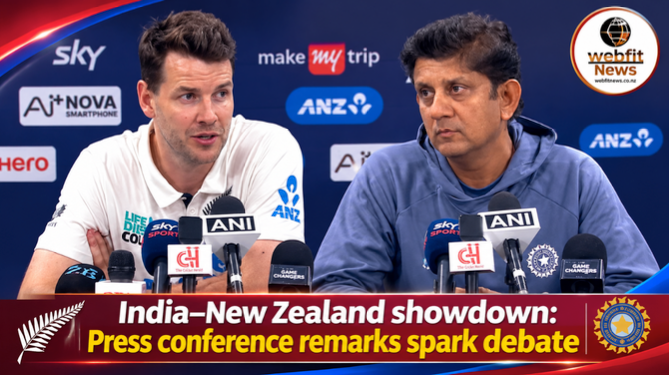
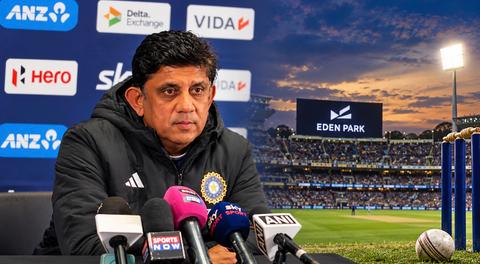
Speaking to the media following Day 2, India spin bowling coach Sairaj Bahutule and New Zealand fast bowler Jacob Duffy offered remarkably candid assessments of their respective performances.
One spoke about missed opportunities, execution and the belief that India could still fight back. The other opened up about technical struggles, self-doubt, dressing-room support and the satisfaction of contributing to his team's success again.
India disappointed, but not defeated
Despite New Zealand's commanding position, Bahutule insisted that India were far from conceding the contest.
"You can never say that the game has gone out of reach till the last ball is bowled."
However, he made little attempt to disguise his disappointment with India's batting performance.
Several Indian batters managed to get starts, but none converted them into substantial scores. On a surface offering pace, bounce and seam movement, the inability to build partnerships left India increasingly vulnerable.
Bahutule explained that each batter entered the contest with an individual plan suited to the conditions. While some chose to counterattack, errors in judgement and execution prevented India from establishing any sustained momentum.
"I think we didn't play to our potential."
For Bahutule, the issue was not necessarily a lack of intent or preparation. It was the inability to execute those plans when the situation demanded patience, discipline and resilience.
The hidden cost of India's dropped catches
India's difficulties were not confined to their batting.
Bahutule acknowledged that the visitors could have bowled tighter lines on the opening morning, when the Christchurch surface offered considerable seam movement.
Although the bowling unit improved as the innings progressed, missed opportunities in the field allowed New Zealand to accumulate valuable additional runs.
The Indian coach estimated that the hosts could have been restricted to approximately 30 to 40 fewer runs.
What made those missed catches particularly frustrating was that the batters who benefited from them went on to score runs.
Bahutule defended the team's preparation, highlighting the considerable work being done behind the scenes on catching, throwing and fielding. He also acknowledged the challenges presented by the windy conditions in Christchurch, without using them as an excuse.
The message was clear: preparation means little unless it translates into execution on the field.
In Test cricket, a dropped catch rarely appears as a separate statistic on the scoreboard. Its consequences, however, can influence the outcome of an entire match.
Jacob Duffy: The story behind the comeback
While India reflected on what went wrong, Jacob Duffy offered a refreshingly honest account of his journey from frustration in Wellington to renewed confidence in Christchurch.
The New Zealand fast bowler admitted that the previous Test had been among his most difficult experiences in a Black Caps shirt.
"You feel like you're letting the team down a little bit, don't you? So that's never a nice feeling."
It was an unusually personal admission from an international cricketer, offering a glimpse into the pressure players place upon themselves when performances fall below their own expectations.
Duffy explained that an extended period of white-ball cricket had affected his bowling mechanics.
The demands of limited-overs cricket, including yorkers, slower deliveries and variations, had gradually influenced the consistency of his natural bowling action.
For a bowler who relies heavily on rhythm, wrist position and technical precision, those subtle changes had significant consequences.
Rather than searching for a dramatic solution, Duffy returned to the basics.
Between the two Tests, he worked on his technique through shorter run-ups and controlled bowling sessions, allowing him to focus on his mechanics without placing excessive physical demands on his body.
His performance at Hagley Oval was an encouraging reward for that work.
How New Zealand refused to fall into Rishabh Pant's trap
One of the most revealing tactical discussions from the two press conferences centred on Rishabh Pant.
The Indian wicketkeeper-batter's aggressive approach has troubled bowling attacks around the world. His willingness to advance down the pitch and attack fast bowlers can disrupt established plans and force opponents into uncomfortable adjustments.
Duffy explained that New Zealand's strategy was built around refusing to let Pant dictate their lengths.
When a batter advances down the pitch, the natural reaction can be to shorten the next delivery. But that adjustment can play directly into the batter's intentions.
New Zealand instead focused on maintaining their preferred areas, consistently targeting the top of off stump and using the short ball selectively.
The objective was not to eliminate Pant's attacking opportunities altogether, but to prevent his aggression from disrupting the bowling unit's discipline.
Bahutule, meanwhile, defended Pant's natural approach, pointing to his century in the previous Test and his ability to change the course of a match.
However, he acknowledged that India needed a partnership at the time of Pant's dismissal.
The contrasting perspectives highlighted a fascinating tactical battle: a batter attempting to force the opposition away from its strengths, and a bowling attack determined not to surrender control.
On Day 2, New Zealand won that battle.
Why India left Ravindra Jadeja out
The omission of experienced all-rounder Ravindra Jadeja was another significant talking point during Bahutule's press conference.
The Indian coach explained that the decision was driven by the conditions and the balance of the playing XI.
India believed that four specialist fast bowlers were necessary at Hagley Oval, allowing the attack to rotate effectively and maintain pressure throughout the innings.
Washington Sundar's inclusion also formed part of the team's preferred batting and bowling combination.
Bahutule stressed that the selection strategy had been communicated clearly and that Jadeja understood the reasoning behind the decision.
Nevertheless, India's batting struggles have inevitably renewed questions about whether the experience and versatility of an all-rounder such as Jadeja could have provided additional stability.
It remains a selection decision that will attract further scrutiny as the match develops.
Jasprit Bumrah's value extends beyond wickets
Questions were also raised about Jasprit Bumrah's relatively quiet return in the wicket column.
With several less experienced fast bowlers around him, expectations naturally remain high whenever Bumrah takes the field.
Bahutule, however, rejected the suggestion that his performances should be assessed solely through wickets or bowling speeds.
He explained that Bumrah adapts his pace according to the conditions, sometimes prioritising seam movement and control rather than attempting to bowl at maximum speed.
The coach also highlighted the importance of assessing how often a bowler beats the bat, creates uncertainty and induces false shots.
Beyond his individual performances, Bumrah continues to play an important role in guiding India's younger fast bowlers.
His communication, experience and understanding of different match situations remain valuable assets within the dressing room.
For Bahutule, the wickets will eventually come. The immediate priority is maintaining the quality of execution and creating opportunities.
New Zealand's fast bowlers are hunting as a pack
Perhaps the biggest difference between the two sides on Day 2 was New Zealand's ability to sustain pressure across successive bowling spells.
Duffy described this collective responsibility as passing the baton.
When Matt Henry or Kyle Jamieson establishes pressure with disciplined bowling, the responsibility of the next bowler is to maintain it rather than offer the opposition an opportunity to recover.
Duffy admitted that this was precisely where he had struggled in Wellington. His inability to sustain the pressure created by his teammates had contributed to his personal disappointment.
In Christchurch, alongside Henry, Jamieson and Nathan Smith, he was able to contribute to a more cohesive bowling performance.
The Black Caps' approach demonstrated that successful Test bowling is not simply about individual brilliance.
It is about consistency, complementary skills and the ability to operate as a collective unit.
A dinner, a conversation and the importance of dressing-room culture
Away from the technical discussions, Duffy also shared a particularly human insight into the New Zealand dressing room.
Following a difficult day in Wellington, senior fast bowler Matt Henry spent time with Duffy in his room, sharing a meal from Lone Star and having a conversation.
There was no elaborate motivational speech or dramatic intervention. Just two teammates spending time together after a challenging day.
Duffy spoke warmly about Henry's leadership and the support he receives from the wider bowling group, coaching staff and captain.
He also credited his family and the arrival of his young baby with helping him maintain perspective beyond cricket.
International sport often celebrates individual achievements while overlooking the relationships that help athletes recover from setbacks.
Duffy's account was a reminder that confidence is not always rebuilt in the practice nets. Sometimes, it begins with a conversation away from the ground.
Hagley Oval Test: Day 2 at a glance
Match statistics
Details
Venue
Hagley Oval, Christchurch
New Zealand first innings
356 all out
India first innings
116/6
India's first-innings deficit
240 runs
Tom Blundell
89 runs
Akash Deep
5/99
Jacob Duffy
2/21
Kyle Jamieson
2/33
Jasprit Bumrah
0/49
Dhruv Jurel
7 not out
A pitch that is testing every cricketing skill
Despite India's difficulties, Bahutule praised the Hagley Oval surface, describing it as an ideal pitch for Test cricket.
Compared with Wellington, the Christchurch surface has offered additional pace and bounce, challenging batters while rewarding bowlers capable of maintaining disciplined lines and lengths.
Bahutule suggested that batting conditions could improve as the surface continues to dry under the sun over the coming days.
That possibility offers India some encouragement, although any recovery will depend heavily on their ability to occupy the crease, build partnerships and capitalise on improving conditions.
For New Zealand, the challenge will be to maintain their intensity as the surface evolves.
From 700-plus runs to a battle for survival
India's dramatic change in fortunes between Wellington and Christchurch underlines the unpredictable nature of Test cricket.
A batting unit that dominated the previous Test is now searching for answers. A New Zealand fast bowler who questioned his own contribution just days earlier has rediscovered his rhythm.
The difference has not necessarily been a dramatic change in talent or ability.
It has been execution.
New Zealand have held important catches, maintained disciplined bowling areas and sustained pressure. India have struggled to convert starts, missed opportunities in the field and endured costly periods of inconsistency.
With three days remaining, the contest is far from over.
India still possess the quality to mount a recovery, but reputation alone will not erase the deficit. They need partnerships, patience and a significant improvement in execution.
New Zealand, meanwhile, have earned their advantage through collective discipline rather than relying on a single standout performance.
As both press conferences demonstrated, Test cricket is as much a examination of character, adaptability and resilience as it is of technical ability.
At Hagley Oval, New Zealand are currently passing that examination.
India still have three days to change the story.
Follow Webfit News for live scores, match analysis, press conference coverage and the latest updates from India's tour of New Zealand.