Election night gave New Zealand a result. It did not give New Zealand the final result. Nearly 400,000 special votes, several close electorates and the final shape of Parliament are still to be settled.
By Webfit News Political Desk | 25 November 2026
For almost three weeks, New Zealand has been looking at an election result that is real, but not yet final.
That changes on Friday.
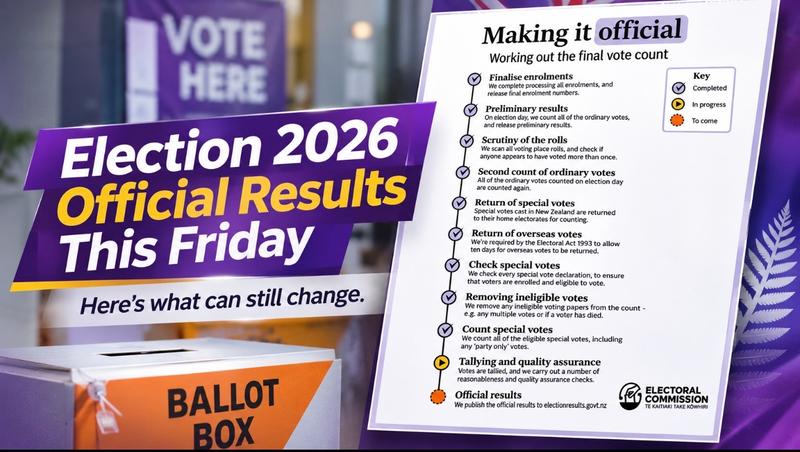
The Electoral Commission expects to publish the official results of the 2026 General Election on the afternoon of 27 November, completing the formal count that began after polling day.
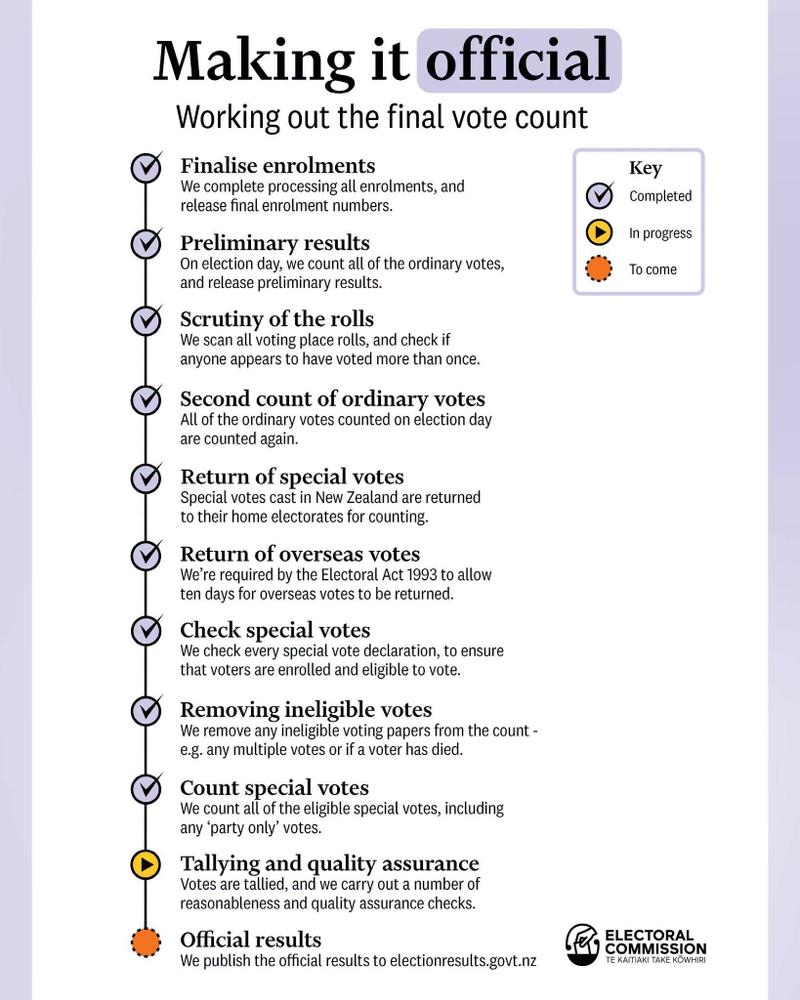
Most of the work is already done.
Ordinary votes counted on election night have been counted again.
Electoral rolls have been checked for possible multiple voting.
Special votes cast around New Zealand have been returned to their home electorates.
Overseas votes have arrived.
Special-vote declarations have been checked.
The process is now in its final stages: tallying, quality assurance and preparation of the official result.
But Friday is not simply an administrative formality.
It can still change electorate winners, list MPs and the final balance of Parliament.
And in a Parliament this finely balanced, even one seat matters.
Nearly 400,000 votes were missing from election night
The preliminary result released on 7 November did not include an estimated 399,000 special votes, including overseas votes.
That means a significant share of the total vote was still outside the election-night count.
Special votes are not unusual or secondary votes.
They are part of the normal election process.
People may cast a special vote because they are outside their electorate, overseas, enrolled close to election day, on an unpublished roll or not listed correctly at the voting place.
What makes them different is that they require additional checks before they can be included in the official result.
That is why they take longer to count.
Why Friday could change the party numbers
On preliminary results, Labour narrowly leads the nationwide party vote, with National close behind.
The gap between the two largest parties is small enough that the special votes could change the final percentages.
Under MMP, that matters because the party vote determines the proportional allocation of seats.
The preliminary Parliament currently stands at 131 seats.
The preliminary seat numbers are:
Party
Preliminary seats
National
42
Labour
36
Green
16
ACT
13
New Zealand First
12
Opportunity Party
7
Te Pāti Māori
5
Total
131
The preliminary National-ACT-New Zealand First bloc has 67 seats.
In a 131-seat Parliament, 66 seats are needed for a majority.
That means even a small shift in seat allocation could matter.
It does not mean the balance will change.
It means Friday’s numbers need to be watched carefully.
Special votes can change more than percentages
Special votes have altered electorate results and parliamentary seat allocations in previous elections.
That does not tell us what will happen in 2026.
But it does show why several hundred thousand uncounted votes cannot be treated as a footnote.
The final result may confirm the election-night picture.
It may also move some margins enough to change who enters Parliament.
The close electorates matter
Most electorate contests were decided by comfortable margins.
Some were not.
Several finished election night with only a few hundred votes separating the leading candidates.
In those seats, special votes can make a real difference.
That matters not only for the electorate winner.
Under MMP, an electorate result can also affect who enters Parliament from party lists and, in some circumstances, the total size of Parliament.
So Friday is not simply a recount of the same numbers.
It is the point at which close contests become official.
Why is Parliament projected to have 131 seats?
New Zealand normally starts with a 120-seat Parliament.
The preliminary 2026 result has produced a larger House because of overhang seats.
An overhang happens when a party wins more electorate seats than its share of the party vote would normally entitle it to.
Those electorate MPs still keep their seats.
That can increase the overall size of Parliament.
The final party vote and electorate results will determine whether the House remains at 131 seats.
Why does the official count take so long?
Election night and the official count serve different purposes.
Election night is designed to give New Zealand an early indication of the result.
The official count is designed to establish the legal result.
New Zealand counts votes by hand.
Ordinary voting papers are counted again.
Voting-place rolls are checked for possible multiple voting.
Special-vote declarations are checked to confirm that voters were enrolled and eligible.
Ineligible voting papers are removed.
Only once those checks are complete can the official result be declared.
The emphasis is on accuracy, not speed.
What does “removing ineligible votes” actually mean?
The Electoral Commission’s process includes removing votes that cannot legally be counted.
That does not mean large numbers of suspicious votes are being discovered.
It is a normal part of validating the election.
Officials check whether voters were eligible, whether someone appears to have voted more than once, and whether special-vote declarations meet the legal requirements.
Any vote that cannot legally be included is removed before the final tally.
This is another reason the official result is more than simply adding special votes to the election-night numbers.
What should people watch on Friday?
There are four things worth watching.
The final party-vote percentages
Small movements can change list-seat allocations.
The closest electorates
Candidates leading by only a few hundred votes will be watching closely.
The total number of seats
The preliminary Parliament has 131 MPs. That number could still change.
The governing majority
The current preliminary National-ACT-New Zealand First combination has 67 seats.
That calculation should be made again once the official result is released.
Friday may still not be the absolute end
Even official results can be challenged.
Candidates can apply for judicial recounts.
Political parties can seek recounts of party votes.
Election petitions can also be lodged under the legal process.
So Friday gives New Zealand the official count.
It does not necessarily rule out every possible legal challenge afterwards.
Election night was only the first answer
There is a tendency to think an election ends when the television graphics stop moving.
It does not.
Election night gives the country the fastest available picture.
The weeks afterwards produce the legal one.
Ballot papers are counted again.
Special votes are checked.
Overseas votes arrive.
Eligibility is confirmed.
Errors are corrected.
And only then does the preliminary result become official.
Nearly 400,000 special votes have been sitting outside the result New Zealand has been discussing since 7 November.
On Friday, they finally become part of it.
For most parties, the overall picture may remain familiar.
For some candidates, a few hundred votes could change everything.
And with the parliamentary numbers close, even one seat can matter.
Election night told New Zealand what appeared to have happened.
Friday tells New Zealand what officially happened.