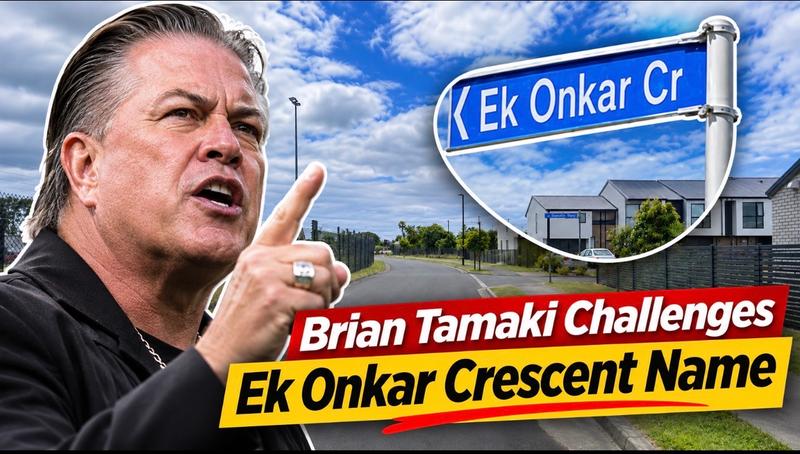
Tamaki argued that New Zealand streets should carry names reflecting the country’s history, heritage, people and identity.
He also asked three questions that deserve proper answers:
Who approved the name?
Was the community consulted?
And what criteria were used?
Strip away the political rhetoric, and those are reasonable questions.
But the answers cannot be found simply by deciding whether a name sounds sufficiently “New Zealand”.
They lie in Auckland’s road-naming process.
First, what is Ek Onkar Crescent?
Ek Onkar Crescent is a new residential road in Takanini serving a development of 33 homes.
The name comes from Sikh religious tradition.
Ek Onkar, also written Ik Onkar or Ik Oankar, appears at the beginning of the Guru Granth Sahib and expresses one of Sikhism’s central beliefs in a single universal divine reality.
So there is no ambiguity about the name having cultural and religious significance.
The harder question is whether that cultural significance has an appropriate connection to the place where the road has been created.
That is the test Auckland Council’s own guidelines are designed to address.
Developers can suggest names. They do not have the final say.
One misconception in the public debate is that a developer can simply choose a name and put up a sign.
That is not how Auckland’s formal process works.
When a subdivision creates a new road, the applicant or developer may propose preferred names.
Those names are assessed against Auckland Council’s road-naming guidelines.
Relevant mana whenua are expected to be given an opportunity to engage in the process.
The final decision sits with the relevant local board.
For Takanini, that means the Papakura Local Board.
So Ek Onkar Crescent was not simply created by somebody deciding privately that the name sounded appropriate.
It required public approval through Auckland Council’s governance structure.
That does not mean the decision is beyond criticism.
It means criticism should begin with the actual approval process.
What do Auckland’s rules say?
This is where the debate becomes more complicated.
Auckland Council’s published road-naming rules do not say street names must be English.
They do not say names must originate in New Zealand.
And they do not say a name from another culture is automatically unsuitable.
Instead, proposed names are expected to demonstrate a connection with the locality.
That connection can include:
- historical, ancestral or cultural links to the site or surrounding area;
- local landscape, environmental or biodiversity features;
- local history;
- an existing theme in the area;
- or, in some developments, a new theme that can be properly justified.
Council guidelines also say engagement with mana whenua and the local community is expected when applicants develop new road names.
The use of Māori names is actively encouraged because of the unique place of mana whenua history and identity in Tāmaki Makaurau.
The important point is this:
Auckland’s rules do not require a road name to be “New Zealand” in origin. They require it to be suitable, locally justified and properly approved.
That is a very different test.
So what was the local connection?
This is the question Webfit News believes now needs a clear public answer.
Why was Ek Onkar considered appropriate for this particular development in Takanini?
Was the name proposed because of the Sikh community’s presence in the area?
Was it connected to the developer?
Was it part of a wider naming theme?
What alternative names were submitted?
Which mana whenua groups were approached?
What feedback was received?
Was there wider community engagement?
And what reasoning did the Papakura Local Board rely on when approving it?
Those details matter because they move the debate from slogans to evidence.
If there was a strong local connection and the required process was followed, that should be clearly documented.
If the connection was weak, or consultation was limited, that is also a legitimate matter for scrutiny.
The name itself cannot answer those questions.
The approval record can.
Public consultation does not necessarily mean a public vote
Another part of the debate needs some clarification.
When people ask whether “the community was consulted”, that can create the impression that every street name must go to a neighbourhood referendum.
That is not how road naming usually works.
Applicants generally develop proposals, council staff assess them, mana whenua are approached, and the relevant local board makes the decision.
In some cases, community organisations or local residents are also consulted.
In others, the engagement is more limited.
Auckland Council’s own records from other road-naming decisions show that mana whenua groups may be contacted but do not always provide feedback before a decision is made.
So the better question is not simply:
“Was everybody asked?”
It is:
What consultation was required in this case, and was that process properly completed?
Auckland street names already reflect many cultures
The claim that Auckland streets should only have recognisably “New Zealand” names also runs into the reality of the city itself.
Auckland already has streets named after people, places, traditions and languages from many different parts of the world.
That reflects the history of settlement.
British names are everywhere.
Pacific heritage appears increasingly in South Auckland.
Indian-linked names have also been approved.
In 2019, a street in Hillsborough was named Prakash Lane, an Indian name meaning “bright light”.
The decision was tied to the history and use of the site.
More recently, Chardi Kalan Way was approved in Papatoetoe.
Chardi Kalan is a Punjabi expression associated with optimism and resilience.
In that case, the developers linked the name to their cultural heritage as New Zealanders of Punjabi background.
These examples do not automatically prove Ek Onkar Crescent was correctly approved.
Each application needs to stand on its own merits.
But they do show that Auckland’s street-naming system has never operated on the principle that all names must come from one cultural tradition.
Religious meaning is not automatically disqualifying either
The fact that Ek Onkar carries religious meaning also does not, by itself, make it unusual in New Zealand’s landscape.
Christian history is embedded in countless place names.
Māori spiritual concepts are part of the identity of many places throughout Aotearoa.
Auckland has also approved road names carrying explicitly religious or biblical associations where those names were connected with the history of the land.
So the useful question is not:
“Is this religious?”
It is:
“Why was this particular religious expression considered relevant to this particular place?”
Again, context matters.
Then there is the harder question: what counts as Kiwi?
Tamaki’s argument goes beyond road-naming procedure.
He wrote that immigration should come with assimilation and that people who make New Zealand their home should embrace the “Kiwi way of life” rather than replace it.
That is a political position.
It is not an Auckland Council naming rule.
And it raises a much larger question.
What exactly is the Kiwi way of life?
New Zealand culture has never been frozen in one decade.
The country’s public identity has been shaped by Māori, European settlement, Pacific migration, Asian migration and generations of people who arrived from somewhere else and eventually became part of the national story.
That does not mean every cultural proposal deserves automatic approval.
It certainly does not reduce the special status of mana whenua or the responsibility to protect Māori history in public spaces.
But it does make the idea of a single, easily defined “New Zealand name” difficult to sustain.
English itself came here from somewhere else.
So did Christianity.
So did many surnames, foods, architectural styles, sports and traditions that are now treated as entirely ordinary parts of New Zealand life.
The country changes because the people living in it change.
The real argument is about how that change should be reflected in public space.
Takanini matters to this debate
Location is important.
Takanini and the wider South Auckland area are among the most culturally diverse parts of New Zealand.
Indian and Sikh communities have become an established part of the area’s social, religious and commercial life.
The new development sits within that contemporary reality.
That does not automatically establish the local connection required by council rules.
But it does mean Ek Onkar Crescent has not appeared in a cultural vacuum.
Any serious examination of the name should consider not only New Zealand’s past, but the community that lives in that part of New Zealand today.
Tamaki has asked one question that council should answer clearly
The rhetoric surrounding this story is likely to continue.
Some will see the name as a natural expression of modern multicultural Auckland.
Others will see it as another sign of cultural change happening too quickly.
Those arguments are unlikely to disappear.
But one part of the controversy should be relatively easy to settle.
Auckland Council should clearly set out how the name was approved.
That means showing:
- who proposed Ek Onkar Crescent;
- why it was considered locally relevant;
- what other names were considered;
- what mana whenua engagement took place;
- whether wider community consultation occurred;
- and the local board’s reasoning for approving it.
That information would improve the debate immediately.
Supporters would have something concrete to defend.
Critics would have something concrete to challenge.
And the public would no longer be arguing largely from assumptions.
This is bigger than one street sign
Ek Onkar Crescent is a small residential road.
Yet the reaction to it has touched a much larger nerve.
Whose history belongs on the map?
Does integration mean migrants adopting an existing culture unchanged?
Or does becoming part of New Zealand also mean adding something to the culture over time?
How should Auckland acknowledge its growing diversity while also protecting the unique place of mana whenua history and identity?
Those are difficult questions.
They deserve better than slogans.
They also deserve better than automatically dismissing criticism as prejudice or automatically treating cultural change as displacement.
The starting point should be simpler.
Establish the facts.
Show the approval process.
Explain the local connection.
Then debate the decision.
Because the most useful question is not whether Ek Onkar sounds Indian.
Its Sikh origins are clear.
The question is whether Auckland’s own rules were followed when that name was placed on a New Zealand street sign.
That is where accountability begins, and it is the answer Aucklanders deserve.