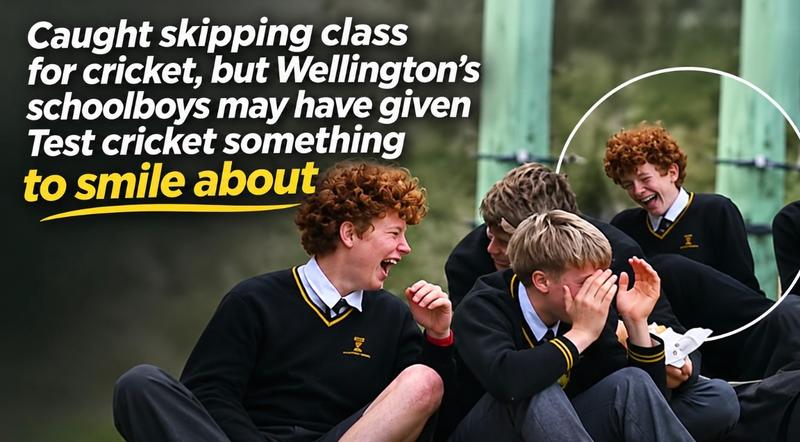
Another covered his face.
The third appeared to realise there was absolutely no point hiding.
The commentary box immediately understood what had happened.
It was a school day.
They had been caught.
On television.
At an international cricket match.
Within hours, the clip had travelled far beyond Wellington.
But perhaps the most interesting question is not why three teenagers skipped class.
It is why, in 2026, three teenagers decided that Test cricket was worth skipping class for.
An opportunity too tempting to ignore
Wellington College sits close to the Basin Reserve.
Entry to the fifth day of the Test was free.
For three cricket-loving students, India against the Black Caps was playing practically on their doorstep.
They later acknowledged they had slipped away to watch the match and reportedly received rubbish duty as punishment.
It is exactly the sort of minor teenage rebellion that becomes a family story years later.
Except most people do not have their school-day adventure broadcast to thousands of viewers.
The camera changed everything.
What might once have remained a story between three friends became a viral sporting moment.
The obvious reaction is not the most interesting one
Yes, students are supposed to be at school.
Schools need attendance rules.
Parents are entitled to expect their children to be where they say they are.
Nobody needs to turn truancy into a virtue.
But treating this as some great collapse in discipline would also miss the point.
The students broke a rule.
They were caught.
They were punished.
That part is simple.
The more interesting part is what drew them away in the first place.
Test cricket.
Not a T20 final.
Not a concert.
Not a celebrity event.
A fifth day of Test cricket.
Test cricket spends years asking how to attract young people
That is what makes this little episode worth more than a laugh.
Cricket administrators around the world constantly worry about the future of the five-day game.
Young audiences have endless alternatives.
Short-form cricket offers instant entertainment.
Social media offers something new every few seconds.
Football, basketball, gaming and streaming all compete for the same attention.
And yet these boys crossed the road voluntarily to watch New Zealand trying to save a Test against India.
No campaign persuaded them.
No marketing department had to manufacture their interest.
They simply wanted to be there.
That is something cricket should notice.
And what a Test they chose
They also happened to choose one with plenty of drama.
India had piled up 720 for 9 declared, the highest Test innings total made in New Zealand.
The Black Caps were trying desperately to save the match.
Daryl Mitchell and Glenn Phillips were grinding through the final afternoon while India searched for the wickets that would turn dominance into victory.
New Zealand eventually held on for a draw.
From a pure entertainment perspective, it was hardly designed for teenage attention spans.
There were long periods of defence.
Runs were secondary.
Time became everything.
Yet the students were there.
Watching.
Laughing.
Following the match closely enough to choose the Basin over the classroom.
That says something.
The Basin has always belonged to the city around it
There is also something very Wellington about the story.
The Basin Reserve is not isolated on the edge of the city.
It sits inside it.
People walk past it.
Schools sit nearby.
Generations of Wellingtonians have grown up with cricket happening almost within reach.
That relationship matters.
The Basin is part stadium, part landmark and part shared piece of the city.
In another era, three schoolboys slipping over to watch cricket might never have been noticed.
There would have been no giant screen.
No viral clip.
No social media frenzy.
They would simply have returned to school with a story.
What changed was not the behaviour.
It was the camera.
The punishment seems about right
Rubbish duty is unlikely to ruin anyone’s life.
And that is probably the right scale of consequence.
Not every teenage mistake needs to become a morality play.
The students knew they had broken a rule.
They got caught.
They faced the consequence.
That should be enough.
They will also probably remember the afternoon for the rest of their lives.
Both things can be true.
A school can enforce attendance without pretending three teenagers watching international cricket represent a crisis.
And cricket supporters can enjoy the moment without suggesting students should abandon class whenever the Black Caps are playing nearby.
Perspective matters.
Before the camera found them, they were simply fans
The funniest part of the video is obviously the reaction.
The instant recognition.
The panic.
The hopeless attempt to disappear after thousands of people had already seen their faces.
But perhaps the better image is the one immediately before that.
Three young people sitting together watching Test cricket.
No elaborate promotion.
No manufactured enthusiasm.
Just friends and a game.
At a time when cricket keeps asking how the longest format can stay relevant to the next generation, that image is worth remembering.
The boys should probably have been in class.
They know that now.
But Test cricket should also notice what happened.
Three teenagers looked across the road at a fifth-day Test and decided they wanted to be there.
For Wellington College, that was truancy.
For the boys, it became a story.
For everyone watching, it was funny.
And for Test cricket, it may have been an accidental reminder that young people are still capable of caring deeply about the old game.
Sometimes the best advertisement for a sport is not a campaign, a slogan or a marketing budget. It is three teenagers deciding they simply cannot miss it.
Photo courtesy: New Zealand Cricket / Broadcast imagery, subject to publication rights