
Bluff Hill has become the first mauka included in the national Tohu Whenua heritage network, placing one of Southland’s most familiar landmarks inside a much deeper story of whakapapa, navigation, early contact, wartime defence and living culture.
News
Motupōhue becomes first mountain recognised by Tohu Whenua
Bluff Hill has become the first mauka included in the national Tohu Whenua heritage network, placing one of Southland’s most familiar landmarks inside a much deeper story of...
Listen to this articleAudio accessibility
By Webfit News | 24 November 2026
For many visitors, Motupōhue Bluff Hill is the place you drive up for the view.
For generations of people in Bluff and Murihiku, it has always meant much more.
Now that deeper story is being formally recognised.
Motupōhue has become the first mauka, or mountain, to be included in Tohu Whenua, the national programme that identifies and shares some of Aotearoa New Zealand’s most significant heritage places.
The recognition was announced as Tohu Whenua launched its new Murihiku Southland guide, featuring seven sites across the region.
But Motupōhue stands apart.
This is not a historic building, battlefield or museum.
It is a landscape.
And the decision to include it acknowledges that heritage in Aotearoa is not always something built by people.
Sometimes the land itself carries the story.
A mountain carrying generations of history
For Kāi Tahu, Motupōhue forms Te Taurapa o te Waka o Aoraki, the sternpost of the waka of Aoraki that became Te Waipounamu, the South Island.
The hill has deep whakapapa connections for Kāi Tahu, Kāti Mamoe and Waitaha, and is recognised through Tōpuni status under the Ngāi Tahu Claims Settlement Act 1998.
It has also long served as a navigational marker and strategic lookout across Te Ara a Kiwa Foveaux Strait, connecting travel routes towards Rakiura, Ruapuke Island and the Tītī Islands.
That gives Motupōhue significance well beyond the panoramic view from its summit.
The mountain has helped people understand where they are, where they have come from and how they move through the southern landscape.
Bluff’s place in the early history of Aotearoa
The new heritage recognition also draws attention to Bluff’s role in some of the earliest sustained contact between Māori and Europeans in Te Waipounamu.
Nearby Ruapuke Island was home to prominent Kāi Tahu rangatira Tūhawaiki, who maintained relationships with sealers and whalers operating around Foveaux Strait.
Tūhawaiki was one of three Kāi Tahu chiefs who signed Te Tiriti o Waitangi on Ruapuke Island on 10 June 1840.
That history means Motupōhue is connected not simply to local identity, but to some of the foundational encounters that shaped modern New Zealand.
Heritage New Zealand Pouhere Taonga chief executive and Tohu Whenua Governance Group chair Dean Whiting said the site met exactly the qualities the programme seeks.
He described it as nationally significant, with deep and continuing connections for Kāi Tahu.
From signal flags to wartime radar
Motupōhue’s strategic value did not end with early navigation.
Europeans also recognised the advantage of its height.
A flagstaff was established on the hill in 1862 to signal shipping entering Bluff Harbour.
During the Second World War, a radar installation was built there in 1941 to watch for armed raiders moving through Foveaux Strait.
The remains of those wartime installations can still be found on the hill today.
Modern communication infrastructure continues that pattern.
The summit remains an important location for marine radio, emergency communications and mobile services.
Few places in New Zealand illustrate so neatly how the same landscape can serve navigation, defence, communication and culture across different centuries.
Not a monument frozen in time
What makes Motupōhue particularly interesting as a heritage site is that its story is still being written.
Te Rūnaka o Awarua and community groups continue restoration work on the hill, including native replanting, wilding pine removal and pest control.
The area remains a place where whakapapa is shared, tamariki learn about gathering natural resources and cultural traditions continue rather than simply being interpreted for visitors.
That matters.
Too often, heritage is presented as something completed.
A plaque tells visitors what happened.
A building is preserved.
A story is placed in the past tense.
Motupōhue does not fit that model.
Its cultural relationship with the people of the region remains active.
Southland’s seven-site heritage journey
Motupōhue is one of seven places selected for the new Murihiku Southland Tohu Whenua network.
The full collection stretches across a remarkably broad interpretation of Southland history:
- the Matariki Wayfinding Journey
- the Kingston Flyer Railway
- Mata Ura Awa Mataura River
- Templeton Flax Mill
- Southland Rural Heritage Centre
- Motupōhue Bluff Hill
- Tumu Toka Curio Bay
Together, they range from Māori celestial knowledge and river systems to farming, rail history, flax processing and a Jurassic-era petrified forest.
That breadth is important.
It avoids telling Southland’s story through a single historical lens.
Instead, landscape, industry, mātauranga Māori, ecology and settlement sit alongside one another.
More than putting Bluff on another tourism map
There is also an economic dimension.
Tohu Whenua is designed not only to identify significant places, but to encourage visitors to spend longer exploring the regions around them.
That is particularly relevant for Bluff.
For many travellers, the town has historically been treated as an endpoint.
People take a photograph at Stirling Point, look across Foveaux Strait and move on.
The Motupōhue recognition creates an opportunity to change that behaviour.
The hill already connects with the Glory, Tōpuni and Millennium walking tracks, while the nearby Te Wahi Tākaro o Motupōhue Adventure Park offers more than 10 kilometres of walking and mountain-bike trails across 27 routes.
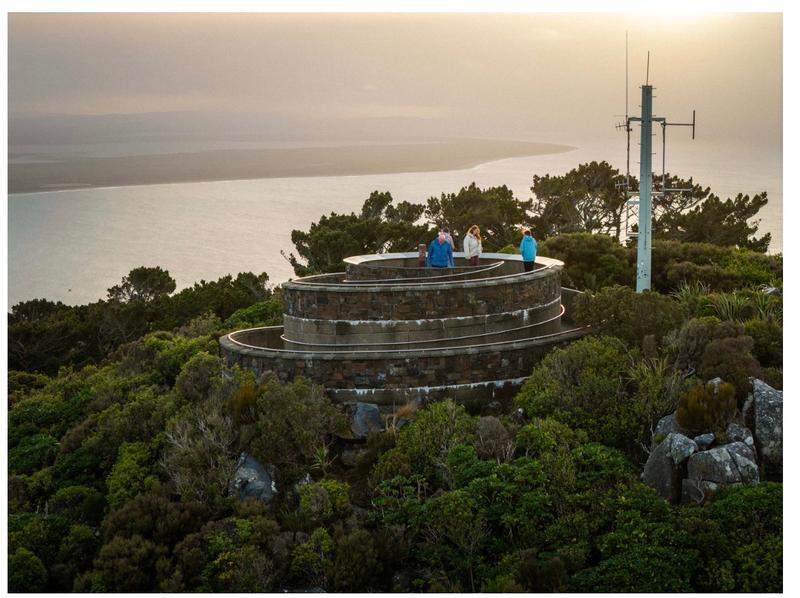
Tohu Whenua has also committed funding for updated interpretation panels along the spiral walkway to the summit.
That means the visitor experience can shift from simply seeing the landscape to understanding it.
Bluff is already thinking bigger
The recognition also arrives as wider plans are being considered for Motupōhue.
Bluff planning documents identify the hill as part of a flagship visitor project that could include improved parking, cultural interpretation, pouwhenua and stargazing experiences.
That creates an interesting opportunity.
If managed carefully, Motupōhue can become a stronger tourism destination without being reduced to one.
The challenge will be ensuring visitor growth follows the cultural and environmental significance of the place rather than overwhelming it.
That balance matters particularly at sites where heritage is living rather than simply historical.
“Part of who we are”
Invercargill Mayor Tom Campbell said the recognition reflected the mountain’s importance to generations of people in Bluff and Invercargill.
“Motupōhue is part of who we are as a community,” he said.
That may be the simplest explanation of why this recognition matters.
A tourism programme has added another destination to its national network.
But for Bluff, the significance is more personal.
Motupōhue has always been there.
Watching over the harbour.
Guiding movement across the strait.
Carrying histories from before European settlement through war, communication, conservation and modern recreation.
The Tohu Whenua designation does not make the mountain important.
It recognises that it already was.
And by becoming the first mauka in the programme, Motupōhue may also broaden the way New Zealand thinks about heritage itself.
Not every historic place has walls. Some have been standing much longer than anything we could ever build.
Photo credit: Wade McClelland / Tohu Whenua
Was this article useful?