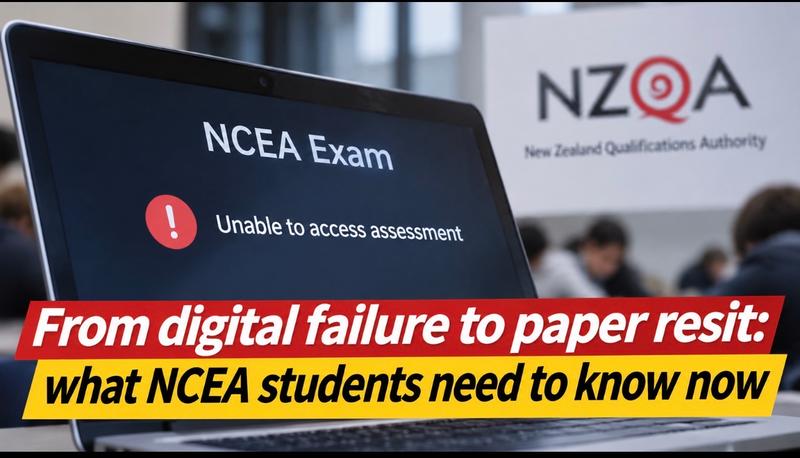
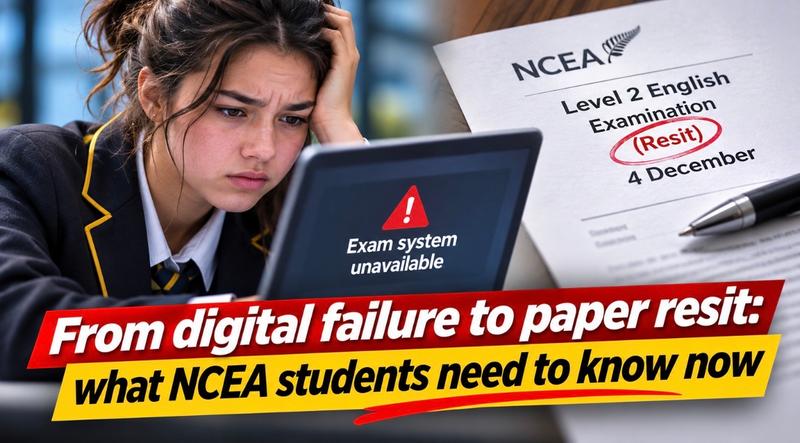
From digital failure to paper resit: what NCEA students need to know now
After weeks of exam disruption, lost work and growing doubts over New Zealand’s digital assessment system, NZQA is now assuring Level 2 English students that they will not be...
After weeks of exam disruption, lost work and growing doubts over New Zealand’s digital assessment system, NZQA is now assuring Level 2 English students that they will not be turned away from the 4 December resit because of a registration deadline.
By Webfit News Education Desk | 25 November 2026
What began as a technical problem during an English exam has now become a much bigger test of confidence in New Zealand’s assessment system.
Students have been locked out.
Some reported losing work.
Schools have scrambled for paper backups.
A second major English exam suffered another slowdown days later.
And now, thousands of students are being offered something highly unusual in the NCEA system:
another chance to sit the exam.
The latest reassurance is important.
Students eligible for the additional NCEA Level 2 English exam on 4 December will not be turned away simply because their school did not meet NZQA’s initial notification deadline.
That removes one more layer of anxiety from a group of students who have already had an unusually difficult examination season.
But it also highlights how far the system has moved from where it was supposed to be.
A digital examination designed to make assessment easier has ended with NZQA preparing a nationwide paper-based replacement.
The problem did not begin with one outage
Webfit News first reported concerns earlier this month after approximately 120 Year 13 students at St Andrew’s College in Christchurch were unable to complete their NCEA Level 3 English examination because of a computer systems failure.
Those students were moved toward derived grades because there were not enough printed papers available to allow everyone to continue the examination.
At the time, the incident looked like a serious but localised failure.
It did not stay localised for long.
The following day, on 12 November, NZQA’s digital assessment platform suffered a significant nationwide disruption during the NCEA Level 2 English examination.
Tens of thousands of students were entered for the exam.
Some could not log in.
Others were locked out after starting.
Some students reported seeing written work disappear.
Schools switched students to paper where possible, while others relied on additional time or the derived-grade process.
NZQA later acknowledged the disruption had been significant enough to affect students’ ability to demonstrate what they knew.
That became the basis for the extraordinary decision to offer another exam.
Then it happened again
NZQA spent the weekend testing its system and said it had received assurances from its technology provider that the platform was ready.
Then came the Level 1 English examination on 17 November, the largest digital exam of the year.
The platform slowed again.
NZQA said the disruption lasted about 20 minutes before the system returned to full operation.
Students were able to continue, and printed backup papers were available.
The disruption was less severe than the Level 2 failure, but its significance was hard to ignore.
New Zealand had experienced major problems in two high-profile English exams within days.
NZQA chief executive Christian Hawkesby said the performance had fallen short of expectations and announced a full independent review, including scrutiny of the technology provider.
By then, the issue was no longer simply whether one examination had malfunctioned.
The question had become whether schools and students could trust the digital platform at all.
The 4 December resit: who can sit it?
NZQA has scheduled an additional paper-based Level 2 English examination for Friday, 4 December.
The opportunity is open to students who were entered for the original Level 2 English examination on 12 November.
It is optional.
Students do not have to sit it.
And importantly, they cannot make their final result worse by trying again.
For students affected by the digital disruption, NZQA will compare the available results and use the best applicable grade.
Depending on the student’s circumstances, that may include:
the grade from work completed on 12 November;
a derived grade based on previous evidence;
the result from the 4 December examination.
Students whose schools had entered everyone on paper can also choose to sit the additional exam and receive the better of their two exam results.
That means the resit is genuinely another opportunity rather than a gamble.
What about the registration deadline?
Schools were asked to tell NZQA how many students intended to sit the additional exam so the authority could arrange rooms, supervision and printed papers.
That created understandable concern for students who were still deciding whether another examination was worth the effort.
The latest position is that eligible students will not be turned away from the resit simply because the initial notification deadline has passed.
That distinction is important.
The deadline helps NZQA and schools plan the exam.
It is not intended to become another barrier for students already affected by the original failure.
Students who are still uncertain should contact their school as soon as possible rather than assuming they have missed their chance.
Why would a student choose to sit again?
That decision is more complicated than it first appears.
Some students will see the additional examination as an obvious opportunity.
If their original work was badly disrupted, incomplete or lost, sitting again gives them another chance to demonstrate their ability.
Others may reasonably decide they have had enough.
Examination preparation takes time.
The original Level 2 English exam was on 12 November.
The replacement is on 4 December, extending the assessment season by more than three weeks for students who may already have completed their other exams and mentally moved on from school for the year.
There is also a practical issue.
The resit will be completed on paper.
For students accustomed to writing extended essays on a keyboard, handwriting an entire English examination may feel very different.
That does not make the paper exam unfair.
But it does mean students are being asked to change assessment format because the digital system failed, not because they chose to.
The replacement exam itself has raised questions
NZQA says the paper being used for 4 December was already under development for the 2027 examination cycle and had been going through its normal preparation process.
That is significant because external exams are not normally created in a matter of days.
They require development, checking, moderation and quality assurance.
The New Zealand Association for the Teaching of English has questioned whether the replacement examination can be prepared to the required standard within such a compressed timeframe.
NZQA says it is completing the remaining work with both pace and care.
Students should not have to worry about whether one version of an exam is easier or harder than another.
That is NZQA’s responsibility.
But after everything that has happened this month, those questions are understandable.
This is no longer only an IT problem
The technical failures have naturally attracted most of the attention.
But the deeper problem is confidence.
A high-stakes examination system depends on something very simple:
Students must believe that if they prepare properly, arrive on time and do the work, the system will reliably record and assess what they produce.
Once that confidence is damaged, every other question becomes harder.
Should I type or use paper?
Will my work be saved?
What happens if the screen freezes?
Should I trust my derived grade?
Should I sit the exam again?
Those are questions students should not have to be asking while trying to demonstrate their knowledge.
Paper has gone from backup to rescue plan
There is also an uncomfortable irony in the way this examination season has unfolded.
Digital assessment was supposed to modernise the examination experience.
Instead, paper has repeatedly become the safety net.
After the Level 2 disruption, schools were told to strengthen contingency arrangements.
NZQA subsequently made paper backups available for remaining digital exams.
Now the replacement Level 2 English examination itself will be entirely paper-based.
That does not mean digital examinations should automatically be abandoned.
Technology can provide real advantages, particularly for students who type more comfortably than they handwrite and for some students with additional assessment needs.
But digital assessment only works if reliability is treated as non-negotiable.
A platform that works almost all the time is not necessarily good enough when tens of thousands of students are sitting the same high-stakes examination at once.
Teachers are already asking what happens in 2027
The New Zealand Association for the Teaching of English has warned that some schools may reconsider whether they want students sitting digital examinations next year.
That may prove to be one of the lasting consequences of the 2026 exam season.
Schools have spent years adapting to digital assessment.
Students increasingly work digitally throughout their education.
Returning wholesale to handwritten examinations would itself create problems.
But schools also have a duty to minimise avoidable risk for students.
If teachers no longer trust the platform, simply telling them the technology has been fixed may not be enough.
Confidence will need to be rebuilt.
The independent review matters
NZQA has announced a full independent review of the digital examination failures.
That review now has several important questions to answer.
What caused the Level 2 outage?
Why did another disruption occur during Level 1 English after extensive testing?
Was system capacity the problem?
Did the technology provider meet its obligations?
Were backup arrangements adequate?
And why did some schools appear better prepared to switch to paper than others?
The review should also examine what happened before the exams.
NZQA says similar problems occurred in 2023, while the system performed well through 2024 and 2025.
If known risks existed, students and parents deserve to understand what safeguards were put in place and why they were not sufficient this year.
For students overseas, this is what the story actually means
NCEA can be confusing even for families living in New Zealand.
For readers overseas, the important point is that NCEA is New Zealand’s national secondary-school qualification.
Level 2 is commonly undertaken by Year 12 students, generally aged around 16 or 17.
External examinations contribute to students’ subject results and can also matter for future study.
English is particularly important because achievement in English standards can contribute towards literacy requirements associated with further education.
So this was not simply an online classroom test going down.
It was disruption during a national qualification examination being sat by thousands of young people at the same time.
That is why the response has become a national education issue.
What students need to know now
For students affected by the Level 2 English disruption, the immediate position is much clearer than it was two weeks ago.
The 4 December examination is optional.
It will be paper-based.
Eligible students should not be turned away simply because of the earlier notification deadline.
Sitting it cannot lower the grade they would otherwise receive.
And NZQA will use the best applicable result available under the student’s circumstances.
Students who are unsure about whether to sit should speak directly with their school.
That conversation should include their original exam experience, their likely derived grade, how comfortable they are completing a full paper examination and whether another attempt gives them a realistic opportunity to improve their result.
The student should not carry the cost of the system failing
There is no perfect remedy for what happened on 12 November.
Students cannot simply recreate the preparation, concentration and examination conditions of that morning.
Some had work interrupted.
Some lost confidence.
Some had to switch formats in the middle of an exam.
Others may now have to return to school weeks later and sit the entire assessment again.
NZQA’s decision to offer another examination is therefore not a bonus opportunity.
It is an attempt to repair a situation students did not create.
That distinction matters.
The resit is necessary because the system failed them first.
And if there is one principle that should guide every decision from here, it is this:
No student should lose a grade, an opportunity or a future pathway because the technology designed to assess them failed to do its job.
That includes making sure an administrative deadline does not become yet another obstacle.
The 4 December exam may help resolve individual results.
The much bigger test will come afterwards.
Can NZQA convince students, parents and schools that when digital examinations return, the system will be ready before the students are asked to trust it again?