It also warned that some usual products and services could be delayed or limited until the centre reopened.
The PSA said this was the first closure since the centre opened in 2018.
Why the centre matters
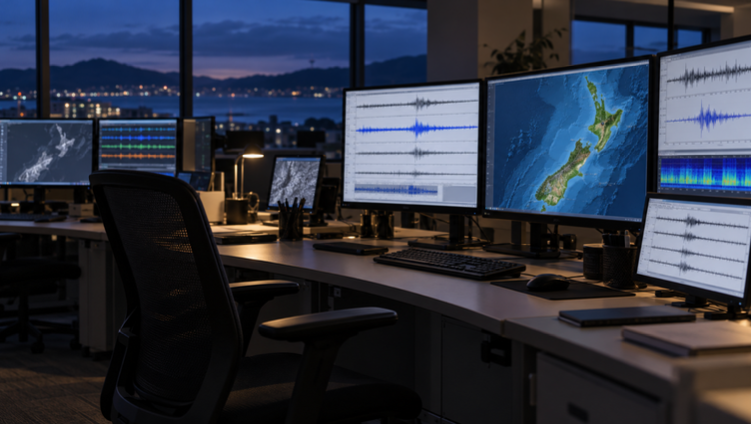
The National Geohazards Monitoring Centre normally provides around-the-clock monitoring of earthquakes, tsunami, volcanic activity and landslides.
Analysts review incoming information, assess unusual activity and call in specialist scientists when further investigation is needed.
That work supports advice to the National Emergency Management Agency and other decision-makers.
Earth Sciences New Zealand says the centre’s opening in December 2018 improved the speed and quality of scientific advice during natural-hazard events, when minutes can make a critical difference.
For the public, the distinction is between instruments collecting information and trained people continuously interpreting it.
A functioning sensor network is essential. The monitoring centre adds the human assessment needed to understand what that information means.
What the PSA says
PSA national secretary Fleur Fitzsimons blamed government cuts for the staffing shortage and said the union had previously warned that reduced staffing could force temporary closures.
“Geohazard monitoring is not a nice to have,” she said.
Fitzsimons argued that maintaining the service was a basic public-safety responsibility in a country exposed to earthquakes and tsunami.
She called for funding to be restored and for Prime Minister Christopher Luxon to take responsibility for the closure.
The union also challenged National’s campaign message about fixing the basics, arguing that reductions in essential scientific services contradicted that promise.
The claim that government cuts caused the closure is the PSA’s position. GeoNet’s public notice confirmed the disruption but did not itself establish that causal link.
A team reduced by a quarter
According to the PSA, the team monitoring live earthquake data had fallen from 20 staff to 15, a reduction of 25 percent.
The union said fewer analysts meant less flexibility to maintain continuous coverage when staff were unavailable.
It cited former geohazard analyst Caleb Rapson Nuñez del Prado, who took redundancy following the reduction in his team.
According to the PSA’s release, he had previously warned that staffing pressures could sometimes force monitoring to move from a continuously staffed service to an on-call arrangement.
The union argued that Friday’s closure demonstrated the consequences of those pressures.
These staffing figures and the account of the earlier warning were supplied by the PSA.
What could the consequences be?
The confirmed immediate concern was possible delays or limitations in services, rather than a complete loss of monitoring capability.
GeoNet’s normal operating model involves analysts assessing live data and escalating concerns to duty scientists and specialist panels. A gap in that continuously staffed service removes a layer of immediate human assessment.
The PSA warned that repeated closures could weaken preparedness, particularly during a fast-developing emergency.
However, the material reviewed for this article did not identify a specific missed warning or delayed emergency response resulting from Friday’s closure.
The union is raising a concern about the system’s resilience, rather than documenting a disaster caused by this particular shift closure.
Funding and accountability under scrutiny
Fitzsimons argued that staffing capacity should be treated as a safeguard, rather than simply an expense that could be reduced.
Her central point was that public-safety services need enough people to cope with unexpected absences and emergencies while maintaining their normal work.
The PSA is seeking urgent funding and assurances that the centre can remain staffed around the clock.
The closure raises practical questions about minimum staffing, backup arrangements and how service interruptions will be communicated.
GeoNet’s assurance that scientists remained ready to respond provides important context. The unresolved issue is whether the centre has sufficient staffing to maintain its usual continuous coverage reliably.
Sources: PSA media release supplied to Webfit News; GeoNet closure notice and monitoring-centre information; Earth Sciences New Zealand.