This is where the logic collapses.
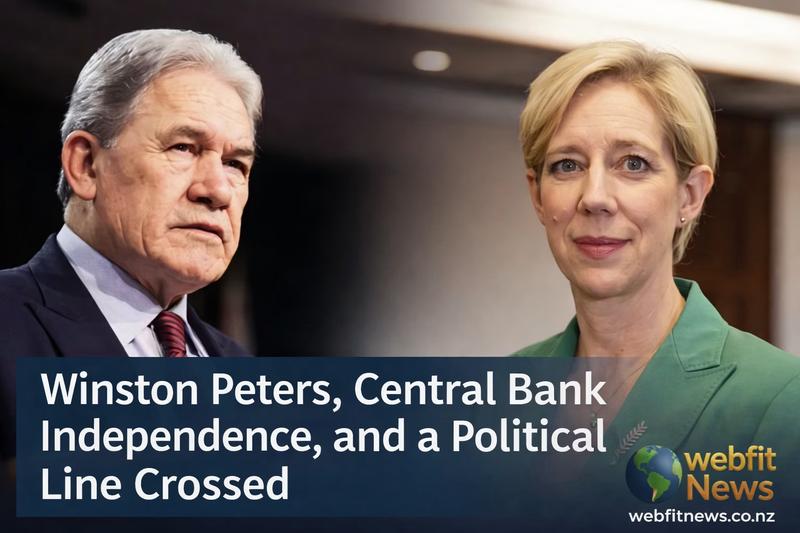
Central bank independence is not a decorative principle. It exists precisely to prevent politicians from instructing monetary authorities on what they may say, think, or do. For a Foreign Minister to publicly chastise a central banker for defending independence is not merely ironic. It actively undermines the very principle he claims to protect.
Breman did not stray into diplomacy. She acted within her mandate as head of an institution whose credibility depends on its insulation from political pressure. Requiring ministerial sign-off before expressing solidarity with peers would convert independence into a conditional privilege.
A global norm, not a New Zealand aberration
Perhaps the most revealing aspect of the episode is how isolated New Zealand appears in this response. The letter Breman signed was co-signed by the heads of the European Central Bank, the Bank of England, the Reserve Bank of Australia, the Bank of Canada, the Swiss National Bank, and others. None of those governments publicly reprimanded their central bank governors.
No British minister told Andrew Bailey to stay in his lane. No Australian minister warned Michele Bullock to keep quiet. No European politician accused Christine Lagarde of freelancing.
Only New Zealand chose to turn a routine act of professional solidarity into a political drama.
That raises an uncomfortable question. Why?
Fear of displeasing Washington
The most plausible explanation is not constitutional principle but political caution. Peters suggested that MFAT would have advised Breman against signing the letter. If that is true, it suggests a foreign policy driven less by norms than by anxiety.
The anxiety, in this case, appears to centre on Donald Trump.
The letter implicitly criticised Trump’s treatment of Powell. While it avoided naming him, the context was unmistakable. Peters’ reaction reads less like a defence of process and more like a pre-emptive apology to Washington. Do nothing. Say nothing. Avoid offence at all costs.
This is not neutrality. It is deference.
New Zealand has long claimed an independent foreign policy grounded in international law and multilateral norms. Yet here, the instinct seems to be silence when those norms are threatened, if defending them might irritate a powerful ally.
The slippery slope
Once this logic is accepted, it does not stop with central banking.
If a Reserve Bank Governor must seek political approval before defending institutional independence, what about judges speaking at international legal forums? What about academics criticising authoritarianism abroad? What about diplomats quietly objecting to breaches of international law?
The principle becomes simple and corrosive. If it might offend Washington, keep quiet.
That is not how mature democracies behave. It is how small states make themselves smaller.
Vanity as governance
There is a personal dimension here that cannot be ignored. Winston Peters has always been acutely sensitive to perceived slights. Age has not mellowed that instinct. If anything, it has sharpened it. The offence taken here was imaginary, but the response was real and public.
The performance was not about Breman’s conduct. It was about Peters reasserting relevance and authority. About reminding institutions who he believes is in charge.
Yet governance by vanity is a poor substitute for leadership. It prioritises ego over credibility and posturing over principle.
The cost to New Zealand
New Zealand Stays Silent as Trump Escalates Venezuela Crisis – WebfitNews
The damage from this episode is subtle but real. It sends a signal to international partners that New Zealand’s institutional independence is negotiable. It tells domestic officials that defending global norms may carry political risk. It reinforces the perception that Wellington is cautious to the point of timidity when power politics intrude.
Most of all, it weakens trust. Not in Anna Breman, whose actions were defensible and orthodox, but in a political class that appears more concerned with not offending than with standing for something.
The takeaway
This was never about a letter. It was about whether New Zealand still believes in the principles it claims to uphold.
Central bank independence matters. Speaking up for it matters. Doing so without asking permission matters.
When a Foreign Minister treats that as a disciplinary issue, the problem is not the governor. It is the politics.
Webfit News takeaway:
New Zealand did not look strong in this episode. It looked nervous. And when governance is driven by fear and vanity rather than principle, independence becomes performative, not real.