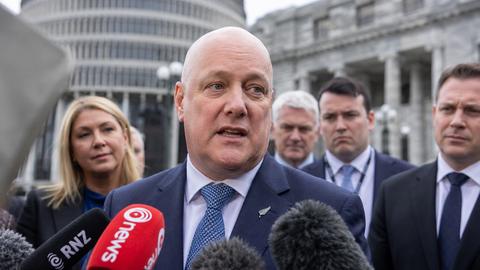
Mike Butterick narrowly leads Kieran McAnulty. If special votes reverse the result, National could lose an extra seat in Parliament while Labour’s overall tally stays unchanged.
By Webfit News | 9 November 2026
Mike Butterick narrowly leads Kieran McAnulty.

Mike Butterick narrowly leads Kieran McAnulty. If special votes reverse the result, National could lose an extra seat in Parliament while Labour’s overall tally stays unchanged.
By Webfit News | 9 November 2026
Just 139 votes separate National’s Mike Butterick and Labour’s Kieran McAnulty in Wairarapa, where an unfinished local contest could have consequences for the next government.
Butterick leads with 17,943 candidate votes against McAnulty’s 17,804 in the preliminary count. All 85 voting-place results have been reported, but special votes and the official recount remain outstanding.
The immediate question is who becomes Wairarapa’s electorate MP. The less obvious question is whether the result removes one of National’s additional seats and makes Parliament smaller.
Why this seat matters nationally
The preliminary national allocation gives National, ACT and New Zealand First a combined 67 seats in a projected 131-seat Parliament. An outright majority requires 66.
National currently has more electorate victories than its party vote would ordinarily entitle it to. Those additional electorate seats create an overhang, expanding Parliament beyond its usual size.
If McAnulty wins Wairarapa, with all other electorate results and party-vote entitlements unchanged, National would lose one overhang seat.
Labour would ordinarily exchange a list seat for McAnulty’s electorate seat, leaving its total unchanged.
Under that scenario, Parliament would shrink to 130 MPs. National, ACT and New Zealand First would hold 66 seats, exactly the number needed for an outright majority.
Wairarapa changing hands would therefore narrow their advantage without, by itself, removing their majority. Other close electorates and changes in the party vote could further alter that calculation.
From comfortable margins to almost nothing
The two leading candidates have each experienced a much clearer victory.
In 2020, McAnulty won 22,042 votes against Butterick’s 15,497, a majority of 6,545.
In 2023, Butterick reversed the result, securing 20,313 votes against McAnulty’s 17,497, a majority of 2,816.
His current preliminary advantage is less than one-twentieth of that final winning margin.
The comparison needs care. Electorate boundaries have changed, and this year’s figures exclude the remaining count. Nevertheless, a seat that delivered decisive results at the previous two general elections is now exceptionally close.
Both candidates are outperforming their parties locally
Wairarapa’s figures also show why the electorate contest cannot be understood through party support alone.
Butterick’s 17,943 candidate votes exceed National’s 12,804 local party votes by 5,139.
McAnulty’s 17,804 exceed Labour’s 11,940 by 5,864.
National leads Labour by 864 party votes in the electorate. Between the candidates, that advantage falls to 139.
These totals demonstrate different patterns in the two votes. They do not reveal precisely how individual residents split their ballots or why.
Both candidates brought experience representing Wairarapa into the campaign. Butterick is the incumbent and an Associate Minister of Agriculture. McAnulty previously held the electorate and chaired Labour’s election campaign.
Their personal standing therefore deserves attention alongside the national contest.
The local pressures behind the campaign
Cost of living, transport and funding for Wairarapa Hospital featured in the candidates’ pre-election discussion on Newstalk ZB.
These are practical concerns for residents: paying household bills, accessing healthcare and travelling around the region.
Their prominence establishes what the candidates debated. It does not prove which issue produced the close result.
New Zealand First’s Ron Mark added another significant presence, receiving 3,555 candidate votes. But those votes cannot simply be assigned to either leading candidate in a hypothetical contest without him.
Mark previously contested Wairarapa in 2020, receiving 3,278 votes. His support is part of the electorate’s longer political history.
Special votes could decide it, but history offers no guarantee
Assuming no other corrections, McAnulty needs 140 more votes than Butterick receives in the remaining count to move ahead.
That is a net advantage of 140, rather than simply another 140 votes.
There is also a reason to avoid assuming special votes will automatically favour Labour.
In 2023, Butterick’s election-night lead of 2,481 increased to 2,816 after the official count. That does not predict this year’s outcome, but it shows why both candidates must wait.
All voting places reporting does not mean every eligible vote has been counted. Ordinary votes are recounted and special votes checked before the official results, scheduled for Friday, 27 November.
For Wairarapa, the remaining count will determine its local representative. For the country, it could also reduce the governing parties’ margin for error.
Sources: Electoral Commission preliminary and historical results; Newstalk ZB’s Wairarapa candidate discussion; Hawke’s Bay Today election reporting.
Was this article useful?