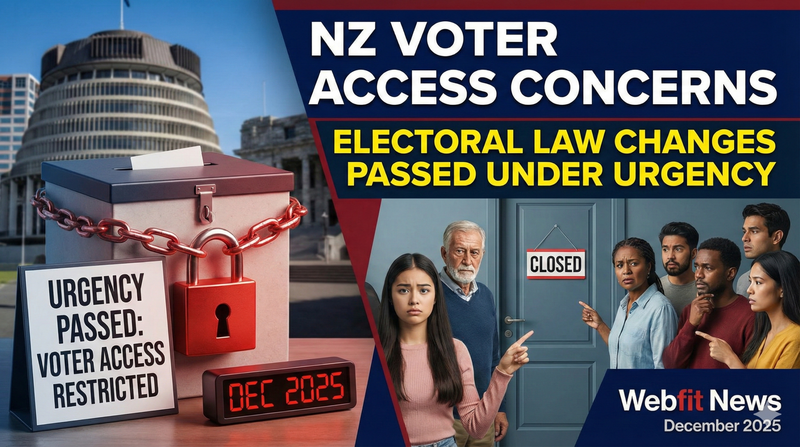
New Zealand’s Parliament has passed changes to electoral enrolment rules under urgency, triggering concern from opposition parties and community groups who warn the move could prevent thousands of voters from having their say in the next general election.
The changes limit the ability of voters to update or correct their enrolment details close to election day. In previous elections, voters were able to enrol or make changes later in the campaign period. Under the new rules, those late updates will no longer be accepted, meaning some votes could be excluded if enrolment details are not finalised earlier.
What Has Changed
According to figures referenced during parliamentary debate, around 20 percent of voters changed their enrolment details in the final weeks of the last election. Those voters would be affected under the new system if similar behaviour occurs again.
The government has argued the changes will improve administrative certainty and reduce pressure on election-day processing. However, critics say the timing and process of the reform raise serious questions.
The legislation was passed using urgency, which limited select committee scrutiny and public submissions.
Voter Access and Suppression Concerns
Opposition MPs and advocacy groups have described the change as a form of voter suppression, arguing it disproportionately affects voters who are already less engaged with the political system.
Concerns have been raised that the impact will fall more heavily on young voters, renters, and multicultural communities, where people are more likely to change addresses or update details closer to an election.
Some critics have drawn comparisons to voter access debates in the United States, where changes to enrollment and voting rules have been widely contested.
Impact on Multicultural Communities
In areas such as Mount Roskill in Auckland, where large multicultural and migrant communities live, local organisers say enrolment can already be challenging due to language barriers, limited access to official information, and unfamiliarity with the voting system.
Community leaders argue that removing flexibility late in the election cycle risks silencing voices that already face barriers to participation.
Several groups have announced plans to increase voter enrolment efforts well ahead of the next election to reduce the risk of votes being lost.
Government Response
The government has rejected claims of voter suppression, stating the changes are about improving efficiency and ensuring the integrity of the electoral process.
Ministers have said voters still have ample time to enrol and that responsibility ultimately lies with individuals to ensure their details are correct before deadlines.
However, critics argue that modern elections should be designed to maximise participation rather than restrict it.
What Voters Need to Know
With the new rules now in place, voters are being urged to check and update their enrolment details as early as possible.
Failure to do so could mean being unable to vote if details are incorrect or outdated close to election day.
The Electoral Commission is expected to release updated guidance explaining the new deadlines and enrolment requirements in the lead-up to the next general election.
Looking Ahead
The debate has reignited broader questions about how electoral law changes are made in New Zealand and whether urgency should be used for reforms that affect democratic participation.
As preparations begin for the next election cycle, voter awareness and early enrolment are likely to become central issues, particularly in communities most at risk of being left out.
Webfit News will continue to follow developments and provide updates on what voters need to know.
Electoral Law Changes – Before vs Under Urgency
Area
Previous Rule
Change Passed Under Urgency
What This Means in Practice
Voter enrolment deadline
Voters could enrol or update details close to election day
Late enrolment and updates restricted
Voters who miss the earlier deadline may lose their vote
Address updates
Allowed during the final weeks of the campaign
Not permitted close to election day
People who move house late may be unable to vote
Name corrections
Late enrolment and updates are restricted
Corrections restricted
Errors may result in ballots being rejected
Use of urgency
Rare for electoral law
Used to fast-track changes
Limited public consultation and debate
Time for public awareness
Several weeks to adapt
Immediate effect
Higher risk of confusion for voters
Who Is Most Likely to Be Affected
Group
Why They Are Impacted
Risk Level
Renters
More likely to change address close to elections
High
Students
Often move during exam and semester periods
High
Multicultural communities
Language barriers and enrolment complexity
Medium to High
First-time voters
Less familiarity with enrolment rules
Medium
Low-income households
Less access to timely information
Medium
Long-term homeowners
Details already stable
Low
What the Changes Mean – And What They Do Not Mean
Topic
What It Means
What It Does NOT Mean
Voting rights
Enrolment timing now matters more
Voting itself is not abolished
Election day voting
Must already be correctly enrolled
You cannot fix enrolment on the day
Citizenship
Rules apply to citizens and residents
Citizenship eligibility is unchanged
Election outcome
Some votes may be lost
Results are not automatically invalid
Democracy
Process becomes stricter
Elections are not cancelled
Government Position vs Public Concern
Perspective
Key Argument
Government position
Changes improve efficiency and administrative certainty
Supporters of urgency
Reduces last-minute errors and delays
Critics
Limits participation and public input
Civil society concern
Risk of voter suppression
Community groups
Fear lower turnout in marginalised areas
Why This Matters for Democracy
Issue
Impact
Reduced flexibility
Less room to correct genuine mistakes
Public awareness gap
Many voters may not know rules changed
Trust in elections
Perception of fairness may be affected
Voter turnout
Risk of lower participation
Long-term precedent
Future electoral laws may also bypass consultation