Waiting for him at the crease was Bert Sutcliffe, who had already shown extraordinary courage of his own. Sutcliffe had been struck several times by the cricket ball while batting and had even gone to hospital before returning to the field. Bloodied and battered, he stood ready to continue.
When Blair appeared, the crowd of 23,000 fell silent. Players from both teams were moved to tears. It was one of those rare sporting moments where the result of the match became secondary to something much deeper.
Blair and Sutcliffe added 33 runs for the last wicket. Their stand included a remarkable 25 runs from a single over bowled by Hugh Tayfield, which became a world record at the time. Blair was eventually stumped, but the meaning of that innings had already been written.
As the two New Zealanders left the field, the Ellis Park crowd rose to give them a thunderous standing ovation.
It remains one of the most emotional and respected moments in cricket history. It was not just about runs. It was about courage under unbearable pain. It was about a young man grieving the loss of the woman he loved, yet finding the strength to stand with his teammates.
That story continued to shape the relationship between New Zealand and South African cricket. In 2024, New Zealand Cricket and Cricket South Africa jointly introduced the Tangiwai Shield for men’s Test series between the two nations. The trophy was created to honour the bond formed through the events of that 1953 Test and the memory of the Tangiwai rail disaster.
The Tangiwai Shield was crafted from New Zealand native pūriri timber and pounamu sourced from the Tangiwai region. It stands as a tribute not only to Blair and Sutcliffe, but also to the lives lost in the disaster and the spirit shown by both teams during that historic match.
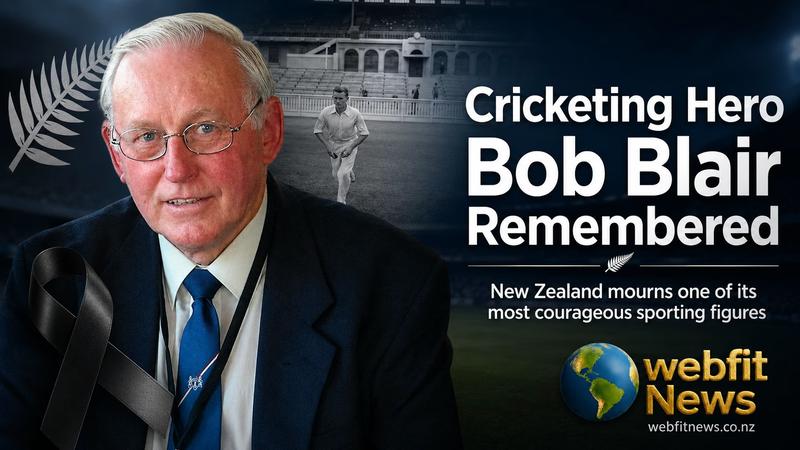
Blair was the last surviving New Zealand player from that Test.
New Zealand Cricket interim CEO Graham Parks paid tribute to Blair and the legacy he leaves behind.
“The story of Bob Blair and the Tangiwai rail disaster has left an indelible mark on cricket in both New Zealand and South Africa,” Parks said.
“The courage and camaraderie shown during the second Test in South Africa in 1953 and in the years that followed epitomises everything that is great about sport.
“To have been able to honour that inspirational story with the introduction of the Tangiwai Shield in 2024 was both poignant and will ensure the legacy of Bob Blair lives on.
“The cricket community extends its deepest condolences to Bob’s wife Barbara, his children, grandchildren, and great-grandchildren, and all who loved him.”
Blair’s cricket career continued long after the 1953 tour. He played for New Zealand for another decade and fittingly ended his international career against South Africa in Auckland in 1964. In that match, he produced his best Test figures, taking 7 wickets for 142 runs.
His domestic career was marked by consistency and dominance. During the 1956-57 season, Blair took 46 wickets at an average of just 9, twice claiming nine wickets in an innings. Those numbers reflected not only his natural pace, but also his skill, accuracy and hunger as a fast bowler.
After retiring from international cricket, Blair never drifted far from the game. He continued playing cricket into his 60s and captained Lancashire Over-50s in county competition. In total, his involvement in playing cricket stretched across more than 40 seasons.
He also gave back to the sport through coaching, working with clubs and associations in Queensland, Zimbabwe, South Africa, Northern Ireland and England. His life in cricket was not limited to New Zealand, but his connection to his homeland remained strong.
Blair later settled in Cheshire, England, with his wife Barbara, whom he married in 1986. He retained a lifelong love of cricket, golf and New Zealand, and made time to reconnect with former teammates whenever he returned home.
The story of Bob Blair and Nerissa Love has inspired books, a television film and a stage play. It has become more than a cricket story. It belongs to New Zealand’s wider history because it speaks to love, loss, courage and national identity.
As a mark of respect, the BLACKCAPS will wear black armbands on the first day of the third Test against England in Nottingham on Thursday.
Bob Blair’s numbers will remain in cricket records, but his legacy will always be measured by something greater than statistics.
He will be remembered as a fast bowler, a teammate, a coach and a proud New Zealander.
Above all, he will be remembered as a man who walked out to bat while carrying unimaginable grief, and in doing so, gave New Zealand sport one of its most enduring stories.