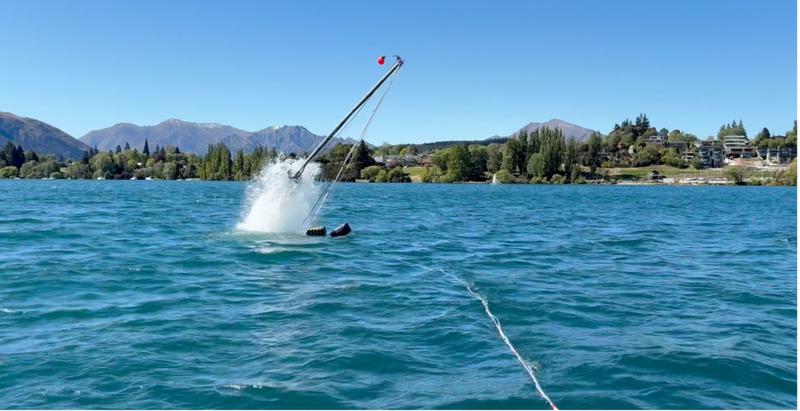
And while the research confirms that the lake continues to have good water quality, it also identifies something that deserves attention: ecological changes have accelerated in recent decades, particularly in Roys Bay and Glendhu Bay.
The message is not that Lake Wānaka is in crisis. It is that a lake can remain clear and beautiful while important changes are taking place beneath its surface.
A thousand years of history, preserved in the lakebed
The research was led independently by Lincoln University and co-funded by Otago Regional Council and the Ministry for Cities, Environment, Regions and Transport.
Rather than relying only on modern water samples, scientists examined sediment cores collected from the bottom of Lake Wānaka.
These cores contain layers of material that have accumulated over centuries, preserving traces of the environments that existed when those layers were deposited.
They are, in effect, a natural archive.
Researchers studied pollen, microscopic fossils, environmental DNA and detailed images of the sediment to reconstruct changes in the lake and its surrounding catchment over more than a millennium.
Each type of evidence helps tell a different part of the story.
Pollen can provide clues about vegetation growing around the lake. Microscopic remains offer information about organisms that once lived in its waters. Environmental DNA helps scientists identify biological communities whose traces have been preserved in the sediment.
Together, these indicators provide a much longer perspective than modern monitoring alone can offer.
Hugo Borges, Otago Regional Council’s Senior Scientist for Lakes, explained that the approach allows researchers to trace changes across generations.
“By examining pollen, microscopic fossils, environmental DNA and detailed images of the sediment, we can see how the environment around Lake Wānaka has changed over time.”
The significance of the study lies in that long historical record. It gives scientists a way to compare the lake’s present condition with what existed centuries before modern development.
How human settlement changed the landscape
The sediment record reveals that Lake Wānaka’s surrounding environment has not remained unchanged over the past thousand years.
Researchers identified significant shifts in catchment vegetation following Māori arrival in the region approximately 700 years ago.
Further changes appeared from around 1850, coinciding with European settlement.
These findings establish important periods in the environmental history of the lake and its catchment.
However, the research does not suggest that every historical change was harmful or that the lake was previously an entirely undisturbed ecosystem.
What it demonstrates is that changes in the surrounding landscape can leave a lasting record in the lake itself.
That connection is particularly relevant today.
A lake is influenced not only by what happens in its waters, but also by what happens across the land that drains into it.
Sediment, nutrients and other materials can enter through waterways and runoff, affecting the conditions in which aquatic organisms live.
Understanding that relationship is central to protecting Lake Wānaka as its surrounding environment continues to change.
Roys Bay and Glendhu Bay show more recent changes
Among the most important findings are changes recorded in two well-known parts of Lake Wānaka: Roys Bay and Glendhu Bay.
Both are closely associated with the wider Wānaka landscape, but the sediment evidence suggests their ecological histories have developed differently over recent decades.
Roys Bay: Changes evident since the 1980s
In Roys Bay, researchers identified noticeable ecological changes dating back to the 1980s.
These included an increase in what is commonly known as lake snow, a term used for suspended organic material that can appear as fine, cloudy particles in freshwater.
The study identified changes across a range of microscopic organisms, including algae and bacteria.
The findings suggest that the biological conditions within the bay have shifted over time.
Glendhu Bay: Increasing changes since around 2000
At Glendhu Bay, scientists found increasing ecological changes from approximately 2000.
These coincided with a rise in sediment entering the lake.
The relationship is important, although the researchers have not established precisely which factors are responsible for all the observed changes.
In both locations, the evidence points to increasing pressure on the lake environment over recent decades.
The differences between the bays also underline why localised monitoring matters. Conditions and ecological responses may not be identical across such a large lake.
What the changes actually mean
One of the most important distinctions in the study is between water quality and ecological condition.
Lake Wānaka continues to be classified as microtrophic, meaning its waters contain very low concentrations of nutrients and are generally clear.
That is good news.
It means the research should not be interpreted as evidence that the entire lake has suddenly become polluted or unsafe.
But clear water does not necessarily mean that everything within an ecosystem is unchanged.
Microscopic organisms can respond to shifts in their environment, including changes in sediment and nutrient inputs, long before those changes become obvious to someone looking across the water.
The sediment study detected changes in precisely these kinds of organisms.
Borges said the evidence was consistent with increasing pressure from the surrounding catchment, while acknowledging that the exact causes remain uncertain.
“There are clear signs that the lake ecosystem has changed over time.”
He said scientists had observed substantial changes among small organisms sensitive to environmental pressures, but further understanding was needed to establish how the lake might respond in the future.
That uncertainty is significant.
The study has identified changes, but it has not determined whether they will continue at the same pace, accelerate or eventually affect the lake’s clarity.
Those are questions that require continued investigation.
Why this matters to Wānaka and New Zealand
Lake Wānaka is more than a scenic backdrop.
It is closely connected to the identity of the town, the surrounding environment and the experiences of people who live in and visit the region.
Its appeal is built on the combination of mountain landscapes, freshwater and outdoor recreation that makes this part of Otago so distinctive.
Protecting that environment requires understanding not just what the lake looks like today, but how it is changing over time.
That is where this research provides real value.
Modern water-quality monitoring can show scientists what is happening now. The sediment record helps place those observations in a much broader historical context.
Without that perspective, it can be difficult to determine whether a change is unusual, how recently it began or whether it forms part of a longer environmental trend.
The findings also raise practical questions for future catchment management.
If sediment and nutrient pressures are influencing aquatic life, understanding where those pressures originate will be important for decisions about land use, environmental protection and long-term monitoring.
The study does not identify a single development, activity or land-use practice as the cause of the changes.
It would therefore be misleading to attribute the findings to tourism, urban growth, farming or any other individual factor without further evidence.
What the research does establish is a reason to investigate those pressures carefully.
For a place whose natural environment is central to its identity, that knowledge is valuable.
What happens next?
The findings are scheduled to be presented to Otago Regional Councillors at their meeting on 18 November 2026.
The presentation will provide councillors with a scientific account of how the lake and its surrounding environment have changed over the past thousand years.
Lake Wānaka is already part of Otago Regional Council’s deep lake monitoring programme, which provides near real-time information about water quality.
That monitoring allows scientists to observe current conditions and identify emerging trends or concerns.
The new sediment research adds another dimension by showing how present-day observations compare with evidence preserved across centuries.
Together, these approaches can help build a clearer understanding of the lake’s condition.
The immediate findings do not establish that new restrictions or management measures are required. Nor has the council announced specific actions arising from the study in its 11 November release.
The next challenge will be determining what is driving the ecological changes, whether they are continuing and what they may mean for the lake in the longer term.
A beautiful lake with a story still unfolding
There is something remarkable about the idea that a lake can preserve its own history.
Long before modern roads, lakeside developments and the thousands of photographs taken along Wānaka’s shoreline, layers of sediment were quietly accumulating beneath the water.
Those layers now offer scientists a record of environmental change extending back more than a thousand years.
They reveal the influence of human settlement, shifts in the surrounding landscape and increasingly noticeable ecological changes during recent decades.
Yet they also confirm something worth recognising: Lake Wānaka remains a lake with good water quality.
This is not a story about a natural treasure already lost.
It is a story about understanding what makes that treasure valuable, recognising changes that might otherwise go unnoticed and ensuring that future decisions are informed by evidence rather than appearances alone.
For visitors, Lake Wānaka may still look much as it always has.
For scientists, the lakebed tells a more complicated story.
And the most important lesson from that story may be simple: protecting a lake begins long before its problems become visible.