.
New Zealand’s migration numbers are improving, but the latest figures reveal a troubling divide. More people are arriving from overseas while thousands of young New Zealand citizens continue to leave, particularly those aged 18 and 19.
New Zealand’s migration numbers are improving, but the latest figures reveal a troubling divide.

.
New Zealand’s migration numbers are improving, but the latest figures reveal a troubling divide. More people are arriving from overseas while thousands of young New Zealand citizens continue to leave, particularly those aged 18 and 19.
By Webfit News | 12 November 2026
New Zealand is attracting more migrants again, but it is struggling to keep some of its youngest citizens.
New figures released by Stats NZ on Thursday show the country recorded a net migration gain of 22,600 people in the year to September 2026, more than double the gain recorded a year earlier.
On the surface, that is encouraging news.
But behind the positive headline is another figure that deserves attention.
New Zealand recorded a net loss of 11,500 citizens aged 15 to 24, the largest net loss of any age group.
And the increase in young people leaving was particularly noticeable among 18- and 19-year-olds.
These are people at the beginning of their adult lives, often making decisions about university, apprenticeships, employment and where they want to build their future.
The figures raise an important question: why is New Zealand becoming more attractive to people arriving from overseas while so many of its own young citizens continue to look elsewhere?
Migration is recovering, but the numbers tell two stories
According to Stats NZ, 136,100 migrants arrived in New Zealand during the September 2026 year, an increase of 7 percent.
Over the same period, 113,500 people departed, down 3 percent.
That produced a net migration gain of 22,600, compared with approximately 9,900 the previous year.
Stats NZ international migration spokesperson Sarah Drake said the improvement reflected both increased arrivals and fewer departures.
However, the overall figure combines two very different trends.
New Zealand recorded a net gain of approximately 60,400 non-New Zealand citizens.
At the same time, it experienced a net loss of 37,800 New Zealand citizens.
In other words, the country’s population is growing through migration despite more New Zealand citizens leaving than returning.
That distinction is important when assessing whether the country’s economic and social conditions are encouraging people to stay.
Why are 18- and 19-year-olds leaving?
Of the New Zealand citizens who departed during the year, approximately 15,800 were aged between 15 and 24.
That was 6 percent higher than the previous year.
After accounting for young citizens arriving or returning, the net loss for this age group was 11,500.
Stats NZ said the increase in young migrant departures was driven particularly by 18- and 19-year-olds.
This is a significant finding because it points to departures at an earlier stage of life.
For some young people, moving overseas may be about gaining independence, studying, travelling or experiencing a different culture.
For others, employment prospects, earnings, housing affordability or family circumstances may influence the decision.
But the migration figures do not establish why individual young people left.
They also do not tell us how many intend to return.
That means it would be premature to describe every departure as a permanent loss of talent.
Nevertheless, the growing number of departures among teenagers deserves attention from policymakers, educators and employers.
The question New Zealand needs to ask earlier
Much of the public debate about New Zealanders moving overseas focuses on qualified professionals leaving for better salaries and career opportunities.
But the latest figures suggest the discussion also needs to include people who are only beginning to make career decisions.
An 18-year-old considering an apprenticeship, university or their first full-time job is making choices that could influence where they live for years.
If more young people are choosing to begin that journey overseas, New Zealand needs to understand what opportunities they believe are missing at home.
Are they finding it difficult to secure their first job?
Do they see better training and career pathways overseas?
Are living costs influencing their decisions?
Or is overseas travel simply becoming a more attractive part of early adulthood?
These are reasonable questions arising from the figures, not conclusions that the statistics themselves can answer.
The distinction matters because effective policies depend on understanding why people leave, rather than assuming every departure has the same cause.
Migrants from India, China and the Philippines contribute to growth
While New Zealand continues to lose citizens through migration, arrivals from overseas are helping offset those departures.
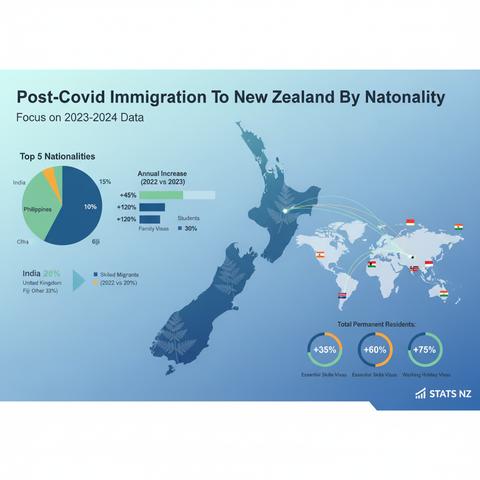
Stats NZ reported that citizens of India, China, the Philippines and Sri Lanka were major contributors to net migration gains.
During the September 2026 year, migrant arrivals included approximately 19,100 Chinese citizens, 17,500 Indian citizens and 11,100 Filipino citizens.
The figures also included around 4,300 Sri Lankan citizens.
These arrivals reflect New Zealand’s continuing connections with international communities and labour markets.
Migrants contribute to businesses, healthcare, education and local communities, although the published figures do not specify the employment or study circumstances of every arrival.
It is also important to remember that citizenship does not necessarily identify where someone previously lived or where they are moving next.
An Indian citizen arriving in New Zealand, for example, may have previously lived in Australia or another country.
The figures measure changes in residence, not simply international passenger movements or new visa approvals.
Is New Zealand replacing the people it loses?
The latest figures may prompt some people to ask whether incoming migrants are replacing New Zealanders who leave.
Numerically, the net gain of non-New Zealand citizens more than offsets the net loss of citizens.
But people are not interchangeable entries in a population spreadsheet.
Someone arriving with years of professional experience may contribute different skills from a teenager leaving to begin university or an apprenticeship.
Equally, a young person leaving New Zealand may eventually return with valuable international experience.
The available migration data does not establish whether the country is gaining or losing particular skills, occupations or qualifications overall.
That is why the distinction between population growth and workforce development matters.
A positive migration figure does not automatically mean every industry has enough workers.
Nor does a high level of citizen departures automatically mean those individuals are gone permanently.
For New Zealand’s long-term planning, both sides of the migration equation need attention.
The economy matters, but the reasons are not yet clear
The migration figures arrive during a challenging period for parts of New Zealand’s economy.
The country’s unemployment rate reached 5.7 percent in the September 2026 quarter, according to Stats NZ.
That provides relevant economic context, particularly for people entering the workforce.
However, the figures do not prove that unemployment caused the increase in young people leaving.
Migration decisions can be influenced by several factors, including employment conditions in New Zealand and overseas, education opportunities, family connections and immigration policies.
Economic conditions in Australia and other potential destinations can also affect decisions.
The latest figures show what is happening.
Understanding why it is happening requires more detailed evidence.
What should happen next?
The immediate policy challenge is not necessarily to persuade every young New Zealander to stay.
Living, studying and working overseas can be valuable experiences.
The more important question is whether young people feel they have a genuine choice.
Can they find worthwhile work in New Zealand?
Are training and apprenticeship pathways accessible?
Can they see a realistic future here after completing their education?
And if they do leave, are there attractive opportunities to return?
These questions matter to families, employers and communities across the country.
They also matter to a government trying to support economic growth while maintaining the skills and workforce New Zealand will need in the future.
A positive headline with an uncomfortable question
New Zealand’s migration recovery is real.
The country recorded more arrivals, fewer departures and a substantially larger net migration gain than a year earlier.
That is an improvement worth recognising.
But the loss of 11,500 young New Zealand citizens aged 15 to 24 shows why the overall migration figure cannot tell the whole story.
The particularly strong increase in departures among 18- and 19-year-olds makes the issue more pressing.
New Zealand is still a country people want to move to. The challenge is understanding why so many of its own young citizens are choosing to move away.
And perhaps the most important question is not how to stop them leaving, but how to make New Zealand a place they can see themselves returning to.
Source: Stats NZ, International Migration: September 2026, released 12 November 2026.
Was this article useful?