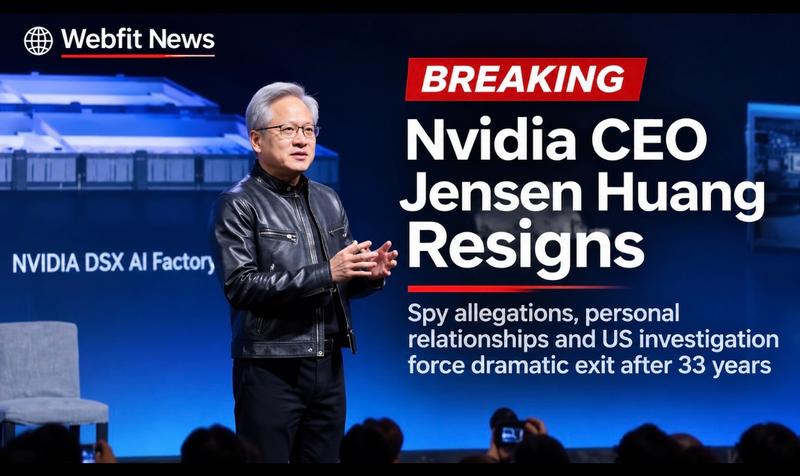
The announcement sent shockwaves through financial markets and raised questions about Nvidia’s future, US-China technology relations and the enormous influence Huang had accumulated.
But while the resignation is confirmed, the most serious allegations surrounding the controversy remain under investigation.
There has been no publicly established finding that Huang knowingly engaged in espionage or disclosed Nvidia’s confidential technology to a foreign intelligence service.
How did the controversy begin?
The crisis developed following reports about Huang’s relationship with Alice Huang, a business executive associated with Singapore-based technology company Megaspeed International.
According to international reporting, US intelligence officials suspect Alice Huang of having links to Chinese intelligence.
The reports raised concerns about whether the relationship could have provided opportunities to influence Nvidia’s leadership or obtain sensitive commercial information.
The situation became particularly serious because Megaspeed has also faced scrutiny over shipments of advanced Nvidia technology.
Such chips are subject to US export restrictions intended to prevent certain high-performance computing systems from reaching China.
Investigators have been examining whether restricted technology was improperly diverted.
However, an investigation is not proof of a violation, and the allegations concerning Alice Huang have not been established in court.
Megaspeed has denied wrongdoing and indicated that it is cooperating with authorities.
Huang publicly apologised before resigning
On 8 November, Huang issued a personal statement acknowledging that he had been unfaithful to his wife.
He apologised to his family, colleagues and Nvidia’s shareholders, accepting responsibility for his conduct.
He also pledged to cooperate with an independent investigation announced by Nvidia’s board.
Initially, the board expressed confidence in Huang and his leadership team.
It said it had no reason at that stage to believe Nvidia’s confidential information or US national security had been compromised.
That position was important.
The company was acknowledging the seriousness of the allegations without declaring that espionage or a security breach had occurred.
But the controversy continued to develop.
International media subsequently reported a separate alleged relationship involving Kimberly Powell, an Nvidia executive associated with the company’s healthcare business.
That introduced additional questions about workplace relationships, potential conflicts of interest and corporate governance.
The reported relationship involving Powell is separate from the allegations concerning Alice Huang. There is no established evidence linking Powell to the suspected intelligence activity.
As pressure mounted, Nvidia’s directors considered Huang’s future.
On 12 November, the company announced his resignation.
The controversy is now bigger than Huang’s personal life
The central issue is not simply that a powerful executive had extramarital relationships.
For Nvidia, the greater concern is whether personal relationships created vulnerabilities involving commercially sensitive technology or corporate decision-making.
The company supplies advanced processors used to train and operate artificial intelligence systems.
These chips have become strategically important to governments because powerful AI computing systems can support scientific research, economic development and potentially military applications.
That is why Washington has imposed restrictions on exports of certain advanced processors to China.
Reports concerning Megaspeed have raised questions about whether some technology may have reached Chinese customers through arrangements designed to circumvent those controls.
US lawmakers have demanded answers about Nvidia’s activities, the handling of export restrictions and the government’s response to the allegations.
The company’s independent investigation is expected to examine whether safeguards were adequate and whether sensitive information was compromised.
For now, those questions remain unresolved.
Who is Jensen Huang, and why does his departure matter?
Huang is not an ordinary chief executive who joined an established business.
He helped create Nvidia in 1993 alongside Chris Malachowsky and Curtis Priem.
The company initially focused on graphics processors, particularly technology used in computer games.
At the time, few people could have predicted that those processors would eventually become essential to the development of artificial intelligence.
Nvidia recognised that graphics processing units, commonly known as GPUs, could handle enormous numbers of calculations simultaneously.
That capability made them valuable for scientific computing and, later, machine learning.
The company’s CUDA software platform, introduced in 2006, helped researchers and developers use Nvidia processors for tasks beyond graphics.
As demand for AI accelerated, Nvidia became one of the most important suppliers of computing infrastructure.
Its technology now supports data centres, cloud platforms and AI systems used by businesses and researchers worldwide.
Huang played a central role in that transformation.
His technical understanding, business relationships and willingness to invest heavily in emerging technologies helped establish Nvidia’s position.
Over three decades, he became closely identified with the company’s success.
That is precisely why his sudden departure presents such a challenge.
Nvidia’s extraordinary growth, in numbers
The scale of Nvidia’s business helps explain the global reaction.
In its fiscal 2027 second-quarter results, covering the period ending 26 July 2026, Nvidia reported:
- US$96.2 billion in quarterly revenue, up 106 percent from a year earlier.
- US$89 billion in data-centre revenue, reflecting the enormous demand for AI computing infrastructure.
- 75 percent gross margin, highlighting the profitability of its business.
- 18 percent quarterly revenue growth, demonstrating continued expansion.
These figures show how dramatically Nvidia has grown from its origins as a graphics-chip manufacturer.
They also explain why uncertainty surrounding its leadership can influence the wider technology sector.
Nvidia is deeply connected to companies investing billions of dollars in AI infrastructure.
Any significant change in its strategy could affect customers, suppliers and future investment decisions.
Why did Nvidia shares fall?
Financial markets reacted sharply as the controversy intensified.
Nvidia’s shares suffered substantial declines during the week, with reports of particularly steep falls following news of Huang’s resignation.
Investors were not simply reacting to a personal scandal.
They were assessing several potential risks at once.
First, Nvidia must replace a founder who has led the business for more than three decades.
Second, the company faces an independent investigation involving potentially sensitive national-security questions.
Third, the controversy could increase political pressure for tighter restrictions on advanced technology exports.
And finally, Nvidia’s relationships with major technology companies and AI infrastructure providers have been closely associated with Huang’s personal leadership.
A fall in Nvidia’s share price can erase hundreds of billions of dollars in market value.
That does not mean the company has lost an equivalent amount of cash. It reflects a reduction in what investors are prepared to pay for its shares.
The longer-term impact will depend on the investigation, the leadership transition and Nvidia’s ability to maintain its commercial performance.
Who will lead Nvidia now?
Colette Kress, Nvidia’s chief financial officer since 2013, has taken over as interim chief executive.
She has played an important role in managing the company’s finances through its rapid expansion.
Nvidia’s board has indicated that it will consider both internal and external candidates for the permanent position.
Harvey C. Jones has also been appointed chair of the board.
The challenge is substantial.
Nvidia’s next leader must manage relationships with major technology customers, semiconductor manufacturers, regulators and governments.
They must also oversee an extensive product-development programme while navigating increasing competition in AI computing.
But the greatest challenge may be replacing Huang’s influence.
For years, Nvidia’s direction was shaped by a founder who combined technical knowledge with commercial decision-making.
The company now needs to demonstrate that its success can continue without depending on one individual.
Why the United States and China are watching closely
The controversy comes during an already sensitive period in US-China relations.
Advanced semiconductors have become a major point of disagreement between the two countries.
Washington argues that restrictions on certain chips are necessary to protect national security.
China has criticised American technology restrictions while investing heavily in domestic semiconductor development.
Nvidia has been caught between those competing interests.
China represents a significant potential market, but US regulations limit the sale of some of Nvidia’s most advanced products.
Huang had previously argued that American technology companies should remain competitive internationally, including in markets affected by export restrictions.
The latest allegations have intensified scrutiny of those positions.
However, advocating changes to export policy is not, by itself, evidence of wrongdoing.
Investigators must establish whether any laws were broken or sensitive information was improperly shared.
Could this affect ChatGPT and other AI services?
For ordinary users, there is no immediate reason to expect AI services to stop operating because Huang has resigned.
Nvidia’s technology is widely used in the infrastructure behind modern AI applications.
But existing data centres and computing systems do not suddenly stop functioning when a supplier changes its chief executive.
The potential consequences are more likely to emerge over time.
If Nvidia changes its investment priorities, faces additional export restrictions or experiences delays in major technology projects, the effects could reach AI developers, cloud providers and businesses investing in computing infrastructure.
The industry will therefore be watching whether Nvidia maintains its existing commitments and product-development plans.
The resignation alone does not establish that such disruption will occur.
What happens next?
Several developments will determine the direction of this story.
Nvidia’s independent investigation must establish whether company information or national-security interests were compromised.
US authorities may continue examining allegations involving advanced chip shipments and export controls.
The company must appoint a permanent chief executive and reassure customers that its operations remain stable.
Investors will also be watching Nvidia’s next financial results, scheduled for 17 November.
Those results will provide an important indication of the company’s underlying business performance during a period of extraordinary uncertainty.
But even strong financial results may not immediately resolve questions about leadership and governance.
The biggest question: Was Nvidia too dependent on one man?
For 33 years, Jensen Huang helped shape Nvidia’s identity, technology and commercial ambitions.
His leadership transformed the company into one of the defining businesses of the AI era.
Yet the sudden departure of such a central figure exposes a vulnerability that can affect even the world’s most successful companies.
When too much responsibility, influence and strategic knowledge become concentrated around one person, succession becomes difficult.
That is now Nvidia’s challenge.
The company retains its technology, engineers, customers and substantial financial resources.
But it must prove that the organisation Huang built can function just as effectively without him.
The investigation may eventually establish whether serious security failures occurred or whether some of the most damaging allegations were unfounded.
Until then, the facts must remain separate from speculation.
Jensen Huang’s resignation marks the end of an extraordinary chapter in technology history. What comes next will test whether Nvidia’s success was built around one exceptional leader or an institution strong enough to thrive without him.
And with much of the world’s AI industry depending on Nvidia technology, the answer matters far beyond Silicon Valley.
Sources and editorial acknowledgement
This report has been prepared by Webfit News using Nvidia’s official corporate statements, its published financial results, and international reporting from Reuters, Associated Press, ABC News, The Wall Street Journal and other established news organisations.
Editorial note: Allegations involving foreign intelligence, personal relationships and possible export-control violations remain subject to investigation. No finding of espionage or unlawful disclosure of Nvidia technology by Jensen Huang has been established in the reporting reviewed. Market figures and investigation details may change as further information becomes available.