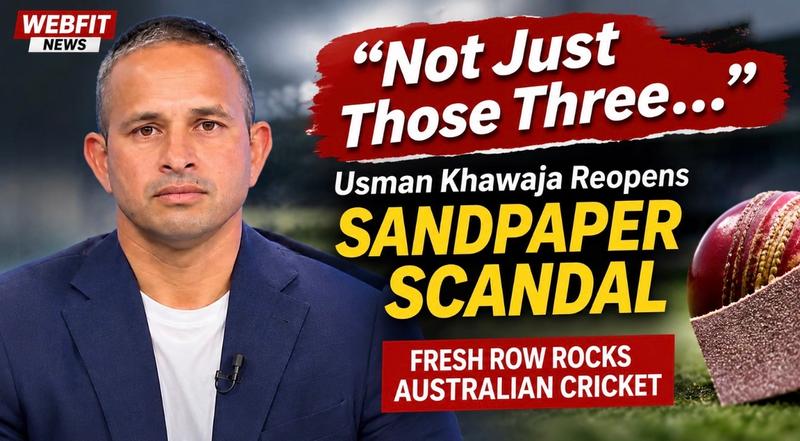
Australian Test captain Pat Cummins has rejected the claims, insisting he had no knowledge of the sandpaper plan.
And with video clips and statements circulating across social media, cricket fans are once again asking the question that has followed the Australian team for nearly nine years.
Did only three players know about the cheating, or was there more to the story?
What happened in 2018? The scandal explained
For those unfamiliar with the controversy, it began during the third Test between Australia and South Africa at Newlands in Cape Town on 24 March 2018.
Television cameras caught Australian player Cameron Bancroft using sandpaper to roughen one side of the cricket ball.
The purpose was to alter the ball’s condition and help Australia’s bowlers generate reverse swing, a technique that can make the ball move unpredictably through the air.
Using sandpaper to achieve that advantage is illegal under cricket’s rules.
The footage quickly became an international scandal.
An investigation by Cricket Australia identified three players as responsible for the plan.
|
Player
|
Role in 2018
|
Punishment
|
|
Steve Smith
|
Australian captain
|
12-month ban
|
|
David Warner
|
Vice-captain
|
12-month ban
|
|
Cameron Bancroft
|
Opening batter
|
Nine-month ban
|
Smith and Warner were also removed from their leadership positions.
The controversy led to major changes in Australian cricket, including the departures of senior team officials.
But questions remained about whether other players knew what was happening.
Why has the scandal returned now?
The latest controversy began with Khawaja’s autobiography, Sabr, in which he revisits the 2018 South African tour.
Khawaja argues that the responsibility for what happened should not have been placed solely on Smith, Warner and Bancroft.
His account raises questions about the wider team’s awareness of ball tampering, including conversations before the Cape Town incident.
Khawaja has also spoken about events during the preceding Test in Port Elizabeth.
His central argument is that Australian cricket should have accepted responsibility as a team rather than allowing three individuals to carry the consequences alone.
He has stressed that he is not trying to launch a personal campaign against former teammates.
But the account has created an obvious problem.
If responsibility extended beyond the three sanctioned players, what exactly did the others know?
And who, if anyone, should have spoken up?
Khawaja refuses to name players when questioned about Cummins
In a video now attracting attention online, Khawaja is repeatedly questioned about the involvement of Australia’s bowling group.
The discussion centres on Pat Cummins, Mitchell Starc, Josh Hazlewood and Nathan Lyon, who have previously denied knowing about the use of sandpaper in Cape Town.
When asked directly whether Cummins had prior knowledge, Khawaja declined to answer.
He maintained that his book explained what he had witnessed and that he did not want to publicly identify individual teammates.
Khawaja also made an important distinction between describing what he saw and accusing specific people of wrongdoing.
He said his purpose was to encourage collective accountability rather than conduct a personal witch hunt.
That leaves a significant gap between his broader claim and the question of individual responsibility.
Saying a team should share responsibility is not necessarily the same as proving that every player knew about a particular cheating plan.
And that distinction has become central to the growing disagreement.
David Warner breaks his silence in an emotional video
On 9 November, Warner posted a video on Instagram supporting Khawaja’s account.
The former Australian opener said he had remained largely silent about the scandal for eight years.
He described Khawaja’s version of events as accurate and thanked his former teammate for speaking publicly.
Warner also questioned Cricket Australia’s original investigation, arguing that it had been rushed and incomplete.
One of his main concerns was that Khawaja had not been formally interviewed, despite sitting near Bancroft during the tour.
Warner questioned how an investigation could be considered comprehensive without speaking to everyone who might have had relevant information.
But the most personal part of his video concerned his family.
Warner explained that the renewed attention had forced him to revisit the scandal with his daughters, including difficult memories of the cameras, public criticism and emotional scenes surrounding his punishment.
He said he had encouraged his children to tell the truth, adding:
“Because lies will eventually get out.”
It was a powerful statement, but Warner did not establish in the video which specific individuals he believed had lied.
His comments nevertheless intensified scrutiny of the original investigation and those who have maintained they knew nothing about the sandpaper plan.
Pat Cummins hits back: ‘Complete and utter nonsense’
The situation escalated further on Friday, 13 November, when Australian captain Pat Cummins addressed the controversy at length in Sydney.
Cummins strongly rejected suggestions that he knew sandpaper was being used or that he helped plan its use.
He described the allegation that he and others had devised a sandpaper scheme as:
“Complete and utter nonsense.”
Cummins said Khawaja’s account was wrong where it suggested the entire team knew sandpaper was being taken onto the field.
He also expressed frustration about the effect the claims could have on the reputations of former teammates.
Cummins said he supported Khawaja’s right to tell his story but believed people had to be accountable for the allegations they made.
His response brought the disagreement into the open.
Khawaja believes the team should have accepted wider responsibility.
Cummins maintains that he did not know about the sandpaper plan and rejects the suggestion of a broader conspiracy.
Both men were members of the Australian squad during the 2018 tour.
Yet their accounts of what happened remain sharply different.
Warner responds again, accusing Cummins of abandoning Khawaja
The disagreement did not end with Cummins’ statement.
Later on Friday, Warner criticised the Australian captain while appearing on Fox Cricket’s coverage of Australia’s ODI against England.
Warner said he was disappointed by the way Cummins had publicly challenged Khawaja.
He accused Cummins of throwing his former teammate under the bus.
Warner also repeated his criticism of Cricket Australia’s investigation, arguing that the process had left the three sanctioned players carrying consequences that continued to affect their lives.
He described the punishment and its aftermath as something far greater than a temporary suspension from cricket.
Warner also spoke about the emotional impact on his family, including the loss of a baby during the period surrounding the scandal.
His comments made clear that, for him, Sandpapergate was never simply an episode that ended when his suspension expired.
The reputational and personal consequences have continued long afterwards.
Was Cricket Australia’s investigation incomplete?
One of the most important questions raised by the latest developments concerns the original investigation.
Khawaja says he was not interviewed despite being present during the tour.
Warner believes that omission raises serious concerns about how thoroughly the matter was examined.
Cricket Australia, however, has defended the investigation and its findings.
The organisation has maintained that the original process established responsibility for the sandpaper incident.
Its chief executive, Todd Greenberg, has indicated there is no compelling reason at present to reopen the investigation.
That decision means the conflicting accounts are unlikely to be formally tested through a new Cricket Australia inquiry in the immediate future.
It also leaves supporters with competing versions of events.
What we know, and what remains disputed
|
Issue
|
Current position
|
|
Was sandpaper used in Cape Town?
|
Yes. This is established.
|
|
Who was sanctioned?
|
Smith, Warner and Bancroft.
|
|
Does Khawaja believe responsibility was wider?
|
Yes.
|
|
Does Warner support Khawaja?
|
Yes, publicly and strongly.
|
|
Does Cummins admit knowing about the sandpaper plan?
|
No. He firmly denies it.
|
|
Was the investigation inadequate?
|
Khawaja and Warner question it; Cricket Australia defends it.
|
|
Will the investigation be reopened?
|
No reopening has been announced.
|
The distinction between confirmed events and disputed claims is essential.
The fact that Warner supports Khawaja does not independently prove that every Australian player knew about the sandpaper.
Equally, the continued disagreement explains why questions about the incident have not disappeared.
Beyond the scandal: Khawaja speaks about racism and belonging
The renewed attention has also brought other parts of Khawaja’s autobiography into public discussion.
The Pakistan-born Australian cricketer has spoken about feeling like an outsider during parts of his career and about stereotypes he believed followed him.
He described being perceived as lazy or insufficiently committed, characterisations he felt affected how he was viewed.
Khawaja also reflected on his disappointment at not being appointed Australian captain after Smith was removed from the position.
He acknowledged that he had no concrete evidence race influenced that particular decision and said he later came to regard Tim Paine as a good captain.
One of his most personal memories involved Cummins.
Khawaja recalled an Ashes celebration in 2022 when he initially stepped away because teammates were spraying alcohol.
As a Muslim, he does not drink alcohol.
Cummins called him back to join the celebrations, a gesture Khawaja said made him feel fully included in the Australian team.
That history makes the current disagreement particularly personal.
The two men share years of cricket and friendship, but they now disagree publicly over one of the most damaging episodes in Australian sporting history.
Why this matters beyond Australia
Sandpapergate was never just an Australian story.
It affected the reputation of international cricket and raised questions about the pressure to win, the responsibilities of team leaders and the standards expected of professional athletes.
For cricket followers in New Zealand, India, South Africa and around the world, the renewed controversy raises an issue that applies far beyond one team.
When wrongdoing happens in a sporting organisation, where should responsibility begin and end?
Should only those directly involved face consequences?
Or should the wider team and its leadership also accept responsibility for the environment in which it happened?
Those questions do not automatically establish guilt.
But they are legitimate questions about sporting culture, leadership and accountability.
Eight years later, the questions remain
The three players sanctioned in 2018 served their suspensions.
Australian cricket rebuilt its leadership and moved forward.
Smith and Warner returned to international cricket, and Cummins went on to captain Australia.
But the publication of Khawaja’s account has shown that not everyone involved believes the story was fully resolved.
Warner says the truth must be acknowledged.
Khawaja wants responsibility to be understood more broadly.
Cummins rejects the allegations concerning his own knowledge and involvement.
Cricket Australia stands by its investigation.
For now, there is no new finding that changes the established account of who was sanctioned in 2018.
What has changed is that the disagreement is now playing out publicly, between players who once shared the same dressing room.
Eight years after a piece of sandpaper changed Australian cricket, the biggest unanswered question is no longer what Bancroft did.
It is who else knew what was happening, and whether the full story has ever been told.