Gambhir Sounds 2027 World Cup Alarm After India's Historic Collapse in New Zealand
“No ball is unplayable,” says India's head coach after the 244-run defeat at Bay Oval, raising concerns over repeated batting collapses, poor footwork and the team's ability to...
“No ball is unplayable,” says India's head coach after the 244-run defeat at Bay Oval, raising concerns over repeated batting collapses, poor footwork and the team's ability to handle conditions similar to those expected at the next World Cup.
By Webfit News | 14 November 2026
MOUNT MAUNGANUI, NEW ZEALAND: Gautam Gambhir has delivered a warning to India's batters following their humiliating defeat against New Zealand, admitting that the team's recurring struggles against seam movement are a concern ahead of the 2027 ICC Men's Cricket World Cup.
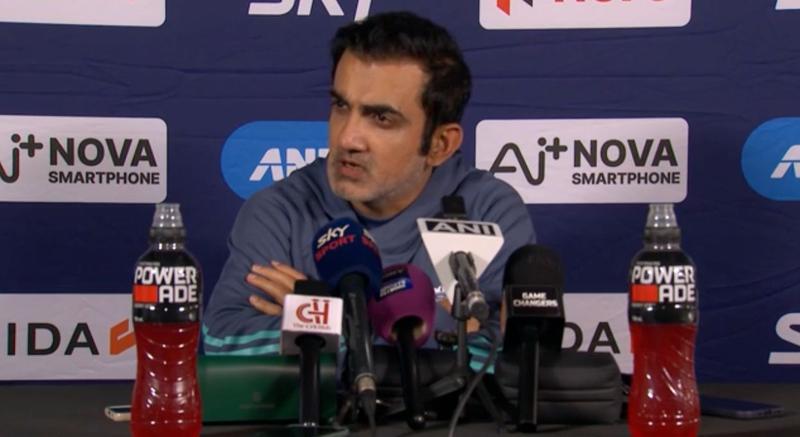
Speaking at the post-match press conference at Bay Oval on Friday, the Indian head coach refused to describe Matt Henry's devastating deliveries as unplayable, arguing that international batters must possess the technique to survive difficult conditions.
"No, first of all, there are no unplayable deliveries, to be honest, in international cricket," Gambhir said.
"You should be able to cope up with any kind of deliveries."
His assessment came after India were dismissed for just 89 in 26.4 overs while chasing New Zealand's 333, suffering a 244-run defeat, their second-largest loss by runs in ODI history.
Henry's remarkable 6/27, including three wickets in the opening over, dominated the headlines. But Gambhir's comments revealed a deeper concern about India's batting preparation for overseas conditions.
Why Gambhir is already thinking about 2027
The 2027 Cricket World Cup will be staged across South Africa, Zimbabwe and Namibia, where pace, bounce and seam movement could present challenges similar to those India encountered at Bay Oval.
Gambhir believes the current New Zealand tour offers an important examination of India's readiness.
"These are conditions which are going to be closest to what we might get during the World Cup," he said.
He contrasted the contest between bat and ball in New Zealand with conditions in India, where pitches often offer less assistance to seam bowlers.
For Gambhir, the concern is not simply about losing a match. It is about whether India's experienced batting line-up can adapt quickly enough when the ball moves.
With the World Cup less than a year away, Friday's collapse has raised questions that cannot be answered by home performances alone.
The numbers behind Gambhir's concerns
Warning sign
What happened
India's fourth ODI innings
89 all out in 26.4 overs
Defeat against New Zealand
244 runs
Opening-over collapse
Rohit, Kohli and Iyer dismissed for ducks
Previous ODI
India had lost seven wickets for approximately 111–112 runs
Henry's bowling
Career-best 6/27
Gambhir's technical concern
Batters caught on the crease against testing lengths
Gambhir specifically referred to India's earlier collapse in the series, making it clear that Friday's performance was not being viewed in isolation.
"You're always concerned when you get bundled out for 90 odd. Why won't I be concerned?" he said.
He then identified what troubled him most.
"The bigger concern is not the runs, it's how quickly we got bundled out."
India had almost half their allotted overs remaining when the final wicket fell.
For a side featuring several established international batters, the inability to build partnerships and occupy the crease is a serious issue.
The technical weakness Henry exposed
Henry dismissed Rohit Sharma, Virat Kohli and Shreyas Iyer in the first over, reducing India to 0/3 before their chase had properly begun.
But Gambhir's analysis went beyond the dismissals themselves.
Asked about New Zealand's use of wobble-seam deliveries, he suggested that the decisive factor was the length the bowlers consistently maintained.
"It's that length, because it was that length where you couldn't go forward, you couldn't go back," he explained.
India's batters were frequently caught between committing to a front-foot defence and responding from the back foot.
Gambhir believes that indecision contributed to the collapse.
"So we might have to be probably more committed towards it, rather than getting stuck on the crease."
His comments identified a specific technical problem rather than blaming unpredictable movement or difficult conditions alone.
The implication is significant: India's batters need to improve their decision-making and footwork against disciplined seam bowling.
What India's young fast bowlers can learn from New Zealand
Gambhir also used the defeat to highlight the difference between New Zealand's bowling approach and India's execution.
Henry repeatedly attacked the stumps, forcing batters to play and bringing both edges of the bat into contention.
Kyle Jamieson complemented him with additional bounce, making it difficult for India's batters to settle.
Gambhir praised the pressure New Zealand created from both ends.
He suggested that India's developing pace attack could learn from the consistency and coordination of the two New Zealand bowlers.
It was not simply about generating pace or bowling short.
The effectiveness came from maintaining attacking lengths, challenging the stumps and preventing batters from releasing pressure at the other end.
India's bowlers had opportunities of their own earlier in the match.
Will Young was dropped twice in the second over before going on to score a century.
Gambhir acknowledged that the missed catches had proved expensive.
New Zealand capitalised on their opportunities. India did not.
Kuldeep Yadav, team selection and the question of opportunities
The press conference also turned to India's bowling combination and the selection of Kuldeep Yadav.
Gambhir explained that the management had considered a wrist-spinner an attacking option through the middle overs, particularly given the dimensions of the ground.
He also rejected the suggestion that limited match opportunities should automatically excuse a player's lack of rhythm.
According to Gambhir, international players must be prepared to perform whenever selected.
He noted that overseas conditions sometimes require teams to field three or four seamers, naturally reducing opportunities for specialist spin bowlers.
The message was consistent with his assessment of India's batting.
At international level, preparation and adaptability cannot depend entirely on ideal circumstances.
‘If you're not hurting, there's a problem’
Despite his criticism, Gambhir expressed confidence in the experience and quality within India's dressing room.
He did not call for wholesale changes before Sunday's final ODI.
Instead, he emphasised the importance of players recognising the seriousness of the defeat.
"I always believe that people should be hurting in the dressing room when you have this kind of a performance, because if you're not hurting, then there's a problem," he said.
For Gambhir, disappointment is a natural response when representing the country.
What matters is how the team responds.
India still lead the five-match series 2–1 and can secure an outright series victory in Sunday's final ODI at Bay Oval.
New Zealand, meanwhile, can level the series at 2–2.
Henry will miss the final ODI as he joins preparations for the upcoming Test series, but India cannot assume his absence will automatically resolve their batting difficulties.
The bigger test begins after Bay Oval
There is an important distinction between losing to exceptional bowling and repeatedly failing to survive challenging conditions.
Henry's opening over was extraordinary. His accuracy, movement and control deserved the highest praise.
But Gambhir's assessment suggests India's concerns extend beyond one bowler or one match.
The coach has identified repeated collapses, indecisive footwork, the inability to occupy the crease and the challenge of adapting to conditions that could resemble those at the 2027 World Cup.
Those are issues that require sustained technical improvement, not merely a change in attitude before the next game.
Sunday's ODI offers India an immediate chance to recover some confidence and finish the series strongly.
The more important examination, however, will come when India's batters encounter similar movement and bounce again.
New Zealand exposed the problem in one evening. Gambhir has made it clear that India must find the answer before the World Cup.
Reporting based on Gautam Gambhir's post-match press conference following the fourth ODI between New Zealand and India at Bay Oval, Mount Maunganui, on 13 November 2026. Match statistics verified against the ICC official scorecard.