It won 42 electorates, more than any other party.
And the National-led coalition still has a narrow path to remaining in government.
So how can a party win so many electorates, potentially retain power, and still lose some of its most senior politicians?
The answer lies in New Zealand's Mixed Member Proportional electoral system, better known as MMP, and a sharp fall in National's party vote.
The election result that changed everything
The Electoral Commission's preliminary results show Labour narrowly ahead of National in the nationwide party vote.
National received 29.21%, compared with Labour's 29.36%.
But National won substantially more electorate seats.
That difference has created an unusual parliamentary outcome.
| Party | Party vote | Preliminary seats |
|---|
| National | 29.21% | 42 |
| Labour | 29.36% | 36 |
| Green Party | 13.30% | 16 |
| ACT | 10.92% | 13 |
| New Zealand First | 9.78% | 12 |
| Opportunity Party | 5.96% | 7 |
| Te Pāti Māori | 0.57% | 5 |
| Total | | 131 |
Source: Electoral Commission preliminary results, 7 November 2026. Figures are subject to the official count.
The numbers tell two different stories.
Labour attracted slightly more party votes.
National won far more local electorate contests.
And smaller parties secured a substantial share of parliamentary representation.
For National, however, winning so many electorates has come with an unexpected cost.
The MMP twist that has left senior ministers stranded
Under MMP, the party vote largely determines how many seats a political party is entitled to in Parliament.
Electorate winners take their seats first. Remaining seats are normally filled by candidates from the party list.
But what happens when a party wins more electorate seats than its share of the party vote would ordinarily justify?
Those electorate MPs keep their seats.
This creates what is known as an overhang, increasing the size of Parliament.
That is what has happened to National.
Its 29.21% party vote would ordinarily entitle it to fewer than the 42 electorate seats it won.
Because all 42 electorate winners must be accommodated, National has no additional list seats on the preliminary figures.
And that is where the trouble begins.
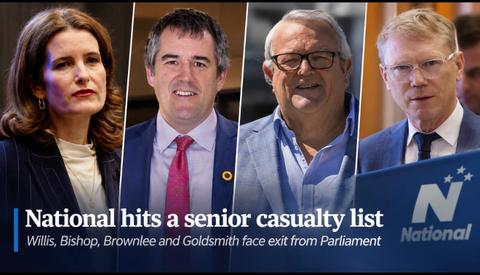
Some of National's most recognisable politicians were relying on the party list to return to Parliament.
Despite their senior positions, their high rankings cannot help if there are no list seats available.
It is a striking reminder that a ministerial portfolio, years of experience or a senior position within a party does not guarantee a place in Parliament after an election.
The biggest names facing the exit
Nicola Willis: Finance Minister and deputy leader
Willis is arguably the most significant potential casualty.
As Finance Minister, she was responsible for overseeing the Government's fiscal strategy during a period of considerable economic pressure.
She was also National's deputy leader and ranked second on the party list.
But her position on that list offers no protection under the preliminary result.
Speaking on election night, Willis acknowledged that her return to Parliament looked unlikely.
Her potential departure raises an immediate question for National: who would take responsibility for the finance portfolio if the party remains in government?
Gerry Brownlee: Nearly three decades in Parliament
Brownlee, who entered Parliament in 1996, is one of National's longest-serving and most experienced politicians.
He has held senior ministerial roles and served as Speaker of the House.
His likely departure would mark the end of a parliamentary career spanning roughly 30 years.
It would also remove a figure with extensive experience of parliamentary procedure and the workings of government.
Paul Goldsmith: A senior minister without a list seat
Goldsmith, who held the justice portfolio in the outgoing government, is another senior National figure affected by the lack of list seats.
His position illustrates how National's election result has reached well beyond backbench MPs.
It is threatening the party's senior ministerial ranks.
Chris Bishop: An electorate defeat with wider consequences
Bishop's position is slightly different.
He contested Hutt South but was behind on the preliminary electorate count.
With no National list seats available, losing that contest would also mean losing his place in Parliament.
As Transport Minister and a senior figure in National's parliamentary team, his potential departure would add to the party's loss of experience.
Unlike list-only candidates, however, Bishop still has an electorate contest that could change when special votes are counted.
Why the number 16 is not yet final
The figure of 16 sitting MPs facing defeat emerged from election-night reporting across the political spectrum.
It is a useful indication of the scale of parliamentary turnover, but it should not be mistaken for a final, certified list of departing MPs.
Some candidates are waiting on close electorate results.
Others are affected by the number of list seats their parties may receive.
Those outcomes can change during the official count.
The Electoral Commission estimates that approximately 399,365 special votes remain to be included.
These include votes cast overseas and votes requiring additional eligibility checks.
The final results are scheduled for Friday, 27 November.
Until then, it would be premature to declare every projected departure permanent.
National could lose senior ministers and still lead the next government
Perhaps the most remarkable aspect of the election is that National's internal losses do not necessarily mean a change of government.
On the preliminary results, the parliamentary numbers are:
| Political grouping | Seats |
|---|
| National + ACT + NZ First | 67 |
| Labour + Greens + Te Pāti Māori | 57 |
| Opportunity Party | 7 |
| Total Parliament | 131 |
| Seats needed for a majority | 66 |
The existing National-led coalition therefore holds a one-seat majority on the preliminary count.
That is a fragile position.
A change of only a few seats after special votes are counted could alter the balance of power.
For Prime Minister Christopher Luxon, the challenge is not simply whether he can remain in office.
It is also whether he can rebuild a government potentially missing several of its most experienced ministers.
A coalition can retain the numbers to govern while losing key people needed to run it.
That is the difficult position National now faces.
What about Labour and the other parties?
Labour's narrow lead in the party vote has not translated into the largest number of parliamentary seats.
The party's 36-seat preliminary result leaves it behind National's 42.
The Greens, meanwhile, have secured a strong preliminary result with 16 seats.
ACT and New Zealand First also remain influential, with 13 and 12 seats respectively.
The arrival of the Opportunity Party, with seven projected MPs, adds another dimension to an already complicated Parliament.
Its presence could become particularly important if the official count changes the balance between the two major political groupings.
The election has therefore produced more than individual winners and losers.
It has left the country facing uncertainty over government formation, coalition negotiations and the composition of the next Parliament.
What does an overhang actually mean?
New Zealand's Parliament normally has 120 seats.
Under MMP, however, additional seats can be created when a party wins more electorates than its party-vote entitlement.
This ensures that candidates who win their local electorates are not denied their seats.
The 2026 preliminary result has produced a 131-seat Parliament.
National's 42 electorate victories and Te Pāti Māori's five electorate wins have contributed to the overhang.
The consequence is a larger Parliament and a higher number of seats required for a majority.
For voters, the important point is that the party vote and electorate vote serve different purposes.
The electorate vote chooses a local MP.
The party vote largely determines each party's overall representation.
When those results diverge sharply, unexpected outcomes can follow.
This election has provided a particularly dramatic example.
A political career can turn on a handful of votes
There is a human side to these numbers.
For a politician who has spent years representing a party, holding a ministerial portfolio or serving in Parliament, election night can bring a sudden change in circumstances.
One moment, they are preparing for another parliamentary term.
The next, their future depends on special votes, an electorate recount or whether their party has enough list seats.
For some, the result may mean the end of a long political career.
For others, it could mean a temporary departure or a different role outside Parliament.
And for National, the loss of senior figures could force difficult decisions about leadership responsibilities, ministerial appointments and succession.
Those decisions cannot be fully resolved until the official results are known.
What happens between now and 27 November?
New Zealand remains under caretaker government arrangements while the electoral process continues.
The Electoral Commission must complete the official count, including checking and counting special votes.
Close electorate contests may change.
Party-vote percentages may shift.
And the final allocation of seats could look different from the preliminary result.
Once the official results are declared, political parties will have a clearer basis for negotiations over the next government.
For now, neither the survival of the existing coalition nor the departure of every MP currently projected to lose their seat should be treated as final.
The bigger message from the 2026 election
National's predicament reveals something important about New Zealand politics.
Winning local electorates is not the same as winning the nationwide party vote.
And holding government office is not the same as securing a parliamentary seat.
A party can perform strongly in electorate contests while losing enough party-vote support to leave its senior list candidates stranded.
That is precisely the problem National faces.
The preliminary result has given Christopher Luxon's coalition a narrow parliamentary advantage, but it has also placed some of his most experienced colleagues on the sidelines.
For Labour, the election has brought a narrow party-vote lead but not a clear route to government.
For smaller parties, it has increased their relevance in a Parliament where every seat matters.
And for voters, it has demonstrated just how unpredictable MMP can become when electorate results and party-vote support pull in different directions.
The 2026 election may yet return National to government. But it could be a very different National Party that walks back into Parliament.
The final answer will come after the official count on 27 November.
Sources: Electoral Commission preliminary results, 7 November 2026; RNZ and 1News election reporting, 7–9 November 2026; NZ Herald election-night reporting; Cabinet Office guidance on caretaker government arrangements.
Editor's note: This article is based on preliminary election results. The final number and identities of departing MPs may change following the official count on 27 November 2026.
Webfit News | New Zealand General Election 2026 | Politics