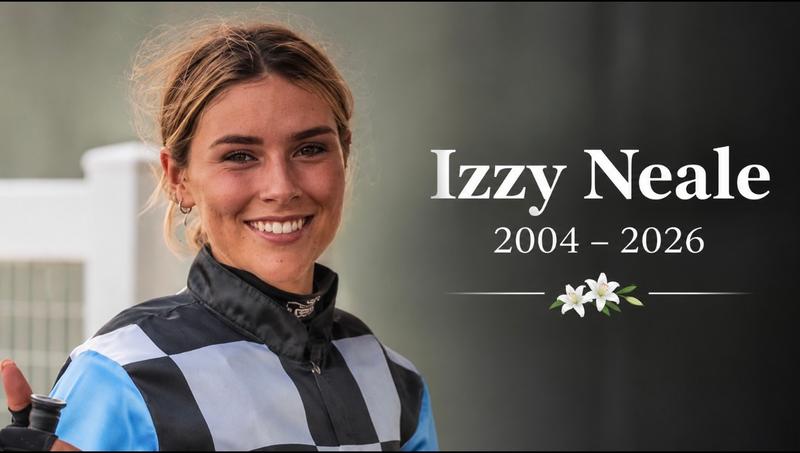
Neale died in Dubbo Hospital, surrounded by her family, after suffering critical injuries in a race fall at Warren Racecourse in regional New South Wales two days earlier.
For her family, the loss is immeasurable. For the racing community, it is the sudden absence of a young woman whose career was only beginning to unfold.
Yet amid the grief, her family shared something extraordinary.
Izzy would become an organ donor.
Even in death, the young jockey who had spent her life chasing opportunities would offer someone else the opportunity to keep living.
It is a final act of generosity that gives this tragedy a meaning beyond the racetrack.
A Sunday afternoon that changed everything
Sunday, 8 November, was supposed to be another day of country racing.
The Warren Shire Cotton Cup, a 1,600-metre contest in western New South Wales, had brought together horses, jockeys, trainers and racing enthusiasts for a familiar regional sporting occasion.
Neale was riding Marnoo, a six-year-old racehorse, when disaster struck near the 400-metre mark.
The horse suffered a serious injury during the race, and Neale was thrown from the saddle.
Another jockey, Diego Montes de Oca, riding Shadow Dane, was also dislodged.
What had begun as a sporting contest quickly became a medical emergency.
Neale lost consciousness and required urgent treatment at the racecourse before being airlifted to Dubbo Hospital in critical condition.
Montes de Oca was taken to hospital by ambulance and later discharged after suffering soft tissue injuries to his left foot.
Marnoo’s injuries were so severe that the horse had to be euthanased.
The final race of the meeting was abandoned.
For those present, the result of the Cotton Cup had suddenly become irrelevant. The only outcome that mattered was whether the injured riders would recover.
Two days of hope, followed by devastating news
As Neale remained in hospital, concern spread across the Australian racing community.
Fellow jockeys, trainers, stable staff and racing officials rallied around her family. Messages of support came from people who had ridden alongside her, worked with her or simply followed her progress through the country racing circuit.
Some travelled to Dubbo to be close to the family.
For two days, the racing community waited.
On Tuesday, the news everyone had feared was confirmed.
Neale had died from her injuries.
Her family expressed their gratitude for the compassion and support they had received, acknowledging the friends, racing colleagues and organisations who had stood beside them during an extraordinarily difficult time.
They thanked Racing NSW and the NSW Jockeys Association for their care and assistance.
But the most moving part of their statement was not about racing.
It was about giving.
Through organ donation, Izzy would offer other people a chance at life.
The family said that knowledge brought some comfort amid their devastating loss.
For those who loved her, it cannot replace the future they had imagined together. But it means that something profoundly generous may emerge from an otherwise heartbreaking event.
From a country town to the Sydney winners’ circle
To understand what Australian racing has lost, it helps to understand where Neale’s journey began.
She grew up in Merriwa, a small town in the Upper Hunter region of New South Wales, where horses and rural life were part of her world.
For many aspiring jockeys, a racing career begins far from the bright lights of major metropolitan tracks.
It begins with early mornings, long drives, physically demanding work and the uncertainty of whether the next opportunity will come.
Neale followed that path.
Her first recorded victory came in February 2024 at the Condobolin Picnic Races, where she rode Scruff’s Magic to success.
It was not a glamorous metropolitan occasion or a major championship.
It was country racing, the kind of meeting where aspiring riders gain experience, develop relationships with trainers and learn to handle the unpredictable demands of competition.
But for a young jockey, that first win matters enormously.
It is proof that the hours of preparation, the difficult rides and the sacrifices have begun to produce something tangible.
From there, Neale continued building her career.
She developed her skills under trainer Brett Robb and also spent time working with Scone trainer Scott Singleton.
The victories gradually accumulated.
By the time of her death, she had recorded 88 wins from 699 race starts.
Those numbers represent considerably more than a sporting statistic.
Behind them were hundreds of races, countless hours working with horses and a young rider learning to compete against more experienced professionals.
Then came a breakthrough that suggested bigger opportunities lay ahead.
The Rosehill victory that showed how far she had come
In July 2026, Neale rode It’s A Tata to victory at Rosehill Gardens in Sydney.
It was her first metropolitan win.
For established jockeys, a victory at a major city racecourse may be one achievement among many.
For a young apprentice who had worked her way through regional meetings, it can represent a turning point.
Country racing had given Neale her foundation. Winning at Rosehill demonstrated that she could also succeed on a larger stage.
It was the sort of milestone that makes the years of hard work worthwhile and opens the door to further opportunities.
At 22, she still had time to develop her skills, build relationships with leading stables and pursue the ambitions that had brought her into racing.
Nobody could know how far her career might eventually have taken her.
But she had already achieved something important.
She had taken a childhood passion and turned it into a profession.
And she was good at it.
The people behind the racing statistics
Professional sport often reduces individuals to numbers.
A jockey becomes a list of wins, starts, strike rates and prize money.
Those statistics are useful, but they rarely explain why a person matters to the people around them.
In Neale’s case, the response to her accident revealed a much more personal story.
Racing officials, fellow riders, trainers and stable workers spoke of their concern for a young woman who had become a valued part of their community.
Former jockey and racing presenter Melinda Turner was among those expressing distress following the incident.
Others shared messages of encouragement while Neale remained in hospital.
Tony Crisafi, chief executive of the NSW Jockeys Association, confirmed that members of the racing community had visited Dubbo Hospital to offer support.
The outpouring of concern was not simply about losing a promising athlete.
It was about someone they knew.
Someone they had watched work hard, improve, celebrate victories and become part of the daily life of Australian racing.
For her family, of course, those professional achievements will never be the most important memories.
They will remember the daughter and sister behind the racing silks, the conversations, the ordinary days and the plans that will now remain unfinished.
Her brother Tommy was reported to have been devastated by the loss.
No sporting tribute can adequately describe what that means for a family.
The risks that remain behind racing’s celebrations
Neale’s death also raises an uncomfortable reality about the sport she loved.
Horse racing depends on extraordinary coordination between riders and powerful animals travelling at considerable speed.
A jockey must make decisions in seconds, maintain balance in crowded fields and respond to movements that cannot always be anticipated.
Most races finish without serious injury.
But when something goes wrong, the consequences can be catastrophic.
The accident at Warren is a reminder that the dangers of racing are not confined to major events or high-profile competitions.
They are present at regional meetings too, where young riders work to establish their careers.
Following the incident, Racing NSW postponed the scheduled Scone race meeting as a mark of respect and in recognition of the distress felt throughout the industry.
An official inquiry into the fall was also announced.
The inquiry is important because serious racing accidents deserve careful examination, not speculation.
Questions about what happened, whether any contributing circumstances can be identified and whether lessons can be learned should be answered through evidence.
At the time of publication, no final inquiry findings had been established.
It would be premature to assign blame or suggest that any particular action could have prevented the tragedy.
What can be said with certainty is that racing has lost another young participant to the inherent dangers of the sport.
That loss deserves more than a passing headline.
Organ donation: a legacy beyond the finish line
Perhaps the most remarkable aspect of Neale’s story is the decision her family shared after her death.
Organ donation is rarely discussed in the context of sporting achievement.
Yet it may become one of the most consequential parts of her legacy.
For people waiting for a transplant, a donated organ can mean the possibility of survival, recovery and more years with loved ones.
For a grieving family, the decision to honour a person’s wish to donate can carry enormous emotional weight.
It does not diminish their grief.
It does not make the loss fair.
And it does not turn a tragedy into something positive.
But it can create the possibility of hope for others.
The number of recipients and the eventual outcomes of Neale’s donation had not been publicly confirmed at the time of reporting.
Her family’s announcement nevertheless carries a powerful message.
A young woman whose own future has been taken away may help give other families the future they are desperately hoping for.
For readers in New Zealand and Australia, her story is also a reminder of the importance of discussing organ donation wishes with loved ones before a crisis occurs.
It is a conversation many families postpone because the subject is uncomfortable.
Neale’s story shows why that conversation matters.
More than 88 victories
There will be tributes to Izzy Neale in the days ahead.
Her name will be remembered at race meetings, among jockeys and trainers, and by those who watched her career develop.
Some will remember her first victory at Condobolin.
Others will remember the excitement of her breakthrough at Rosehill.
Her colleagues will have their own memories of a young rider determined to make her mark.
But perhaps the most meaningful tribute is to remember the person behind those achievements.
At 22, Neale had already accomplished what many aspiring athletes spend years trying to achieve.
She had found something she loved, committed herself to it and earned a place in a demanding professional sport.
She should have had many more years to discover where that journey might lead.
Instead, her family must now face a future without her.
The racing community must say goodbye to a young talent whose potential will remain unfulfilled.
And somewhere, through the extraordinary generosity of organ donation, another family may receive the news they have been waiting and hoping to hear.
Izzy Neale’s racing career ended far too soon.
Her story, however, will be remembered for more than the circumstances of her death.
It will be remembered for her determination, her love of horses, the people who loved her and the possibility that her final gift may allow others to keep living.
Eighty-eight victories marked her career. The lives she touched will define her legacy.
Webfit News extends its deepest condolences to Izzy Neale’s family, friends, fellow jockeys and the Australian racing community.
Sources and acknowledgement
This report was prepared by Webfit News using information reported by 7NEWS Australia, ABC News Australia, Racing NSW, the NSW Jockeys Association, Racing and Sports, and News.com.au.
Special credit: 7NEWS Australia (7news.com.au) for its reporting on Izzy Neale’s passing and her family’s statement.