<p>Could the same mistakes cost Labour again in 2026?</p>
By Geet G | Webfit News | Content Intent: ANALYSIS
Introduction: This Was Not a Surprise. It Was a Slow Burn.
If you think Labour Party lost the 2023 election because of one bad decision, you are oversimplifying it.
They did not lose in October 2023. They started losing the moment voters stopped feeling better under their leadership.
And that is the part most people ignore.
By the time voters went to the booths, the result was already baked in. The economy felt worse, the government looked tired, and trust had quietly eroded.
Meanwhile, National Party did not win by brilliance. They won by being the alternative people were willing to try.
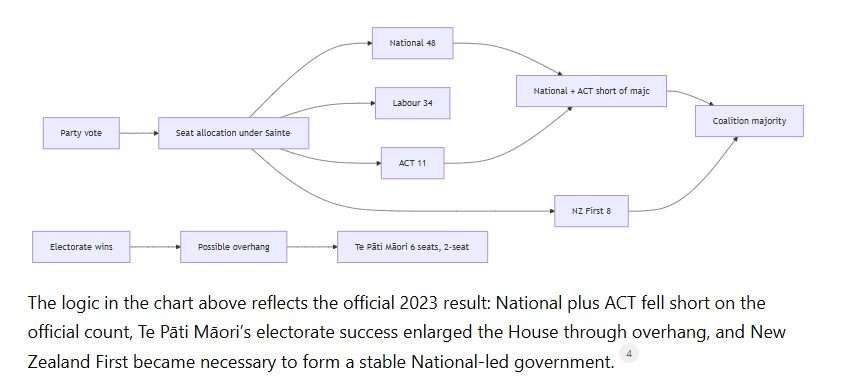
Labour fell from 50 percent vote and 65 seats (2020) to 26.91 percent and 34 seats (2023)
National rose from 25.6 percent to 38.06 percent
That is not a swing. That is a collapse.
And here is the uncomfortable truth.
People still voted.
Turnout stayed relatively strong. This was not apathy. This was rejection.
Date
Event
Likely impact
19 Jan 2023
Ardern resigns
Created a reset opportunity for Labour, but also confirmed the end of the 2020 era
25 Jan 2023
Hipkins becomes PM and prioritizes cost of living
Produced a short-lived Labour polling bounce
13 Mar 2023
“Bread and butter” reset and policy reprioritization
Signaled focus, but also looked like retreat from earlier ambitions
Mar 2023
Stuart Nash scandal
Revived competence concerns just as Labour was recovering
21 Jun 2023
Michael Wood resigns over undeclared shares
Reinforced a narrative of ministerial disorder
24–25 Jul 2023
Kiri Allan crash, resignation, then exit
Deepened the sense of government fatigue and instability
13 Aug 2023
Labour announces GST-free fruit and veg
Concrete cost-of-living pitch, but modest in visible household gain
30 Aug 2023
National launches Back Pocket Boost tax plan
Gave National a simple economic contrast with Labour
2 Sep 2023
Labour campaign launch and free dental policy
Stronger policy offer, but late and phased
19–20 Sep 2023
First leaders’ debate
Luxon exceeded expectations and won the perception contest
Early Oct 2023
NZ First rises in late polls
Made a three-party right government the likeliest post-election path
14 Oct 2023
Election day
National wins decisively; Labour records one of the worst incumbent defeats of the MMP era
Sources and notes: The table synthesizes official announcements, policy launches, and major campaign reporting.
The Core Problem: People Felt Worse, Not Better
This election was decided in supermarkets, not debates.
Inflation stayed high
Interest rates hit hard
Rent and groceries became painful
The Reserve Bank of New Zealand kept interest rates at 5.50 percent. That meant mortgages went up and spending power went down.
Now ask yourself this simple question.
When your life gets more expensive, who do you blame?
You blame the government.
Fair or not, that is politics.
Labour’s Biggest Mistake: They Lost the “Feeling”
Chris Hipkins tried to reset the narrative with “bread and butter” issues.
But here is where Labour got it wrong.
That reset looked like an admission they had been focusing on the wrong things.
Instead of confidence, it signaled panic.
Instead of leadership, it looked like retreat.
And voters are not stupid. They notice when a government changes direction mid-game.
The Competence Problem: Death by a Thousand Cuts
Group or region
What the high-confidence evidence shows
What it suggests
Overall electorate
Turnout among enrolled voters was 78.2%, down from 82.2% in 2020; enrolment was still high at 94.7%
Participation slipped, but not enough to explain Labour’s collapse on its own
Younger voters
Enrolment among 18–29-year-olds reached 82.9%; the Commission said the youngest voters “held their own”; turnout among Māori voters aged 18–24 rose to 70.3%, above 2020 and 2017
Youth disengagement was not the whole story; Labour’s problem was persuasion as much as mobilization
Women and men
NZES-based analysis by Sam Crawley found National won a higher share of women than men in 2023, 41% vs 37%; Labour also did slightly better with women, 28% vs 26%; ACT and NZ First did better with men
National cut across the usual small gender gap and took women from Labour’s broader coalition
Māori voters and Māori electorates
Māori enrolment rose to 567,012 by the election; Te Pāti Māori won all six Māori electorates, creating a two-seat overhang
Labour’s old dominance in Māori seats fractured badly, which damaged both seat count and centre-left arithmetic
Auckland
1News found Auckland respondents more likely to put crime near the top of their concerns; the NZ Herald described Auckland as a “blue sea of change,” with historically Labour-held seats such as Mt Roskill and New Lynn under heavy pressure
Labour’s urban outer-ring and suburban vote eroded sharply where cost-of-living and crime rhetoric resonated
Inner-city progressive seats
Electorate-level results still showed stronger Labour/Green performance in central-city seats and Māori electorates than in suburban Auckland or many provincial seats
The left’s coalition did not disappear everywhere. It got squeezed geographically and socially
Let’s be blunt.
Labour did not just look tired. They looked messy.
A series of scandals hit the government:
Stuart Nash controversy
Michael Wood conflict of interest
Kiri Allan resignation
Individually, survivable.
Together, damaging.
Here is the pattern voters saw:
“This government is losing control.”
And once that belief sets in, it is almost impossible to reverse.