Parliament could grow to 131 MPs after the election. The salary calculation is straightforward. The full cost, and what the public gets in return, deserve closer attention.
Analysis | By Webfit News | 9 November 2026
Parliament could grow to 131 MPs after the election.
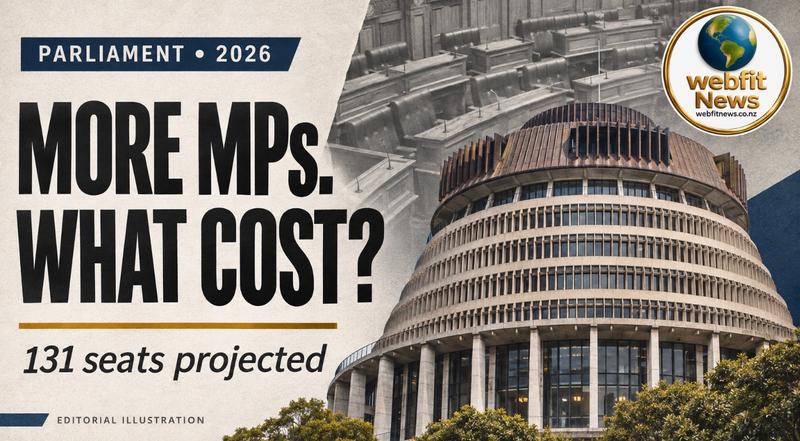
Parliament could grow to 131 MPs after the election. The salary calculation is straightforward. The full cost, and what the public gets in return, deserve closer attention.
Analysis | By Webfit News | 9 November 2026
New Zealanders voted for their next government. They may also be paying for a bigger Parliament.
The preliminary election result projects 131 MPs, 11 above the usual 120. Using published pre-election pay rates, those additional members would account for approximately $2.2 million annually in basic salaries and expense allowances.
Staffing, offices, technology and travel sit outside that calculation.
For households watching every bill, asking what the extra representation costs is reasonable. So is asking what it delivers.
Neither question is answered by simply saying, “That’s how MMP works.”
The salary arithmetic
The last published pre-election rates put an ordinary MP’s annual salary at $181,200, with a basic expense allowance of $19,300.
|
Annual cost |
One ordinary MP |
Eleven MPs |
|
Basic salary |
$181,200 |
$1,993,200 |
|
Basic expense allowance |
$19,300 |
$212,300 |
|
Combined |
$200,500 |
$2,205,500 |
At unchanged rates for three years, that would total approximately $6.62 million.
This is a benchmark, rather than a confirmed budget. It assumes ordinary MPs’ pay throughout and excludes wider support costs. New remuneration decisions and parliamentary appointments could change the figures.
Eleven extra compared with what?
This is where a punchy number can become misleading.
The projected 11 additional seats are measured against Parliament’s standard size of 120. That does not automatically mean 11 more MPs than the outgoing Parliament, or 11 entirely new offices.
Existing facilities and resources may be reassigned. Other spending may genuinely increase.
Taxpayers need the additional cost compared with what was already being spent, alongside the comparison with a standard-sized Parliament.
Otherwise, an accurate multiplication risks becoming an inaccurate impression.
Why the seats exist
Under MMP, the party vote generally determines a qualifying party’s overall seat entitlement. Electorate winners occupy places within that allocation, with list MPs making up the balance.
But when a party wins more electorates than its party vote would ordinarily provide, it keeps those seats. Parliament expands through an overhang.
The preliminary result gives National 42 electorate seats and Te Pāti Māori five. Both have more electorate victories than their proportional entitlement would otherwise provide.
The resulting MPs have won seats under the existing rules. They have not appointed themselves.
That matters because describing them simply as unnecessary politicians skips the voters who elected them.
The bigger issue is power, as well as pay
The overhang does more than add names to the payroll. It changes the parliamentary numbers used to form a government.
The preliminary allocation gives National, ACT and New Zealand First 67 seats in a projected 131-seat House, where an outright majority requires 66.
A close electorate changing hands could therefore affect both Parliament’s size and the governing parties’ advantage.
Wairarapa illustrates the point. If Labour overturns National’s narrow lead there, while all other results and party entitlements stay unchanged, National would lose an overhang seat. Labour would ordinarily replace a list seat with an electorate seat.
Parliament would shrink to 130 MPs, and the governing parties would hold 66.
An individual electorate result can therefore change the cost of Parliament and the balance within it.
That is why the debate deserves more than outrage about salaries.
A bigger Parliament should face a clearer accounting
The Remuneration Authority determines MPs’ salaries and allowances. Section 84 of the Parliament Act 2025 provides permanent legislative authority for specified remuneration-related payments.
The mechanism is established. The public explanation should be equally clear.
Once the result is final, the relevant parliamentary agencies should publish an accessible breakdown of the additional costs: remuneration, staffing, accommodation, technology and travel.
That breakdown should distinguish new expenditure from resources already budgeted.
“About $2 million” is a useful opening calculation. It should not become the last word because the complete answer is harder to assemble.
More MPs should mean more work being done
There is a legitimate case for representation that reflects local election outcomes. A larger pool of MPs can also provide more people to scrutinise legislation, question ministers and serve constituents.
But extra capacity is not evidence of better performance.
The public should be able to see whether that capacity produces stronger committee scrutiny, accessible constituent services and meaningful examination of government spending.
Counting speeches or social media posts will not settle that question. The standard should be useful parliamentary work.
If politicians expect taxpayers to accept the cost of additional representation, they should also accept scrutiny of what that representation delivers.
The bill is provisional. The accountability should not be.
Special votes and official checks could still change the projected membership. Final results are scheduled for 27 November.
Until then, $2.2 million annually remains an illustrative salary-and-allowance figure for 11 additional ordinary MPs, rather than the full additional bill.
Taxpayers do not need to choose between respecting election results and questioning public expenditure.
They are entitled to both: representatives elected under the rules, and a clear account of what those representatives cost and contribute.
Sources: Electoral Commission preliminary results; Parliamentary Salaries and Allowances Determination 2024; Parliament Act 2025;
Was this article useful?