Who Is Giacomo Filibeck? From Congress's Bharat Summit to Deportation from the Philippines
From allegations of voting irregularities at a European youth convention to being blacklisted and deported from the Philippines, the Italian political official's career has faced...
From allegations of voting irregularities at a European youth convention to being blacklisted and deported from the Philippines, the Italian political official's career has faced scrutiny long before his recent appearance in India's political debate.
By Webfit News | 15 November 2026
Giacomo Filibeck has built his political career around democracy, human rights and international cooperation. But the Italian politician, who serves as Secretary General of the Party of European Socialists (PES), has also been involved in controversies that have attracted criticism beyond Europe.
His political history includes a disputed voting process at a European youth convention in 2002, detention and deportation from the Philippines in 2018, and involvement in ideological disputes within Europe's socialist movement.
These incidents do not establish personal corruption or criminal wrongdoing. They do, however, provide a revealing look at the public controversies surrounding a politician whose international profile has grown over the past two decades.
Who is Giacomo Filibeck?
Born in Rome in 1978, Filibeck began his political journey through European youth and student organisations.
He became involved with the European Youth Forum and Young European Socialists before taking on responsibilities within Italy's Democratic Party.
His professional career also included work involving international political relations and government affairs.
In November 2023, Filibeck became Secretary General of the Party of European Socialists, succeeding Achim Post.
The PES is a major European political organisation bringing together socialist, social democratic and labour parties.
Although Filibeck holds an influential position within European political circles, his career has not been free from controversy.
Giacomo Filibeck's Appearance at Congress's Bharat Summit Sparks Political Debate in India
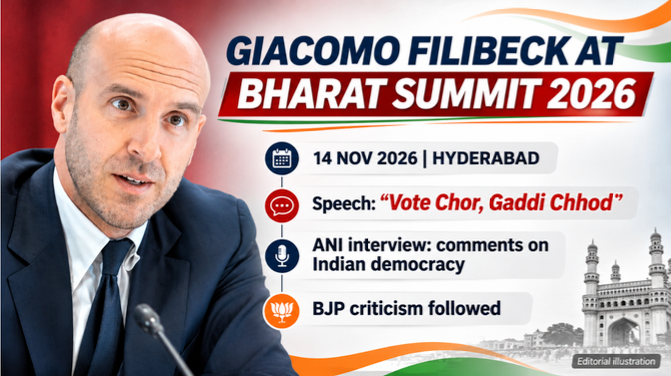
Giacomo Filibeck's involvement in Indian politics has recently attracted attention following reports of his remarks at a Congress-associated Bharat Summit. Filibeck was among the international political representatives who attended the Bharat Summit in Hyderabad on 25–26 April 2025, where he appeared alongside Congress leader Rahul Gandhi, Telangana Chief Minister Revanth Reddy and other prominent figures. The gathering brought together political leaders and representatives from different countries to discuss democracy, social justice and international cooperation, culminating in the presentation of the Hyderabad Resolution.
More recently, reports that Filibeck raised the Congress slogan "Vote Chor, Gaddi Chhod" and expressed support for Rahul Gandhi while criticising the state of Indian democracy have sparked political controversy. BJP leaders questioned the involvement of a foreign political figure in India's domestic political debate. The episode has also drawn attention to Filibeck's earlier political history, particularly his detention and deportation from the Philippines in 2018 over alleged participation in political activities while visiting the country. Although the circumstances are different, the two episodes highlight a recurring debate over international political solidarity, foreign involvement in domestic affairs and national sovereignty.
2002: A youth democracy convention faces allegations of voting irregularities
One of the earliest documented controversies involving Filibeck emerged in July 2002.
At the time, he was president of the Youth Convention on the Future of Europe, an initiative designed to give young Europeans a voice in discussions about the continent's political future.
However, the convention became the subject of complaints about its internal democratic procedures.
According to contemporary reporting by EUobserver, 57 of the convention's 210 participants signed a statement criticising the proceedings.
The complaints included allegations of voting irregularities, inadequate democratic representation and excessive influence by established political youth organisations.
Some participants alleged that political factions had coordinated their efforts to influence the election of convention representatives.
The controversy was particularly significant because the convention itself was intended to promote democratic participation.
Filibeck rejected the criticism, describing the statements as insulting.
There is an important distinction here. The allegations concerned the convention's procedures, and the available reporting does not establish that Filibeck personally manipulated votes or was found responsible for electoral misconduct.
Nevertheless, the dispute remains part of his early political record.
2018: Detained and deported from the Philippines
Sixteen years later, Filibeck became involved in a much more serious international dispute.
In April 2018, he travelled to Cebu in the Philippines to attend a political gathering organised by Akbayan, a progressive political party.
Filibeck was then serving as Deputy Secretary General of the Party of European Socialists.
But instead of entering the country, he was stopped by immigration officials at Mactan-Cebu International Airport.
Philippine authorities informed him that he had been blacklisted.
He was subsequently deported.
Why was he blacklisted?
According to the Philippine Bureau of Immigration, Filibeck had previously participated in political activities while visiting the country as a tourist.
The authorities referred to his October 2017 visit, during which an international delegation had criticised the controversial anti-drug campaign of then-President Rodrigo Duterte.
Philippine officials maintained that foreign visitors were not permitted to engage in certain domestic political activities under the country's immigration rules.
Then-Immigration Commissioner Jaime Morente defended the decision.
The government's position was that foreign nationals entering the Philippines must comply with restrictions governing political participation.
The deportation attracted international attention because Filibeck was a senior representative of a European political organisation.
Filibeck's organisation accused the Philippines of political retaliation
The Party of European Socialists strongly condemned the deportation.
Its leadership argued that Filibeck was being targeted for expressing criticism of the Duterte administration's human rights record.
Akbayan also criticised the decision, describing it as an attempt to silence international political criticism.
The dispute raised an important question about the limits of foreign political involvement.
Should international political representatives be permitted to participate in domestic political discussions while visiting another country?
Or does a sovereign government have the authority to restrict such activities under its immigration laws?
The Philippine government defended its decision on legal grounds, while Filibeck's political allies regarded it as politically motivated.
No criminal conviction against Filibeck was established by the deportation itself.
2025: Another political controversy within Europe's socialist movement
Filibeck's leadership role has also placed him at the centre of disagreements within European politics.
In October 2025, the Party of European Socialists expelled Slovakia's Smer party, led by Prime Minister Robert Fico.
The decision followed longstanding disagreements about the party's political direction and its compatibility with the principles of the European socialist movement.
Filibeck publicly supported the decision, maintaining that membership in the PES required adherence to shared political values.
Fico criticised the expulsion and defended his government's positions.
The episode highlighted tensions within Europe's centre-left political organisations over national sovereignty, social policies and ideological differences.
Filibeck's involvement reflected his official responsibilities as PES Secretary General, rather than an allegation of personal misconduct.
From European politics to India's political debate
Filibeck has recently attracted attention in India following reports of his remarks at a Congress-associated Bharat Summit.
A headline circulating about the event attributes the slogan "Vote Chor, Gaddi Chhod" to him.
The slogan is associated with allegations of electoral irregularities in India's domestic political debate.
However, the precise wording, context and circumstances of Filibeck's reported remarks require confirmation from the original event recording or an authoritative transcript.
The episode nevertheless raises a broader issue about international political figures participating in political discussions outside their home countries.
Such participation is not unusual. Political parties and international organisations regularly exchange ideas, attend conferences and express solidarity with ideological partners.
Supporters see this as legitimate international cooperation.
Critics question whether foreign political representatives should become involved in another country's partisan disputes.
Filibeck's experience in the Philippines demonstrates how these competing interpretations can lead to serious political disagreements.
What does his political record actually reveal?
A closer examination of Filibeck's career identifies several significant episodes.
Year
Incident
Documented outcome
2002
Voting controversy at the European Youth Convention
Delegates alleged irregularities; Filibeck rejected the criticism
2018
Immigration dispute in the Philippines
Blacklisted and deported by Philippine authorities
2023
Appointment as PES Secretary General
Assumed a senior leadership position
2025
Expulsion of Slovakia's Smer party from PES
Filibeck publicly defended the organisation's decision
2026
Reported remarks at a Bharat Summit
Attracted attention in India's political debate; full context requires verification
The record establishes that Filibeck has encountered political disputes and government action during his career.
It does not establish that he was convicted of corruption, personally committed electoral fraud or was found criminally responsible for the allegations associated with the 2002 convention.
The bigger question: Where does international political solidarity end?
Filibeck's career reflects a recurring challenge in international politics.
Political organisations frequently promote democratic values, human rights and international cooperation. Yet their representatives may encounter resistance when they comment on politically sensitive issues in other countries.
The Philippines episode illustrates the potential consequences of that tension.
The 2002 convention dispute raises a different issue: the importance of transparent democratic procedures within organisations that advocate democratic participation.
These are legitimate subjects for public scrutiny, particularly when political leaders participate in international debates about democracy and accountability.
At the same time, allegations must be distinguished from established findings, and political disagreements should not automatically be treated as evidence of misconduct.
A political career that continues to attract scrutiny
More than two decades after entering European youth politics, Giacomo Filibeck remains an influential figure within the international socialist movement.
His supporters point to his work promoting democratic cooperation, political solidarity and human rights.
His critics have challenged aspects of his international political involvement and the positions taken by organisations he represents.
The documented controversies surrounding his career provide context for understanding his public role.
They also underline a principle that applies to political leaders everywhere: those who speak about democracy and accountability can expect their own public records to be examined with the same scrutiny.
For Filibeck, that record includes political advancement, international disputes and questions that continue to follow his involvement in political debates beyond Europe.
Sources: EUobserver (2002 European Youth Convention reporting); Philippine News Agency (2018 immigration and deportation reporting); Party of European Socialists (official statements and leadership biography); VERA Files (fact-checking related to the 2018 deportation).