But there is a crucial distinction. Police are examining possible electoral advertising issues. They are not investigating voters for choosing different parties on their two ballot papers.
And while Mowbray has claimed credit for the election outcome, nobody has established how many voters actually followed his advice.
How did the controversy begin?
The split-vote argument began well before election day.
Mowbray, a businessman whose children founded the toy company Zuru, launched a campaign encouraging National supporters to vote strategically.
His message was simple: support the National candidate in your electorate, but give your party vote to ACT or New Zealand First.
Former National leader Don Brash also promoted the approach. Reality Check Radio ran advertisements and distributed campaign material encouraging centre-right voters to use their votes strategically.
The idea was to help National retain electorate seats while strengthening its potential coalition partners through the party vote.
But National did not welcome the advice.
Luxon repeatedly urged supporters to give their party votes to National, warning that the strategy could hurt his party.
National eventually complained to the Electoral Commission about Mowbray’s website.
On 30 October, the website was taken offline following concerns about electoral advertising requirements. It later returned after changes were made.
Police subsequently confirmed they were making enquiries following a referral from the Electoral Commission.
Detective Senior Sergeant Andrew Compton said police had received the referral but would not comment further while enquiries continued.
Asked about the matter while campaigning in Marlborough, Luxon said:
“I’ve got nothing further to say, and frankly, now that it’s a matter before the police, I’ll leave it there.”
The police involvement was reported before the 7 November election. It should not be mistaken for a new investigation launched because of the election result.
No finding of criminal wrongdoing against Mowbray has been established.
Why would National supporters be told not to party vote National?
This is where the story becomes interesting.
Under New Zealand’s MMP system, voters have two votes.
The electorate vote chooses their local MP. The party vote largely determines how many seats each party receives in Parliament.
Normally, those two parts of the system work together to produce a Parliament that broadly reflects the nationwide party vote.
But there is an exception.
When a party wins more electorate seats than its party vote would normally entitle it to, those electorate MPs still enter Parliament.
The additional seats are known as an overhang.
For example, if a party receives enough party votes for 35 seats but wins 42 electorates, it keeps all 42 MPs.
Parliament grows to accommodate the extra seven.
That is precisely the kind of outcome supporters of the split-vote campaign were trying to encourage.
By backing National candidates locally while giving party votes to ACT or New Zealand First, voters could potentially increase the combined number of centre-right MPs.
There is nothing inherently illegal about splitting votes. The question surrounding Mowbray’s campaign is whether its advertising complied with electoral law.
The election result shows why the strategy mattered
The preliminary results have produced the largest projected overhang in New Zealand’s MMP history.
National received 706,680 party votes, or 29.21%.
Labour received 710,330, or 29.36%.
That means Labour received 3,650 more party votes than National.
Yet National is projected to hold 42 seats, compared with Labour’s 36.
Why?
Because National won 42 electorates, even though its party-vote share would normally have entitled it to approximately 35 seats.
Those seven additional electorate seats create a National overhang.
Te Pāti Māori has also created an overhang. It won five Māori electorates despite receiving only 0.57% of the nationwide party vote, enough for approximately one seat under the proportional allocation.
Together, the two parties account for 11 additional seats.
The preliminary Parliament therefore has 131 MPs rather than the usual 120.
New Zealand election 2026: Preliminary results
|
Party
|
Party vote
|
Seats
|
|
National
|
29.21%
|
42
|
|
Labour
|
29.36%
|
36
|
|
Greens
|
13.30%
|
16
|
|
ACT
|
10.92%
|
13
|
|
NZ First
|
9.78%
|
12
|
|
Opportunity
|
5.96%
|
7
|
|
Te Pāti Māori
|
0.57%
|
5
|
|
Total Parliament
|
|
131
|
Source: Electoral Commission, preliminary results released after the 7 November election. Figures may change following the official count.
The seven seats that could decide who governs
Here is the part of the result that deserves particular attention.
National, ACT and New Zealand First have a combined 67 seats.
The remaining parties have 64.
A majority in a 131-seat Parliament requires 66 seats.
That leaves the centre-right coalition just one seat above the threshold.
But consider what the party votes alone would have produced in a conventional 120-seat Parliament, without the overhang.
Analysis of the preliminary result indicates that the National, ACT and New Zealand First bloc would have held approximately 60 seats, with the other parties collectively holding the remaining 60.
In that situation, neither side would have had a majority.
The seven MPs from the Opportunity Party, led by Qiulae Wong, could have been central to deciding who formed the government.
Instead, the additional electorate seats have given Luxon’s coalition a narrow provisional majority.
That does not make the result illegitimate. The seats are allocated under New Zealand’s existing electoral rules.
But it does show why the overhang has become far more than a technical argument about how votes are counted.
It may determine who governs the country.
National could retain power while losing some of its biggest names
The outcome has created a remarkable problem for National.
Because all 42 of its projected seats come from electorate victories, the party currently has no list seats.
That means senior National figures who depend on the party list cannot enter Parliament unless the final results change the allocation.
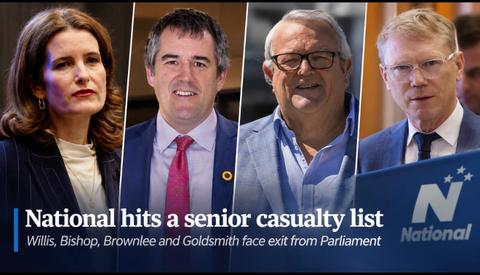
Among those affected are Finance Minister Nicola Willis, Paul Goldsmith and Speaker Gerry Brownlee.
Chris Bishop is also in difficulty after falling behind Labour in Hutt South by 889 votes in the preliminary count.
The irony is difficult to miss.
A strategy intended to strengthen the centre-right may have helped the coalition retain a majority, while leaving some of National’s most experienced politicians outside Parliament.
It also helps explain Luxon’s opposition to the campaign.
National needed party votes not only to strengthen its position against Labour, but also to protect the MPs it wanted in its parliamentary team.
For the coalition as a whole, tactical voting could be useful. For National as an individual party, it carried serious risks.
Te Pāti Māori also encouraged strategic voting
The controversy is not limited to the political right.
Te Pāti Māori also encouraged supporters to split their votes, asking them to back its electorate candidates while giving their party votes to Labour or the Greens.
That strategy was intended to help Te Pāti Māori retain electorate representation while increasing the party-vote strength of its potential political allies.
The preliminary result shows Te Pāti Māori winning five electorates and receiving just 0.57% of the party vote.
Its four additional seats account for part of the record overhang.
This is an important point because the debate about tactical voting cannot reasonably focus on only one political bloc.
Both sides have used or promoted strategies that take advantage of the distinction between electorate votes and party votes.
Any serious discussion about changing the rules would need to consider the consequences for all parties, including Māori electorate representation.
Did Harry Mowbray really change the election?
Mowbray has claimed that his campaign was responsible for the outcome.
Speaking after the election, he reportedly attributed National’s overhang success to the strategic voting effort.
But electoral experts are divided.
Some commentators believe the organised campaign helped produce the result.
Others argue that National’s electorate candidates were already likely to outperform the party’s nationwide support, regardless of Mowbray’s advertising.
That distinction is important.
The preliminary results establish that National won more electorates than its party vote would normally justify.
They do not establish how many people changed their votes because of a particular advertisement, website or campaign.
A voter might have supported a National candidate locally while preferring ACT nationally for entirely personal reasons.
Another might have followed the strategic voting advice.
The ballot paper does not record that motivation.
Until stronger evidence is available, it would be inaccurate to say the campaign alone caused the overhang or determined the election result.
Another question: who paid for the campaigns?
There is a second issue that deserves more attention.
The 2026 election saw significant involvement from organisations and individuals outside the registered political parties.
These included campaigns promoting tactical voting, political advertising and messages aimed at influencing how voters used their two votes.
Political commentator Bryce Edwards has raised concerns about the limited public visibility of funding behind some third-party campaigns.
Mowbray acknowledged financially supporting efforts to promote strategic voting, while Reality Check Radio also ran its own Vote Smart campaign.
However, the full funding picture behind all the outside advertising has not been publicly established.
An analysis published by The Spinoff on 13 November also highlighted the limitations of publicly available digital advertising data.
Online advertising records do not necessarily reveal the full cost of billboards, printed material, consultancy work or other campaign activities.
That leaves a legitimate public-interest question.
When wealthy individuals and outside organisations spend money trying to influence election outcomes, how much information should voters be entitled to know about who is paying?
This question is separate from whether any particular campaign broke the law.
A campaign can comply with existing disclosure rules while still raising concerns about whether those rules provide enough transparency.
An extra 11 MPs also means extra public spending
The overhang has another consequence that rarely receives the same attention as coalition negotiations.
A larger Parliament costs more money.
Victoria University associate professor Barbara Allen told RNZ that an additional backbench MP could cost approximately $500,000 in the first year when salary, staffing, office expenses, allowances and technology are considered.
Using that estimate, 11 additional MPs could cost at least $5.5 million in the first year.
Further parliamentary party funding and accommodation costs could increase the amount.
These are estimates, not a final audited cost of the 2026 Parliament.
Nevertheless, they raise another question for taxpayers.
If the electoral system produces additional MPs through overhang seats, should voters have a clearer understanding of the financial implications?
The answer is not necessarily to remove those seats. Electorate MPs have been directly chosen by their communities.
But the financial consequences deserve to be part of the discussion.
Could New Zealand change the rules?
Calls for a review of MMP are growing.
Labour leader Chris Hipkins has questioned the way overhang seats affect parliamentary representation, while the Greens have also supported reconsidering aspects of the system.
One possible reform would be to change how additional electorate seats are accommodated.
Another proposal is to retain electorate winners but limit the number of parliamentary votes a party can exercise to the representation justified by its party vote.
That would be a substantial change to the present system and would raise difficult questions about the rights of directly elected MPs.
There are arguments on both sides.
Supporters of the existing rules say voters should be free to choose different parties and that candidates who win their electorates must be allowed to represent their communities.
Critics argue that a system designed to produce proportional representation should not allow tactical voting to significantly alter the balance of power.
Any change would need careful public consultation and would apply to future elections, not retrospectively alter the 2026 result.
The final count could still change the entire picture
There is one more reason nobody should treat the current seat numbers as final.
The Electoral Commission estimates that approximately 399,365 special votes remain to be processed.
These include overseas votes and other ballots requiring additional verification.
The official count also includes recounting ordinary votes and checking electoral rolls.
Several electorate contests remain close enough for the final count to change the winner.
That matters enormously because National’s overhang depends on how many electorate seats it wins.
If National loses an electorate, its overhang could shrink.
If the overall seat distribution changes, the number required for a parliamentary majority could also change.
And if the coalition loses its narrow advantage, the Opportunity Party could become central to government formation.
The Electoral Commission is scheduled to release the official results on Friday, 27 November.
Until a new government is appointed, Luxon’s administration remains in office under caretaker conventions.
What does this mean for ordinary New Zealanders?
Most voters are not interested in electoral formulas or complicated parliamentary calculations.
They want to know whether their vote counted, whether the result is fair and who will govern the country.
The answer to the first question is straightforward: both votes matter, but they do different jobs.
The party vote generally determines the overall distribution of seats. The electorate vote chooses a local representative.
When those outcomes differ significantly, the overhang provisions can increase Parliament’s size and change the balance between political blocs.
That is what has happened in the preliminary 2026 result.
It is also why the controversy matters beyond the politicians involved.
A person can vote for a local MP they trust and a different party they prefer nationally. That choice is entirely legitimate.
But when political campaigns deliberately encourage thousands of people to use their votes to produce additional seats, questions about proportionality, campaign transparency and public understanding become unavoidable.
The bigger issue is trust in the election system
The police enquiry into Harry Mowbray’s campaign will follow its own course.
The Electoral Commission will finish counting the votes.
Political parties will then decide whether they can form a government.
But the wider questions raised by this election will remain.
New Zealand has a voting system designed to give parties representation broadly in line with their nationwide support.
Yet the preliminary result has produced a Parliament with 11 extra seats, a governing bloc holding a one-seat majority, and a major party potentially losing senior politicians despite retaining power.
Both the centre-right and Te Pāti Māori promoted forms of tactical voting. Outside campaigners spent money trying to influence how people voted. And the full impact of those campaigns remains uncertain.
None of this proves the election was unlawful or that the result should be overturned.
It does, however, expose a difficult question about the way New Zealand elects its governments.
If a voting system allows political campaigns to turn an evenly divided electorate into a parliamentary majority through additional seats, should the rules remain unchanged?
That is a debate worth having regardless of whether National or Labour ultimately forms the next government.
Because the rules that benefit one side today could benefit its opponents at the next election.
And voters deserve to understand those rules before they enter the polling booth, not after the results have been announced.
Editorial note: This article distinguishes the police enquiry into election advertising from the lawful practice of splitting electorate and party votes. The preliminary election results do not establish that any particular campaign caused the overhang. No criminal wrongdoing has been established against Harry Mowbray in the reporting reviewed.
Sources: Electoral Commission New Zealand, RNZ, 1News, The Spinoff, Democracy Project, Reuters, Associated Press and New Zealand Cabinet Office. Information checked to 15 November 2026.