What actually went wrong?
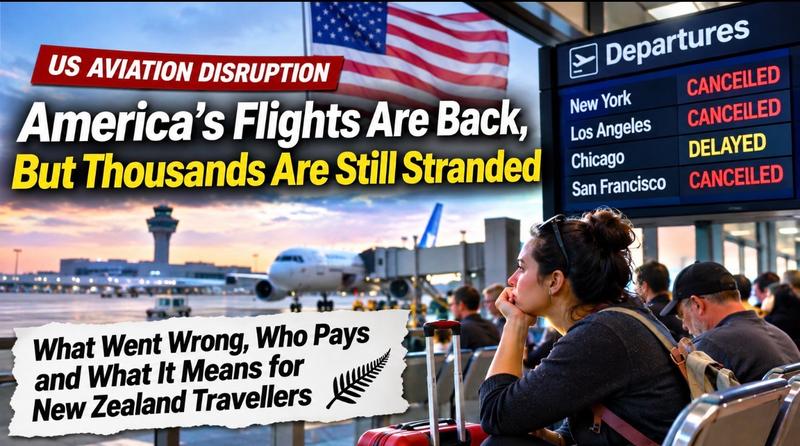
On Friday, 13 November, the US Federal Aviation Administration (FAA) ordered a nationwide ground stop after communications problems affected air traffic control centres across the country.
The order prevented most aircraft from departing US airports. Planes already flying were generally allowed to continue towards their destinations, while international arrivals were assessed individually.
The restriction lasted more than four hours before being lifted at approximately 8.15pm Eastern Time.
Officials said the decision was necessary because air traffic controllers were experiencing unreliable communications and radar information.
The problem was not with the aircraft themselves. It was with the infrastructure that allows controllers to safely manage thousands of flights moving through American airspace every day.
US Transportation Secretary Sean Duffy said ageing switches and routers had become overloaded, causing instability across the network.
Authorities said there was no indication of a cyberattack.
A country investing billions in aviation, yet relying on technology from the 1980s
Perhaps the most troubling part of this incident is what it revealed about the technology behind American aviation.
While passengers fly in aircraft equipped with sophisticated navigation systems, parts of the infrastructure supporting US air traffic control still depend on equipment and copper wiring dating back decades.
Duffy acknowledged that the system uses old switches, routers and communications lines that urgently need replacing.
The US government has already approved US$12.5 billion towards modernising air traffic control infrastructure. Officials say another US$30 billion will be needed to complete the work.
That is more than US$42 billion in existing and proposed investment, yet the country has just experienced a nationwide shutdown caused by problems in the very systems that modernisation is intended to fix.
Investigators are examining the technical circumstances surrounding the failure. There is currently no established evidence that a recently introduced artificial intelligence system caused the outage.
The question now is whether America can modernise its aviation infrastructure quickly enough without exposing passengers to further disruption.
The shutdown lasted hours. The disruption could last days.
For airlines, reopening the skies was only the beginning.
Consider a passenger booked to fly from Los Angeles to New York, with a connecting flight to London.
If the first flight is cancelled, the passenger may miss the international connection. Meanwhile, the aircraft that was supposed to operate another service from New York never arrives.
Its crew may be stranded elsewhere. Replacement flights may already be full.
Multiply that situation across thousands of aircraft, crews and airports, and the scale of the problem becomes clearer.
This is why airlines cannot simply restart their schedules the moment a ground stop ends.
By Saturday, major US carriers were still cancelling flights and working through the backlog. Aviation analysts warned that restoring normal operations could take several days.
The consequences were also being felt in cargo operations, where delayed aircraft can mean delayed commercial shipments and deliveries.
Not every aircraft was grounded in the air
One important detail has been lost in some of the alarming headlines.
The FAA’s order was primarily intended to stop aircraft from taking off, not to force every plane already flying to land immediately.
According to aviation analytics company Cirium, at least 827 flights had been diverted or returned during the disruption, including 670 that went back to their departure airports and 157 redirected elsewhere.
For passengers, that meant some flights ended up back where they started.
But the ground stop itself was a safety precaution. Officials wanted to limit new departures until controllers could once again rely on their communications systems.
The decision was disruptive, but allowing aircraft to continue departing while essential information was unreliable could have created a much more serious situation.
Why the rest of the world felt America’s aviation problem
The United States is not simply another destination on the international aviation map.
It is a major hub connecting passengers travelling between North America, Europe, Asia, Australia and the Pacific.
When American airports stop accepting departures, the consequences quickly spread to other countries.
International airlines must decide whether to delay flights heading towards the United States. Aircraft and crews may be left waiting overseas. Passengers who planned to change planes at American airports can find themselves stranded even when their original international flight operates normally.
The disruption also affected international departures and freight movements.
It is a reminder that modern aviation works as one connected network. A problem in one major country can disrupt journeys thousands of kilometres away, even when airports elsewhere are operating normally.
The cost of being stranded is not always covered
There is another side to this disruption that deserves attention.
A cancelled flight can mean an unexpected hotel stay, additional meals, missed accommodation bookings or a family waiting another day for someone to arrive.
But who pays for those expenses?
Passengers affected by US flight cancellations are generally entitled to a refund if they choose not to travel or accept an alternative. That does not automatically mean airlines must compensate them for every additional expense.
The distinction matters because this disruption originated in air traffic control infrastructure rather than an individual airline’s operations.
Travel insurers are also examining claims carefully.
In New Zealand, Go Insurance has classified the disruption as a known event from 10am on Saturday, 14 November. Policies purchased after that time may exclude losses arising from the incident.
Allianz Partners has also issued a travel advisory, encouraging passengers to seek assistance from their airline before making insurance claims.
Even travellers with insurance purchased earlier are not automatically covered. Their entitlement depends on the circumstances and policy conditions.
Could it happen again?
The United States has experienced nationwide aviation shutdowns before, although they remain extremely rare.
In January 2023, an FAA computer system failure halted domestic departures for around 90 minutes. Before that, American airspace was shut down following the September 11 attacks in 2001.
Friday’s incident was different, but it raised familiar concerns about the reliability of essential aviation infrastructure.
The FAA is now investigating what caused the latest failure, including whether equipment being upgraded played a role.
The investigation will need to establish not only which component failed, but why the problem spread so widely and whether existing safeguards were sufficient.
That matters beyond the United States. Aviation authorities everywhere depend on communications, radar information and backup systems working together.
New Zealand travellers were caught in the disruption too
For New Zealanders, the story is not simply about crowded American airports.
Air New Zealand confirmed that it had proactively delayed flights departing the United States for New Zealand by approximately two hours while assessing the situation.
Flights scheduled to leave Auckland for the United States were initially expected to operate, although the airline advised passengers to keep checking for updates.
There were also New Zealand travellers caught up in the disruption inside America.
Auckland businesswoman Juanita Neville was reportedly stranded in Houston while trying to reach Nashville. Another Auckland traveller, Leigh Robertson, experienced repeated delays while waiting for a flight from San Francisco to Los Angeles.
Their experiences show how quickly an international journey can unravel, even when the passenger is nowhere near the source of the technical failure.
What New Zealand passengers should know
Anyone travelling to or through the United States over the coming days should check their complete itinerary, particularly if it includes domestic connections.
A flight leaving Auckland on time does not guarantee that a connecting service in Los Angeles, San Francisco or another American airport will operate as planned.
Passengers should also avoid cancelling or purchasing expensive replacement tickets before speaking with their airline.
New Zealand’s Consumer Protection guidance makes clear that refund and compensation rights depend on the cause of the disruption, the type of flight and the applicable ticket conditions.
Travellers should keep their booking confirmations, airline messages and receipts in case they need to make a claim.
Air New Zealand continues to publish information through its official travel alerts and flight-status service.
A bigger problem than delayed flights
There is something unsettling about the fact that a country capable of sending spacecraft into orbit can still have its commercial aviation network brought to a halt by overloaded communications equipment.
The United States has some of the busiest airports, largest airlines and most advanced aircraft in the world. Yet the technology connecting those aircraft to air traffic controllers has not kept pace in every part of the system.
Friday’s shutdown exposed that weakness in a way that passengers could see immediately.
It also demonstrated why aviation safety cannot be measured only by the technology inside an aircraft. The systems on the ground are just as important.
For now, the immediate priority is getting stranded passengers moving again and restoring airline schedules.
But once the departure boards return to normal, a more difficult question will remain.
How did a communications problem become a nationwide aviation shutdown, and what will it take to ensure the next equipment failure does not leave another generation of travellers sleeping in airport terminals?
For New Zealand, where international air travel connects families, businesses and communities to the rest of the world, that is a question worth following.
Sources: FAA, US Department of Transportation, Reuters, Associated Press, Air New Zealand, 1News, NZ Herald, Consumer Protection NZ and travel insurer advisories.