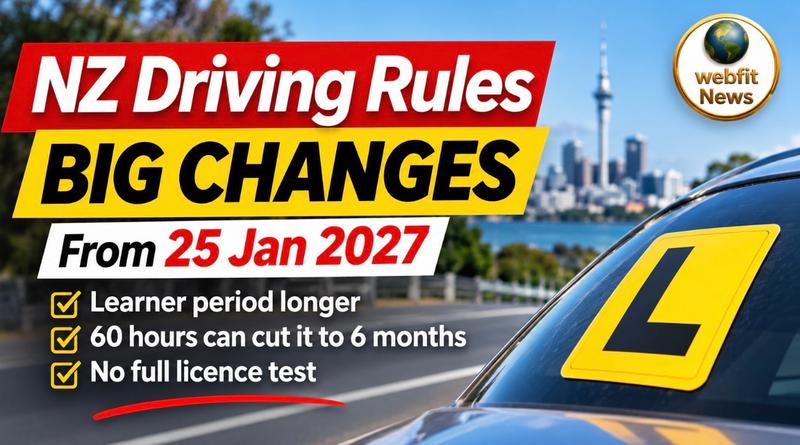
At a glance: What changes on 25 January 2027?
|
Requirement
|
Current rules
|
New rules from 25 January 2027
|
|
Learner period, under 25
|
6 months
|
12 months
|
|
Shorter learner period, under 25
|
Not required
|
6 months with 60 logged supervised hours or an approved course
|
|
Learner period, 25+
|
6 months
|
6 months
|
|
Minimum restricted age
|
16 years, 6 months
|
Unchanged
|
|
Restricted period, under 25
|
Normally 18 months
|
12 months
|
|
Restricted period, 25+
|
Normally 6 months
|
6 months
|
|
Advanced course reducing restricted time
|
Available under current rules
|
No longer available
|
|
Restricted practical test
|
Required
|
Still required
|
|
Full practical test
|
Required
|
Removed for most Class 1 drivers
|
|
Demerit points on restricted
|
Existing penalties apply
|
Can add 6 months to restricted period
|
|
Eyesight checks
|
Required at certain licence stages
|
Generally at first application and renewals, not each progression
|
These changes apply to Class 1 car licences. Motorcycle, heavy vehicle and overseas licence conversion requirements must be checked separately.
Official overview: https://www.nzta.govt.nz/car-licence-changes
1. Under 25? Your learner period is doubling, but there are two ways to shorten it
Under the new rules, drivers younger than 25 will normally need to hold their learner licence for 12 months before they can obtain a restricted licence.
Previously, the minimum was six months.
However, NZTA has confirmed two pathways to bring that period back down to six months:
Pathway A: Complete 60 hours of supervised driving.
You must record qualifying driving sessions and have them validated by an eligible supervisor.
Pathway B: Complete an approved practical learner driving course.
An NZTA-approved course can also reduce the learner period to six months.
You do not need to complete both pathways. Successfully completing either one is sufficient.
Importantly, the six-month minimum remains. Completing 60 hours in a few weeks does not allow someone to obtain a restricted licence immediately.
Example: A 17-year-old gets a learner licence on 1 February 2027
|
Situation
|
Earliest time-based eligibility
|
|
Does not complete either pathway
|
1 February 2028
|
|
Completes 60 qualifying hours
|
1 August 2027
|
|
Completes an approved learner course
|
1 August 2027
|
The learner must also meet the minimum age requirement, pass the restricted practical test and satisfy all other conditions.
The key message: 60 hours can save six months of waiting, but it cannot eliminate the minimum learner period.
2. Already have a learner licence? The transition rules matter
This is particularly important for people who started learning in 2026.
From 25 January 2027, existing learner licence holders will move to the new system if they have not already progressed to restricted.
For those under 25, the normal minimum becomes 12 months from the original learner licence issue date, unless they qualify for the six-month reduction.
Time already spent holding the learner licence is recognised. However, practice completed before 25 January 2027 cannot be counted towards the new 60-hour pathway.
Examples for people who already have a learner licence
|
Learner licence issued
|
Situation
|
What happens?
|
|
1 March 2026
|
Under 25, still on learner on 25 January 2027
|
The new 12-month rule applies; normal time-based eligibility is 1 March 2027
|
|
1 August 2026
|
Under 25
|
Normal time-based eligibility is 1 August 2027, or potentially 1 February 2027 with a completed reduction pathway
|
|
1 December 2026
|
Under 25
|
Normal time-based eligibility is 1 December 2027, or potentially 1 June 2027 with a completed reduction pathway
|
|
1 February 2027
|
Under 25
|
Normal time-based eligibility is 1 February 2028, or potentially 1 August 2027 with a completed reduction pathway
|
These examples assume the person meets the age requirements and has no other restrictions affecting eligibility. The shorter dates are not automatic: the course or 60 qualifying hours must be completed first.
What about people who got their learner licence before 25 July 2026?
Under the current system, some may become eligible for restricted before the changeover.
If they successfully obtain their restricted licence before 25 January 2027, they move forward under the rules applicable to restricted drivers.
If they remain on learner when the new system begins, the new learner rules apply.
Check your exact date using NZTA’s official calculator:
https://www.nzta.govt.nz/driver-licences/apply-for-a-car-licence/car-licence-eligibility-calculator
3. How to record 60 hours of supervised driving
From 25 January 2027, eligible learners can begin recording supervised practice through the NZTA app or an official paper logbook.
Option A: Use the NZTA app
The digital logbook is designed to record practice sessions and allow supervisors to approve them.
The process is:
- Download the NZTA Waka Kotahi app.
- Set up your account and verify your identity using RealMe.
- Ask your eligible supervisor to set up their own app access and verified identity.
- From 25 January 2027, record each supervised driving session.
- Send the session to your supervisor for approval.
- Monitor your approved total until you reach at least 60 hours.
- Once your minimum learner period and other requirements are met, apply for your restricted licence.
Both learner and supervisor need RealMe verified identities to use the digital logging system.
A standard RealMe login is not necessarily the same as a verified identity, so users should arrange verification in advance.
Option B: Use a paper logbook
No suitable smartphone? The paper option is available.
NZTA says the official logbook will be available to download and print from 25 January 2027.
The learner and supervisor must record the required details, including dates, session times, total minutes and supervisor signatures.
Once 60 hours are completed, the learner signs a declaration and takes the completed logbook to a driver licensing agent.
The nominated primary supervisor must also complete a declaration and either attend with identification or arrange for the declaration and identification to be appropriately witnessed.
This is more than simply writing down a total number of hours. The records must be properly completed and verified.
Official instructions:
https://nzta.govt.nz/driver-licences/apply-for-a-car-licence/how-to-get-a-restricted-licence/logging-supervised-driving-hours
4. What counts as supervised driving?
Learners can practise with more than one eligible supervisor. Professional driving instructors and community driving providers may also supervise qualifying sessions.
A supervisor must meet NZTA’s licence and supervision requirements, sit in the front passenger seat, remain attentive and be ready to intervene if necessary.
The learner must comply with the conditions of their learner licence throughout the session.
A trip to school, the supermarket or work can provide useful driving experience if it is lawful supervised practice and properly recorded.
Example: How long does it take to reach 60 hours?
|
Weekly supervised practice
|
Time to reach 60 hours
|
|
2 hours
|
30 weeks
|
|
3 hours
|
20 weeks
|
|
5 hours
|
12 weeks
|
|
6 hours
|
10 weeks
|
|
10 hours
|
6 weeks
|
These are mathematical examples, not recommended weekly targets.
NZTA continues to recommend approximately 120 hours of overall practice before attempting the restricted practical test.
Learners should gain experience on different roads and in different conditions, including night driving where safe and appropriate.
The objective is not simply to collect hours. It is to become a safe, confident driver.
5. What happens if you are 25 or older?
For drivers aged 25 or over, the minimum learner period remains six months.
They do not need to complete the new 60-hour pathway to obtain that six-month minimum.
The restricted period also remains six months.
However, the removal of the full practical test and the new demerit-related progression rules can still affect them.
Example: A 30-year-old gets a learner licence on 1 February 2027
Assuming the required tests are passed promptly and no restrictions delay progression:
- Learner licence issued: 1 February 2027
- Earliest restricted eligibility: 1 August 2027
- Earliest full-licence eligibility: 1 February 2028
The full licence will not ordinarily require a separate practical test.
6. Restricted licence holders: Some drivers could progress sooner
The minimum restricted period for drivers under 25 is reducing from 18 months to 12 months.
For drivers aged 25 and over, it remains six months.
That means some people already on restricted when the rules change could become eligible for a full licence immediately.
Example: A 20-year-old has held restricted since October 2025
By 25 January 2027, they will have held their restricted licence for more than 12 months.
If they satisfy all other requirements and have no relevant demerit-related extension, they may be eligible to apply for their full licence under the new system without sitting another practical test.
Example: A 22-year-old gets restricted on 1 September 2026
Their normal 12-month restricted period would end on 1 September 2027.
Provided no additional period applies, they may be eligible to progress then.
They do not need to wait the old 18-month period.
Example: A 28-year-old gets restricted on 1 October 2026
The normal six-month period ends on 1 April 2027.
They may then progress to full without the standard full practical test, subject to the applicable requirements.
The exact eligibility date can be checked using NZTA’s calculator.
7. The full practical test is being removed, but driving standards are not
One of the biggest changes is the removal of the ordinary Class 1 full-licence practical test.
From 25 January 2027, most drivers will need to pass only one practical driving test during the graduated licensing process: the restricted practical test.
The hazard-perception assessment currently associated with the full test will move into the restricted test.
This means the restricted practical test becomes especially important.
What does not change?
Learners still need to pass the theory test to obtain their learner licence.
They must still meet the relevant age and time requirements.
They must still pass the restricted practical test.
And drivers on restricted licences must still comply with their licence conditions.
The new system removes a testing stage, not the requirement to demonstrate safe driving.
Some overseas licence conversion applicants will continue to require a full practical test.
Official guidance:
https://www.nzta.govt.nz/driver-licences/apply-for-a-car-licence/how-to-get-a-full-licence
8. Demerit points could cost restricted drivers another six months
This is one of the most important changes for drivers already on restricted.
Under the new rules, receiving demerit points while on a restricted licence can extend the required restricted period by six months for each qualifying event.
And the transition reaches back into 2026.
Demerit points received from 7 May 2026 may affect progression after 25 January 2027.
Example: A driver gets restricted on 1 February 2027
For a driver under 25:
|
Driving record
|
Illustrative minimum restricted period
|
|
No qualifying demerit events
|
12 months
|
|
One qualifying demerit event
|
18 months
|
|
Two qualifying demerit events
|
24 months
|
These examples assume each event triggers a separate six-month extension. Actual eligibility depends on NZTA’s application of the rules and the driver’s record.
This is not a system in which a driver can assume a small infringement has no effect on when they obtain a full licence.
It also means a driver who has already completed the normal restricted period may need to wait longer because of relevant demerits.
9. Other changes drivers should know
The licensing overhaul includes changes beyond the headline learner and restricted periods.
Eyesight checks: Routine eyesight checks will generally no longer be required when progressing to restricted or full. They remain relevant at initial application, renewal and where otherwise required.
Advanced driving courses: Courses will no longer shorten the restricted licence period. This is separate from the new approved learner courses, which can shorten the learner stage for under-25s.
Zero alcohol: The Government has also announced an extension of the zero-alcohol requirement to all learner and restricted drivers, regardless of age. NZTA’s published implementation material indicates this measure is being introduced on a different timetable, so it should not be assumed to start on 25 January 2027.
Overseas licences: Overseas conversion applicants should follow the specific conversion requirements rather than assuming the standard removal of the full practical test applies to them.
10. Frequently asked questions
Can I record my 60 hours now, in November 2026?
No. Practice is encouraged, but only qualifying sessions from 25 January 2027 can count towards the new reduction pathway.
Do I need 60 hours if I am 26?
No. The new 60-hour reduction pathway is intended for drivers under 25 who want to shorten their 12-month learner period to six months.
Can my parent supervise me?
Yes, provided they meet NZTA’s supervisor eligibility requirements.
Can I use different supervisors?
Yes. Each must meet the requirements and correctly approve or record the sessions they supervise.
Can I use a driving instructor?
Yes, provided the instructor is an eligible supervisor and the session meets the logging requirements.
Do I need RealMe?
For the NZTA app’s digital driving logbook, a RealMe verified identity is required for the learner and supervisor. A paper logbook is available as an alternative.
Can I get restricted immediately after completing 60 hours?
No. You must still have held your learner licence for at least six months, meet the minimum age requirement and pass the practical test.
What if I already have a restricted licence?
The new restricted periods apply from 25 January 2027. Depending on your age, issue date and demerit history, you may become eligible for full sooner.
Will I need to sit a full practical test in February 2027?
Most ordinary Class 1 applicants will not. Overseas conversion and other exceptional requirements should be checked separately.
Will the restricted practical test become harder?
The hazard-perception component will move into the restricted test. Drivers should prepare using the updated NZTA testing guidance rather than assuming the test is unchanged.
Is 60 hours enough practice to become a safe driver?
It is the minimum for the shortened learner period, not NZTA’s overall recommended practice target. NZTA recommends around 120 hours before the restricted test.
11. Official NZTA links: Keep these handy
12. Your checklist before 25 January 2027
- ☐ Check the issue date on your current licence.
- ☐ Use the NZTA eligibility calculator to identify your dates under the new system.
- ☐ If under 25 and on learner, decide between 60 supervised hours and an approved course.
- ☐ Arrange eligible supervisors and set up RealMe verified identities if using the app.
- ☐ Continue practising now, but do not count pre-25 January practice towards the new 60-hour requirement.
- ☐ If already on restricted, check whether the shorter period could make you eligible for full sooner.
- ☐ Check whether demerit points could extend your restricted period.
- ☐ Confirm the applicable requirements before booking or changing a driving test.
The bottom line
New Zealand is making one of its biggest changes to the car licensing pathway in years.
For drivers under 25, the learner stage becomes longer unless they demonstrate supervised experience or complete an approved course. The restricted stage becomes shorter, and the standard full practical test disappears for most drivers.
For parents, driving instructors and learners, 25 January 2027 is not just the start of new rules. It is the first day qualifying supervised driving hours can be recorded.
The smartest approach is to check your eligibility date, understand which pathway applies and plan ahead rather than relying on advice meant for someone in a different situation.
This guide is based on official NZTA Waka Kotahi and Ministry of Transport information available as at 17 November 2026. The rules are scheduled to commence on 25 January 2027. Individual eligibility depends on age, licence history, demerits and other applicable requirements.