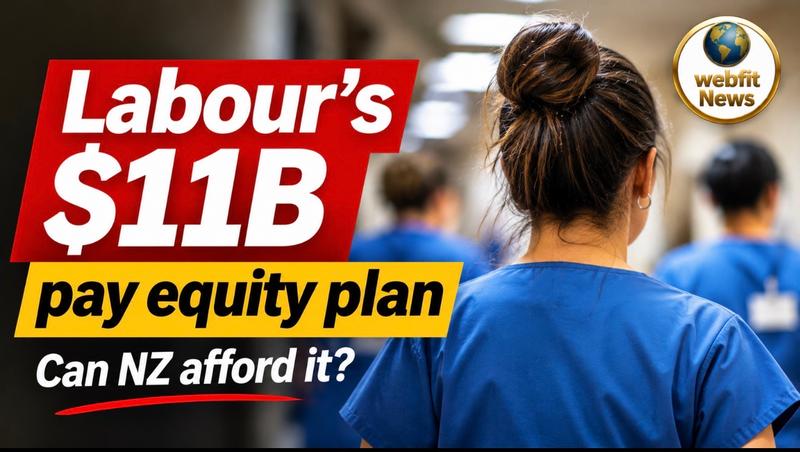
Both parties are talking about fairness. But they disagree sharply over what the country can afford and how the system should work.
First, what exactly is pay equity?
Equal pay and pay equity sound similar, but they address different problems.
Equal pay means a woman and a man doing the same or substantially similar work should not be paid differently because of their sex.
Pay equity goes further. It asks whether an occupation dominated by women has historically been undervalued compared with different work requiring comparable skills, responsibilities, effort and working conditions.
For example, a care worker and a worker in a male-dominated occupation might perform very different jobs. A pay equity assessment can examine whether the value of their work is comparable and whether sex-based undervaluation has affected wages.
It does not mean every female-dominated occupation automatically qualifies for a pay rise. A claim must establish the relevant grounds.
That distinction sits at the heart of the current argument.
How did New Zealand get here?
The story stretches back more than half a century.
|
Year
|
What happened
|
|
1972
|
New Zealand passed the Equal Pay Act.
|
|
2012
|
Care worker Kristine Bartlett, supported by her union, challenged the undervaluation of care work.
|
|
2013–14
|
Court decisions established that the Act could address sex-based undervaluation across occupations, not simply unequal pay within the same job.
|
|
2017
|
A National-led government reached a pay equity settlement worth about $2 billion over five years for approximately 55,000 care and support workers.
|
|
2020
|
A Labour-led government introduced a clearer statutory process for raising and resolving pay equity claims.
|
|
2025
|
The National-led coalition tightened the requirements and discontinued existing unresolved claims.
|
|
2026
|
Labour campaigned on restoring the earlier framework, reopening the political argument over cost and fairness.
|
One important historical detail is often overlooked: the landmark 2017 care workers’ settlement happened under a National-led government.
Pay equity has not always been a straightforward Labour-versus-National issue.
What changed in 2025?
The coalition government’s Equal Pay Amendment Act came into force on 14 May 2025.
It raised the female-workforce threshold from 60% to 70% and required that threshold to have been met for at least ten consecutive years for a pay equity claim.
The amendments also introduced stricter requirements for establishing claims and discontinued those still unresolved under the previous framework.
A Human Rights Commission-related report identifies 34 discontinued claims, including 33 connected to the public sector. That is a useful distinction because the numbers are sometimes reported interchangeably.
The government argued that the previous system allowed claims to progress without sufficient evidence of sex-based undervaluation and needed to be more sustainable.
Critics argued the changes made it substantially harder for workers to pursue claims, particularly after years of preparation and negotiation.
The right to bring a pay equity claim was not abolished. But the pathway became more restrictive.
What is Labour promising now?
Labour’s proposal has two important parts.
The first is a commitment to restore pay equity legislation within its first 100 days in government, with transitional arrangements intended to preserve work already undertaken on previous claims.
The second is a $4-an-hour increase for approximately 65,000 care and support workers, which Labour proposed would begin on 1 January 2027.
For a worker employed for 40 hours a week, that would mean:
|
Pay increase
|
Before tax
|
|
Per hour
|
$4
|
|
Per week
|
$160
|
|
Per year (52 weeks)
|
$8,320
|
That is a meaningful amount for households facing rent, groceries, transport and power bills.
But the $4 increase is not the same thing as settling every pay equity claim.
Other claims would still need to be assessed and negotiated. The cost of those future settlements is where the larger financial dispute begins.
Where does the $11 billion figure come from?
National has cited a Treasury estimate of approximately $10.97 billion for reinstating the previous pay equity regime.
The figure is a projected fiscal cost, not a bill already paid or a guaranteed payout to workers.
National’s finance spokesperson Nicola Willis argues Labour has specifically allocated about $2.5 billion for its immediate commitment, leaving roughly $8.5 billion associated with wider settlements to be met from other fiscal provisions.
Labour says its immediate care-worker increase is fully funded and that future settlements should be funded through future Budgets as their negotiated costs become clear.
Labour also argues that announcing a fixed amount for future settlements in advance could weaken negotiations.
The disagreement is therefore not simply whether pay equity is desirable.
It is about how much future settlements may cost, when those costs will arise and whether Labour’s financial plan has enough room to accommodate them.
The Treasury estimate deserves scrutiny, but so does the distinction between a modelled liability and money already committed to individual workers.
What both sides are leaving voters to weigh up
National has a legitimate question for Labour: if the previous regime is restored, where will the money come from when further claims are settled?
A commitment to fund future agreements through future Budgets does not remove the need to explain the fiscal trade-offs.
Labour, meanwhile, raises a legitimate question for National: if work has genuinely been undervalued because it is predominantly performed by women, how should that inequality be corrected?
Making claims harder to bring may reduce future government costs, but it does not necessarily prove that historical undervaluation has disappeared.
And there is another issue that often receives less attention.
Care and support work is not optional. New Zealand needs people to look after older residents, disabled people and others requiring daily assistance.
If pay remains unattractive, recruitment and retention can become more difficult. Improving wages may help, although the scale of any resulting savings or benefits would need separate evidence.
That is why this debate cannot be settled by looking at the headline cost alone.
What happens after the election?
Labour’s policy remains a proposal unless it can form or participate in a government able to implement it.
The 2025 legal framework remains in force unless Parliament changes it.
Workers should therefore not assume that the proposed $4 increase or the restoration of previous claims has already taken effect.
The next government’s composition, its legislative priorities and the available Budget funding will determine what happens.
For affected workers, the questions are immediate: will their previous claims be recognised, how long will negotiations take, and when, if ever, will their pay change?
For taxpayers, the question is equally direct: what will the eventual settlements cost, and how will they be funded?
New Zealand has spent more than 50 years debating what equal pay should mean. In 2026, the argument is no longer just about recognising undervalued work. It is about whether the country is prepared to pay the price of correcting it.
And that is a question neither Labour nor National can answer with a slogan.
Sources: New Zealand Labour’s 2026 pay equity policy and fiscal plan; New Zealand National Party’s October 2026 fiscal statements; Equal Pay Amendment Act 2025; Ministry of Business, Innovation and Employment; Health New Zealand; Treasury records relating to the 2017 care and support workers’ settlement; and published reporting on the 2026 fiscal debate.