From migrant to community advocate
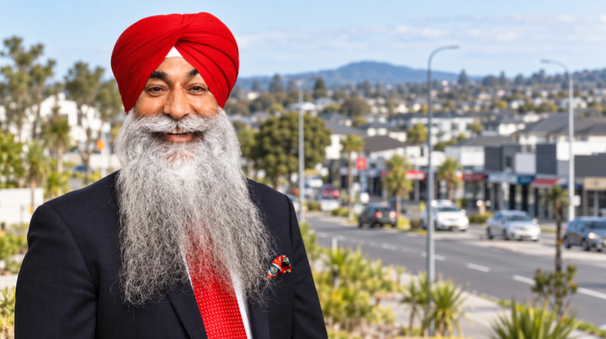
Singh said he arrived in New Zealand in 1987 at the age of 23, after growing up in India and studying economics and public administration.
He described working in the printing industry before moving into business ownership, opening a supermarket in 1995.
Singh credited an immigration policy introduced under the Labour government led by David Lange with helping him establish his life in New Zealand.
He said his involvement in community organisations, alongside his work as a justice of the peace and marriage celebrant, gradually led him towards politics.
Singh recalled seeing families struggling with basic expenses, including school uniforms and winter clothing.
For him, those experiences reinforced the importance of ensuring community concerns were represented in Parliament.
He also spoke about his involvement in previous election campaigns, including the 2020 Takanini campaign and his own candidacy in Botany in 2023.
Singh said his long-standing personal, business and community connections with Takanini had influenced his decision to contest the electorate.
Roads, schools and services in a growing electorate
Asked what he would prioritise if elected, Singh identified cost of living and infrastructure as major concerns for Takanini.
He argued that residential development had placed increasing pressure on roads, schools and other local services.
Singh said some families were travelling outside their local school zones, adding transport costs and time to their daily routines.
He also identified Mill Road as a project he would advocate for.
His proposed approach would involve working with central government, Auckland Council and local boards to coordinate infrastructure investment with residential growth.
Singh argued that building additional housing without providing adequate transport, schools and community facilities would place further pressure on existing services.
He acknowledged that some projects fall outside the direct control of an electorate MP.
“You only promise what you can deliver,” he said.
He added that his responsibility would be to advocate for the constituency and work with the relevant authorities.
The interview did not establish a project budget, construction timetable or specific funding commitment for Mill Road.
Labour's policies: What Singh told viewers
Singh used the interview to outline several Labour election proposals.
These are party commitments rather than measures already in force.
Policy area | Proposal discussed | What it would mean |
|---|
Public transport | $20 weekly fare cap | Labour proposes limiting eligible weekly bus and train fares to $20. |
GP access | Three free GP visits annually | Labour proposes three free GP visits each year through a new Medicard. |
Small business | GST registration threshold of $80,000 | Labour proposes increasing the threshold from $60,000. |
Business investment | Tax support for qualifying equipment purchases | Labour proposes an immediate deduction for qualifying equipment expenditure of up to $10,000. |
GP clinics | Loans to help doctors establish practices | Labour proposes financial assistance for eligible doctors establishing owner-operated practices. |
Student debt | Debt reduction for qualifying borrowers | Labour proposes conditional student loan debt relief. |
Sources: Labour's published 2026 election policies and statements made by Singh during the interview.
The distinction between a candidate's description and a published policy is important.
For example, Singh discussed a $10,000 business tax benefit. Labour's published proposal concerns a tax deduction for qualifying equipment expenditure, rather than a $10,000 cash payment.
Similarly, Singh described student debt relief during the interview. The policy should not be interpreted as an immediate, universal write-off for every borrower.
Housing affordability and the pressure on families
Housing affordability was another major topic.
Asked about families struggling with rent or being priced out of home ownership, Singh linked housing pressures to the wider cost of living.
He criticised the current Government's approach to housing and argued that Labour had a stronger record of building social housing.
Those were Singh's political assessments rather than independently established conclusions presented by Webfit News.
He also connected housing affordability with employment, wages and household expenses.
Singh argued that reducing transport, healthcare and electricity costs could help families manage their finances.
However, he did not outline a specific Takanini housing development target or provide a timetable for increasing local housing supply.
Healthcare: Earlier access and more local services
On healthcare, Singh said the cost of visiting a GP could discourage people from seeking medical attention.
He argued that delayed treatment could result in more serious health problems and additional pressure on hospitals.
Singh pointed to Labour's proposed free GP visits as one way the party intends to improve access.
He also discussed proposals to support doctors establishing practices in communities where healthcare services are needed.
For growing areas such as Takanini, he suggested that additional local practices could help residents access care closer to home.
Asked specifically about after-hours healthcare, Singh focused on the benefits of earlier GP access and expanding local services.
He did not identify a specific new after-hours facility or provide a timetable for one.
Supporting young people and safer communities
Singh also discussed youth crime, prevention and the importance of early intervention.
He argued that young people at risk of offending should receive support before their circumstances deteriorate.
He referred to Labour's approach to youth offending and criticised the Government's boot camp policy.
His comments about reoffending rates were not independently verified during the interview.
Singh also supported maintaining a visible police presence while investing in programmes intended to prevent offending.
His broader argument was that enforcement and prevention should be considered together.
Mental health and cultural barriers
Asked about mental health, Singh encouraged people experiencing difficulties to seek support early.
He acknowledged that cultural stigma could make some people reluctant to discuss mental health concerns.
Singh encouraged residents to speak with trusted friends, family members and healthcare professionals.
He also expressed support for additional mental health funding and improved access to services.
However, the interview did not establish a specific local mental health funding commitment or a new service for Takanini.
Representing Takanini's diverse communities
The interview explored how Singh would represent Takanini's Māori, Pacific, Indian and other communities.
Singh described relationships developed through community activities, including food distribution during the COVID-19 pandemic.
He said his involvement with different cultural communities had helped him understand their traditions and concerns.
Singh also spoke about the importance of inviting people from different backgrounds to participate in one another's cultural and community activities.
He argued that representation required understanding communities beyond one's own cultural networks.
Asked how he would reach residents outside the groups where he was already known, Singh pointed to his existing relationships and community involvement.
He did not outline a formal consultation programme or a specific mechanism for reaching residents who were not already connected to those networks.
Encouraging young people to participate in politics
Singh said young people should be encouraged to take an interest in politics before reaching voting age.
He suggested that political discussions could begin at home, with young people asking questions about decisions affecting their future.
He also encouraged eligible voters to enrol and participate in the election.
During the interview, Singh referred to an October enrolment deadline.
Voters should confirm current enrolment requirements directly with the Electoral Commission, as election rules and deadlines should not be relied upon solely from a candidate's interview.
What happens when local priorities conflict with party policy?
One of the interview's more direct questions concerned what Singh would do if Labour's national position conflicted with what he believed Takanini needed.
Singh said disagreements would be discussed internally.
“We discuss the issues behind closed doors,” he said.
He explained that once the party reached a decision, members would present a united position publicly.
His response clarified his approach to party discipline.
However, he did not identify a specific issue on which he would publicly challenge Labour.
Asked how residents could hold him accountable, Singh returned to four priorities: cost of living, jobs, health and homes.
He said he would advocate for Takanini while recognising the limits of what an individual MP could deliver.
What remains to be tested?
The interview gave residents an account of Singh's priorities and the Labour policies he supports.
It also left several practical questions for the campaign.
Issue | Singh's stated position | What remains unclear |
|---|
Cost of living | Support Labour's proposals to reduce household expenses | The measurable effect on a typical Takanini household |
Mill Road | Advocate for improvements | Funding, delivery timetable and specific commitments |
School capacity | Seek better infrastructure alongside residential growth | Which schools would receive additional capacity and when |
Healthcare | Support free GP visits and additional local practices | Whether Takanini would receive new facilities or after-hours services |
Housing | Support Labour's housing approach | Specific local housing targets and delivery dates |
Youth crime | Emphasise prevention alongside enforcement | Local programme funding and measurable outcomes |
Community representation | Work with different cultural communities | A formal consultation process and reporting arrangements |
These questions are relevant because several of Singh's priorities involve decisions made by central government agencies, Auckland Council or other organisations.
An electorate MP can advocate for projects and seek government support, but cannot independently guarantee their funding or delivery.
Singh's statements about unemployment, migration, business liquidations and youth reoffending were not independently verified during the interview and should be treated as claims made by the candidate.
A campaign built around local connections
In his closing remarks, Singh emphasised his long association with Takanini.
He said he had lived, worked and participated in community activities in the area for decades.
He described his campaign as an opportunity to advocate for the electorate and contribute to its future development.
Throughout the interview, Singh repeatedly returned to four priorities: cost of living, jobs, healthcare and housing.
For Takanini residents, the interview provides a clearer picture of the issues he intends to pursue.
The next questions concern which projects could be funded, when changes could happen and how residents would be able to measure progress.
Reporting: Webfit News Date: 29 September 2026
Source: Webfit News interview with Kharag Singh, supplemented by Labour's published 2026 election policy material.