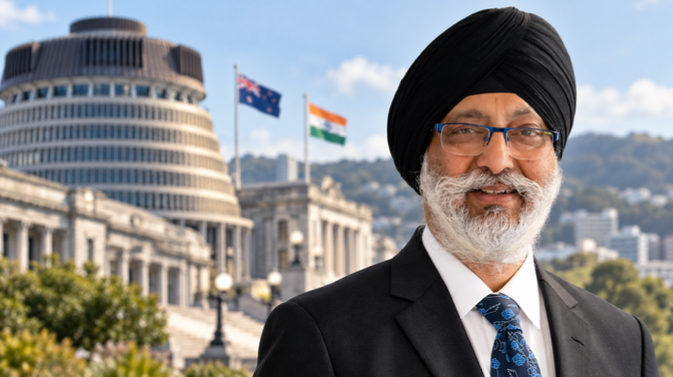
Bakshi described travelling to India on official delegations and working to improve understanding of India's development among his parliamentary colleagues.
He also recalled arranging a presentation to National MPs by India's then high commissioner, Admiral Suresh Mehta, to highlight developments in India's infrastructure, defence and aerospace sectors.
For Bakshi, the relationship was about more than government meetings.
He argued that sustained contact between ministers, officials and communities was essential to building trust.
He also pointed to sporting exchanges, education and cultural connections as important parts of the relationship.
“It's not only trade,” he said, discussing opportunities for cooperation between the two countries.
Why trade negotiations took time
A substantial part of the interview focused on New Zealand's trade relationship with India.
Bakshi said India's concerns about protecting its farmers had been a major challenge in negotiations.
He argued that New Zealand could offer complementary agricultural products, expertise and technology rather than simply compete with Indian producers.
As an example, he discussed opportunities to improve the movement of produce from farms to markets and reduce losses along the supply chain.
He also praised Trade Minister Todd McClay's engagement with Indian counterparts, describing repeated visits and relationship-building as important to progress.
Bakshi spoke about the New Zealand–India Free Trade Agreement and its potential benefits for exporters, including reduced tariffs and faster clearance of perishable goods.
The agreement was signed on 27 April 2026, with ratification completed on 21 September. It is scheduled to enter into force on 20 October 2026.
The Government says 57 percent of New Zealand exports to India will be tariff-free when the agreement takes effect.
Bakshi urged businesses to look beyond the immediate tariff arrangements and consider longer-term opportunities.
Asked whether the relationship should be measured primarily in export dollars, Bakshi said education, research, cultural exchange and sporting cooperation also mattered.
He expressed the view that these connections could create benefits extending well beyond the value of goods traded.
Representation beyond a seat in Parliament
Bakshi also reflected on becoming New Zealand's first Indian-born MP in 2008.
He said that after arriving in New Zealand in 2001, he noticed the absence of Indian-born representation in Parliament and began encouraging political participation within the community.
He recalled initially looking for someone else to stand before being persuaded to put his own name forward.
Bakshi said representation had practical consequences.
One example he raised involved immigration settings for religious workers.
He described difficulties faced by Hindu, Sikh and Muslim religious leaders whose training did not fit conventional academic qualification requirements.
Bakshi said he worked with the immigration minister to improve recognition of religious experience and community endorsement.
He presented that work as an example of how an MP familiar with a community's practices could explain problems that might otherwise be overlooked.
Asked what meaningful representation should look like beyond placing Indian-origin names on candidate lists, Bakshi pointed to cooperation across party lines.
He recalled working with MPs of Indian origin from other parties, including Labour's Dr Rajen Prasad and New Zealand First's Mahesh Bindra.
Their party affiliations differed, he said, but they could still discuss concerns affecting their communities.
Bakshi expressed hope that future generations would see more Indian-origin New Zealanders serving in Parliament and holding senior political roles.
Law and order: From parliamentary inquiry to today's debate
Bakshi served as chairperson of Parliament's Law and Order Committee from 2015 to 2017.
During the interview, he recalled the committee's work on a firearms inquiry and said the experience reinforced his belief that law and order required sustained government attention.
He also spoke about violent incidents affecting Indian New Zealanders during his early years in politics, describing the fear those incidents created among families and business owners.
Bakshi credited National-led governments with improvements in policing and public safety, and criticised Labour's record.
Those were his political assessments. The interview did not establish a comparable set of crime statistics across the periods he discussed.
Asked what he understood differently after leaving Parliament, Bakshi said his commitment to National remained unchanged.
He explained that leaving Parliament had given him somewhat greater freedom to speak, although he continued to regard himself as a loyal party member.
Migrant exploitation and the responsibility to speak up
The conversation turned to the difficulties migrants can face after arriving in New Zealand.
Bakshi said political leaders had a responsibility to respond when migrants experienced exploitation or discrimination.
He referred to immigration protections for people who report exploitation and encouraged those affected to seek assistance rather than remain silent.
“No one should be abused,” he said.
Bakshi also encouraged people experiencing difficulties with government processes to approach their local MP, regardless of party affiliation.
He cautioned, however, against expecting MPs to bypass official procedures.
Recalling his time in Parliament, Bakshi said some constituents expected an MP to resolve an immigration, policing or healthcare issue with a single telephone call.
In New Zealand, he explained, MPs must work through the relevant processes and authorities.
That distinction, he suggested, was important for communities to understand when seeking help.
Human rights and the wider relationship with India
Webfit News also asked how New Zealand should respond when its commercial interests with India and its human rights principles pull in different directions.
Bakshi said New Zealand should continue raising human rights concerns, including those affecting women and LGBTQ people.
He argued that the principle should apply internationally, not only to India.
His answer indicated that he did not regard a closer trading relationship as a reason to abandon discussion of human rights.
He did not, however, identify a particular dispute or set out how New Zealand should respond if a specific human rights concern threatened a commercial agreement.
What should voters ask of their representatives?
Bakshi encouraged voters to attend public meetings, question candidates and remember the commitments they make.
He said people should return to their representatives after an election and ask what had happened to promises made during the campaign.
Asked about politicians who attend cultural celebrations but are harder to reach when difficult issues arise, Bakshi encouraged people to raise those concerns directly.
He said he had tried to respond to challenging questions throughout his political career, while acknowledging that an answer would not always satisfy everyone.
The interview also addressed whether Indian New Zealanders were sometimes treated as a single voting bloc.
Bakshi pointed to the growing presence of Indian-origin people in public life and said MPs from different parties could work together on shared community concerns.
He did not suggest that all Indian New Zealanders held the same political views.
The demands of parliamentary life
One of the interview's more personal moments came when Bakshi was asked what warning he would give his younger self before entering Parliament in 2008.
His answer was that political life could be exhausting and, at times, lonely.
He recalled catching early flights from Auckland to Wellington, working late into the evening and returning home to a weekend filled with community commitments.
There were days, he said, when attending events across Auckland meant driving hundreds of kilometres.
The work also required extensive reading, committee preparation and participation in parliamentary debates.
“Parliament sometimes, I feel, was a very lonely place unless you had good friends with you,” he said.
Yet he described serving as an MP as a privilege that offered experiences money could not buy.
He recalled meeting visiting international leaders and travelling to India as part of an official delegation.
One memory stood out: stepping off an aircraft in India alongside Sir John Key and his wife, Bronagh, and seeing a red carpet laid out for the delegation.
For someone born in India who had gone on to represent New Zealand, Bakshi said the moment carried particular personal meaning.
Bakshi's message ahead of the election
The interview concluded with a discussion of the 2026 general election.
Bakshi encouraged eligible New Zealanders to participate and expressed his support for National, including its party and electorate candidates.
His endorsement reflected his continuing affiliation with the party, not a position taken by Webfit News.
The general election will be held on 7 November 2026. The final day to enrol is 25 October, advance voting begins on 26 October, and overseas voting begins on 21 October.
Bakshi also encouraged voters to examine candidates' promises and question elected representatives about their delivery.
A legacy he hopes will continue
Asked what he hoped people would remember about his public service, Bakshi returned to the question of representation.
He acknowledged that some people would appreciate his work while others would criticise it.
What mattered to him, he said, was helping create opportunities for future generations.
He hoped political parties would continue recognising the contribution Indian New Zealanders could make, not only as candidates but also as MPs and ministers.
Bakshi even raised the possibility that New Zealand might one day have a prime minister of Indian origin.
It was a forward-looking aspiration rather than a prediction.
For Bakshi, the significance of his parliamentary career was not simply that he had been elected. It was the possibility that others could follow, build relationships across political divides and contribute to decisions affecting the whole country.
His conversation with Webfit News offered a view of that career through his own experiences, from the work of an electorate office and select committee to the diplomatic relationships he helped cultivate.
It also highlighted a distinction he returned to throughout the interview: holding public office brings opportunities, but those opportunities come with obligations to the people who seek representation.
Webfit News Interview | 29 September 2026