.
BOOK REVIEW | WEBFIT NEWS
BOOK REVIEW | WEBFIT NEWS He has scored thousands of runs, led New Zealand to a world title and earned the respect of cricket’s fiercest competitors.
.
BOOK REVIEW | WEBFIT NEWS
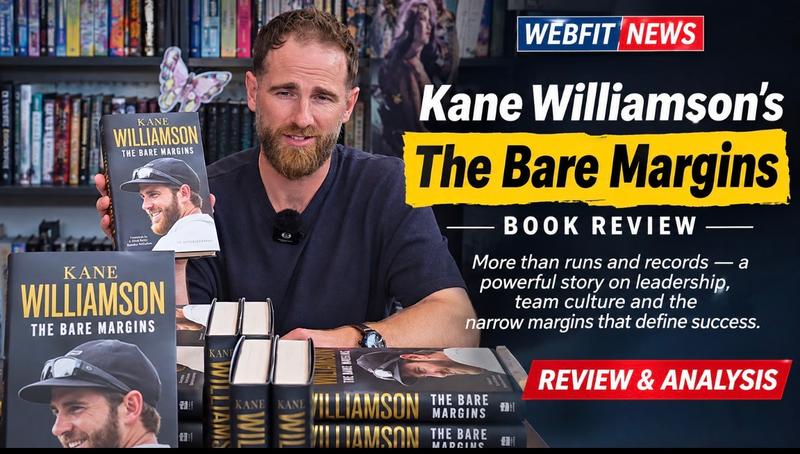
He has scored thousands of runs, led New Zealand to a world title and earned the respect of cricket’s fiercest competitors. But Kane Williamson’s new autobiography, The Bare Margins, reveals a more compelling story about fear, failure, friendship and what it really takes to build a winning team.
By Webfit News Sports Desk | 10 November 2026
There is something unusual about Kane Williamson.
When he scores a century, he barely celebrates. When he loses a match, he rarely looks devastated. And when New Zealand suffered one of the most heartbreaking defeats in cricket history, he somehow managed to smile.
For years, cricket fans have wondered what goes on behind that calm expression.
Now, with the release of his autobiography, The Bare Margins, Williamson offers readers an opportunity to understand the experiences, relationships and difficult moments that shaped one of New Zealand’s most respected sporting figures.
Published by HarperCollins, the book arrives on 10 November 2026, bringing together the story of a boy from Tauranga who became one of international cricket’s finest batters and most admired captains.
But the most interesting part of this story may have surprisingly little to do with batting.
It is about what happens when talented people stop competing against their own teammates and start believing in one another.
And that is where The Bare Margins becomes more than just another cricket autobiography.
The Dressing-Room Story That Says More Than a Thousand Runs
One of the most revealing experiences highlighted in the book’s published description concerns Williamson’s early days in the New Zealand dressing room.
He compares the atmosphere to a herd of antelope being chased by lions.
The idea is simple. You do not necessarily need to be the fastest antelope to survive. You just need to avoid being the slowest.
Now imagine applying that mentality to a cricket team.
A player might worry more about keeping his place than helping another player improve.
A struggling teammate could become competition rather than someone who needs support.
And the fear of failure could become stronger than the desire to win.
It is a striking observation because it challenges how we usually think about professional sport.
We assume that putting talented individuals together automatically creates a strong team.
But it doesn’t.
Sometimes the biggest obstacle to success is not the opposition. It is the environment inside your own dressing room.
This is arguably the most fascinating theme emerging from Williamson’s autobiography.
And it is not difficult to see why it matters beyond cricket.
Anyone who has worked in a competitive office, managed a struggling team or felt pressure to protect their position may recognise that same mentality.
The question becomes whether people are working together to succeed or simply trying not to be the person who fails.
How Brendon McCullum Helped Change the Black Caps
Williamson’s career overlapped with one of the most important cultural transformations in New Zealand cricket.
Under Brendon McCullum, the Black Caps began moving towards a more confident, positive and team-oriented approach.
McCullum encouraged players to express themselves, take responsibility and approach the game with greater freedom.
Williamson inherited and developed that culture in his own quieter style.
The contrast between the two captains is fascinating.
McCullum was bold, expressive and willing to challenge convention.
Williamson was measured, thoughtful and rarely interested in making himself the centre of attention.
Yet both understood something important.
A team cannot perform at its best when players are constantly afraid of making mistakes.
That philosophy would eventually help New Zealand compete with cricketing nations possessing considerably larger populations and deeper financial resources.
The Black Caps became a team respected not simply for their results but also for the way they played.
And Williamson became the face of that transformation.
The Day Kane Williamson Lost the World Cup Without Really Losing
If there is one moment that defines Williamson’s international career for millions of cricket followers, it is 14 July 2019.
The venue was Lord’s, London.
The occasion was the Cricket World Cup final.
New Zealand faced England in a contest that would become one of the most extraordinary matches ever played.
New Zealand scored 241 for eight.
England finished on exactly 241.
The match went into a Super Over.
Both teams scored 15 runs.
Still tied.
Yet England were declared world champions because they had scored more boundaries during the match, under the tournament regulations in force at the time.
For New Zealand, it was devastating.
For cricket fans around the world, it raised an uncomfortable question.
How could a team lose a World Cup final when the scores were still level?
Williamson had led his country through an outstanding campaign and was named Player of the Tournament.
But the trophy went to England.
What made the moment even more remarkable was Williamson’s response.
There was no public outburst, no attempt to make the defeat about himself and no dramatic display of anger.
He accepted the result with extraordinary composure.
That reaction earned admiration across the cricketing world, particularly among Indian fans who had watched New Zealand defeat India in the semifinal.
But there is another side to that famous image.
Just because someone looks calm does not mean the disappointment is small.
And that is what makes the book’s reflections on the narrow margins between winning and losing especially interesting.
Sometimes years of preparation, sacrifice and exceptional performances come down to a rule, a moment of luck or a single delivery.
The result becomes history.
The effort behind it is easily forgotten.
Then Came the Victory That Changed Everything
Two years after the disappointment at Lord’s, Williamson returned to another major ICC final.
This time, the opposition was India.
The occasion was the inaugural World Test Championship final in Southampton in June 2021.
New Zealand’s fast bowlers delivered a superb performance, while Williamson played a crucial role with the bat.
He remained unbeaten on 52 as New Zealand secured an eight-wicket victory.
For the Black Caps, it was a historic achievement.
For Williamson, it was a moment of redemption.
But perhaps the most important lesson was that the team’s approach had not fundamentally changed.
The same emphasis on preparation, patience, discipline and collective responsibility that had guided New Zealand through disappointment was now producing a world championship.
That is the uncomfortable truth about professional sport.
Good decisions do not always produce immediate victories.
And losing does not necessarily mean everything was done incorrectly.
Sometimes the difference between heartbreak and celebration really does come down to the barest of margins.
Virat Kohli’s Words Reveal Another Side of Kane Williamson
One of the most appealing aspects of The Bare Margins is the involvement of people who have known Williamson as both a teammate and an opponent.
The book features forewords from former New Zealand captain Brendon McCullum, Indian cricket superstar Virat Kohli and performance specialist Owen Eastwood.
Kohli’s contribution is particularly significant.
For years, Kohli and Williamson have been among the defining batters of their generation.
They have competed in major international tournaments, captained their countries and faced the enormous expectations that come with representing cricket-loving nations.
Yet their personalities could hardly appear more different.
Kohli is expressive, passionate and fiercely competitive.
Williamson is understated, controlled and famously reserved.
Despite those differences, there is genuine mutual respect.
In the publisher’s promotional material, Kohli offers a particularly memorable assessment:
“As brilliant and magnificent as Kane the cricketer was, it’s the human who will forever be greater for me.”
That statement captures something cricket statistics cannot measure.
You can count centuries.
You can compare batting averages.
You can analyse strike rates and match-winning performances.
But how do you measure the respect someone earns from the people who compete against them?
Perhaps that is one of Williamson’s greatest achievements.
He has managed to become one of the world’s most successful batters without allowing his individual reputation to overshadow the team.
A Boy From Tauranga Who Became a Global Cricketing Figure
Williamson’s journey began far away from the enormous stadiums and intense international rivalries that would eventually define his career.
Born in Tauranga in 1990, he developed his cricketing abilities in New Zealand before progressing through age-group and domestic cricket.
He made his Test debut against India in Ahmedabad in November 2010.
And he announced himself with a century.
For a young New Zealand batter, scoring a hundred on Test debut in India was an extraordinary achievement.
It also provided an early indication of the temperament that would become his trademark.
Williamson would go on to establish himself as one of the leading Test batters of his generation.
His career also took him into franchise cricket, including the Indian Premier League, where he developed a particularly strong following among Indian supporters.
But unlike some modern sporting personalities, Williamson has generally avoided turning his public image into a constant spectacle.
His reputation has been built primarily on performance, consistency and the respect of fellow players.
That makes the arrival of a personal autobiography particularly interesting.
For someone who has spent so much of his career avoiding unnecessary attention, telling his own story is a significant step.
What Early Readers Are Saying
Early reader feedback suggests that The Bare Margins may appeal to more than cricket enthusiasts.
A customer review published by New Zealand bookseller Book Hero highlights the book’s treatment of New Zealand’s evolving team culture.
The reviewer, identified as Ian M., draws attention to Williamson’s role in continuing the changes associated with McCullum’s leadership.
Interestingly, the review also compares aspects of this leadership philosophy with former England football manager Gareth Southgate and the fictional television coach Ted Lasso.
The comparison is worth considering.
All three examples raise questions about confidence, communication, trust and creating environments where individuals can perform without constantly fearing failure.
That is an important distinction.
A successful captain is not necessarily the person who delivers the loudest speech.
Sometimes the most effective leader is the person who makes others feel comfortable enough to perform at their best.
The available early response is limited, so it would be premature to describe the book as universally acclaimed.
Nevertheless, the themes highlighted by the publisher and early readers suggest that the autobiography has something meaningful to offer beyond a chronological account of Williamson’s career.
Webfit News Review: The Story That Deserves More Attention
Many sports autobiographies follow a familiar formula.
A promising childhood.
An unexpected opportunity.
A breakthrough performance.
A few difficult years.
Some major victories.
And finally, a collection of lessons about hard work and determination.
Those stories can be enjoyable, but they often leave the reader knowing more about what happened than why it mattered.
What makes The Bare Margins particularly promising is its attention to the psychology of a team.
The antelope analogy is a perfect example.
It forces readers to consider a question that applies far beyond cricket.
What happens when people become so afraid of failure that they stop helping one another succeed?
The answer can determine whether a talented group remains ordinary or becomes exceptional.
Williamson’s career provides a compelling case study.
He played alongside some outstanding New Zealand cricketers, including Ross Taylor, Brendon McCullum, Tim Southee, Trent Boult and others who contributed to the Black Caps’ success.
Yet those players did not all share the same personalities, backgrounds or methods.
The challenge was not to make everyone identical.
It was to create a culture where different personalities could contribute towards a common objective.
And that may be one of the most valuable leadership lessons associated with Williamson’s career.
The Question the Book Leaves Us Asking
There is also a more challenging question worth considering.
Is being calm always a sign of good leadership?
Not necessarily.
A captain can appear composed while avoiding difficult conversations.
A manager can be polite while failing to address poor performance.
And a team can look united in public while struggling with problems behind closed doors.
Real leadership requires more than maintaining a pleasant expression.
It requires honesty, accountability and the willingness to make uncomfortable decisions.
Williamson’s reputation for humility and composure is well established.
But the most revealing parts of his story may be those that explore how he handled disagreement, pressure, uncertainty and the expectations of others.
That is where a sporting autobiography can become genuinely valuable.
Not when it tells us that a great player was great.
But when it helps us understand the decisions, doubts and relationships behind that greatness.
Should You Buy The Bare Margins?
For New Zealand cricket supporters, the book is an obvious addition to the bookshelf.
It revisits an extraordinary period in Black Caps history, including the 2019 World Cup final and the 2021 World Test Championship triumph.
For Indian cricket fans, Williamson’s relationship with Virat Kohli, his experiences against India and his connections with the IPL provide additional reasons to be interested.
But the strongest argument for reading The Bare Margins is that it appears to offer something for people who do not follow cricket closely.
Young athletes can learn about dealing with expectations.
Coaches can reflect on how to create better team environments.
Managers can consider how fear affects performance.
And ordinary readers may recognise something of their own lives in Williamson’s experiences of competition, disappointment and resilience.
Webfit News’ verdict: Based on the publisher’s detailed account and available early reader feedback, The Bare Margins stands out as a promising sporting memoir because its central themes reach beyond cricket. The most compelling material is not about the runs Williamson scored, but the culture he helped build and the way he responded when success slipped away.
This is an editorial assessment of the book’s published material and early reception, rather than a claim to have independently reviewed every chapter.
Book details
Final Word: Perhaps Kane Williamson’s Greatest Achievement Was Never a Century
There is a reason Kane Williamson occupies such a special place in New Zealand cricket.
It is not simply because he scored important runs or captained his country to historic victories.
It is because of the way he carried himself through both success and disappointment.
The 2019 World Cup final could easily have become a story of bitterness.
Instead, Williamson’s response became one of the most enduring images of sporting dignity.
The 2021 World Test Championship could have become a celebration of one individual.
Instead, it was remembered as a collective New Zealand achievement.
And the culture that developed around the Black Caps offers a lesson that reaches far beyond the boundary rope.
A great player can win a match. A great leader can help an entire team believe it belongs on the biggest stage.
That may be the most important idea readers take away from The Bare Margins.
Not that Kane Williamson was one of New Zealand’s finest cricketers.
We already knew that.
But that some of the most important victories in sport happen long before anyone walks onto the field.
They happen when fear is replaced by trust.
When individual survival gives way to shared ambition.
And when a group of talented people finally begins to behave like a team.
For a man who has spent much of his career letting his bat do the talking, The Bare Margins offers a welcome opportunity to hear the story behind the silence.
And that is a story worth reading.
Webfit News | Books, Sport & Culture
Editorial note: This feature is based on the publisher’s book description, documented cricket history and publicly available early reader commentary. It is an independent editorial preview and critical assessment, not a commissioned or sponsored review.
Was this article useful?