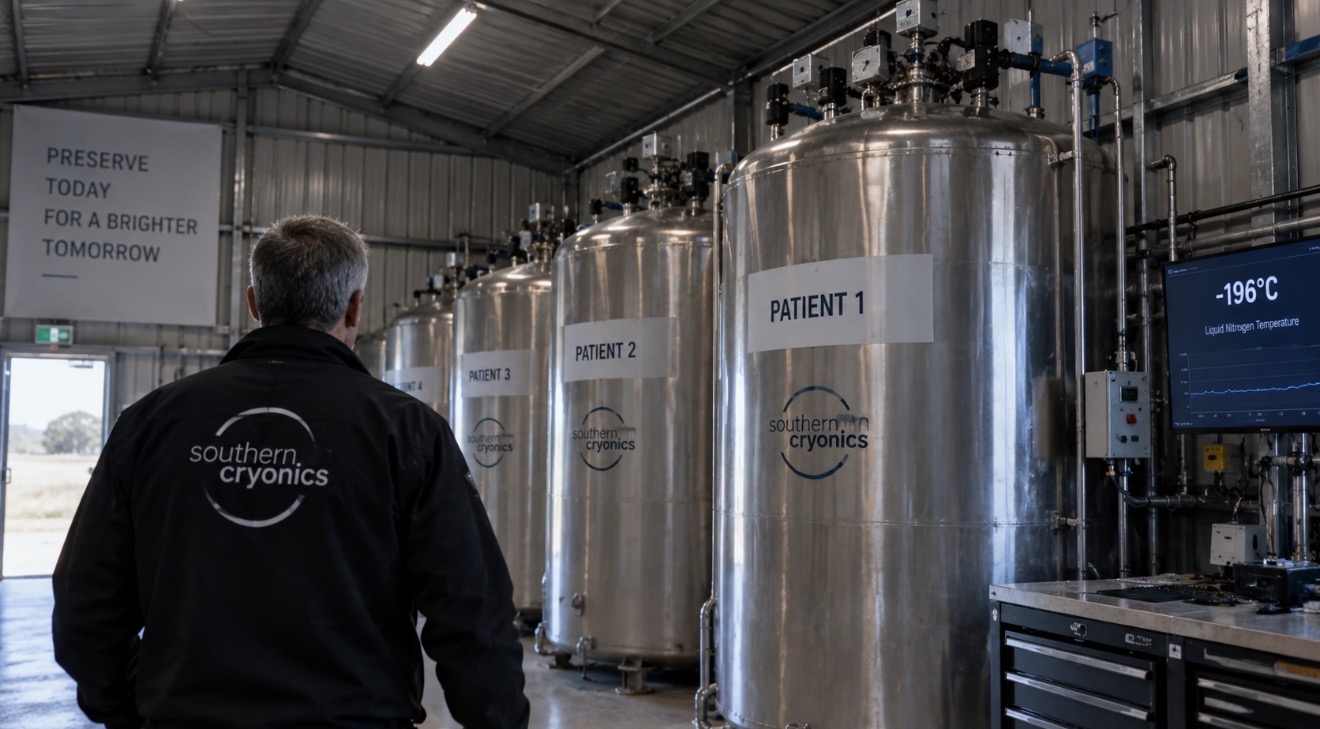
There's a shed in Holbrook. Wrecked cars out front on the grass, the fire brigade right across the road, nothing to suggest anything unusual. Except inside, seven bodies hang upside down in liquid nitrogen at minus 196 degrees. Each person paid more than $200,000 before they died for this. A shot at coming back, someday, somehow.
Southern Cryonics runs it. Only place like it in the whole Southern Hemisphere. Six of these exist worldwide, total.
The Shed Itself
Big steel tanks, dewars they're called, four bodies fit in each one. Peter Tsolakides chairs the company and he won't say "bodies." Patients, he says. Says it like it matters, because it does, that word carries the whole bet the company's making.
Why Holbrook though? Between Sydney and Melbourne, low earthquake risk, no flooding. Makes sense when you're trying to keep something intact for, well, who knows how long. Turns out the town already had liquid nitrogen coming through regularly anyway, a cattle breeding outfit used it for freezing bull semen and embryos. So the infrastructure was basically sitting there waiting.
What You're Actually Paying For
Over $200,000, all in. Sixty grand roughly for the initial freeze right after death, a hundred and fifty for storage that never technically ends. Plus $350 a year, just to keep the membership active. Most people don't pay any of this while alive, they just take out life insurance worth about $210,000 and let that cover it later.
Running one patient costs the company about $5,500 annually. Nitrogen, staff, that's most of it. A local guy tops up the tanks every two weeks because the nitrogen slowly evaporates, and if it drops too low, pressure builds up inside and that's a real problem.
Not Exactly a Crowded Field
"Almost nobody's interested in cryonics," Tsolakides admits. The people who do join, he reckons, usually had this quiet fascination for years and just never realised it was an option here.
Global scene's small too, maybe a thousand people frozen worldwide. Tight-knit, he calls it.
Opened in 2023. First patient didn't show up until May 2024, a man in his 80s. Most recent one, a man in his 90s, joined this past June.
Where the Science Actually Sits
Not good, honestly. Biophysicists point to ice crystals forming during freezing, damage to cells that nothing right now can undo.
Brain's the hard part. Even if the physical structure somehow makes it through undamaged, there's zero guarantee memory or personality or whatever consciousness even is comes along for the ride.
Nobody's ever been revived. Not once, anywhere. So for now this sits firmly in speculation, not medicine.
Legally it's a grey area too. Australia treats these places like storage businesses, not clinics, so no health authority is checking whether revival will ever work, just whether the storage part's done safely.
Betting Anyway
Knowing all that, some people still do it. Figure a small, uncertain chance beats a guaranteed nothing.
So the shed keeps running. Quiet, unremarkable, holding onto a strange kind of hope that science, right now, just can't confirm or rule out either way.
This article is based on original reporting by Guardian Australia.