The Loop Tour by Ed Sheeran is experiencing extremely serious disruption in the United States, since his other supporting artists and backing band have pulled out after Macklemore was dropped from the tour because of the controversy surrounding his pro-Palestinian remarks.
On 19 September 2026 in Philadelphia Ed Sheeran is planning to go on stage again but under very different conditions since a series of withdrawals has left one of the most widely touring musicians in the world without the support acts he had originally arranged.
Sheeran's performance at Lincoln Financial Field on Saturday night will be his first concert since Macklemore was dropped from the remaining US dates of the Loop Tour.
The impact has since expanded to include Finneas, Lukas Graham and Aaron Rowe, as well as members of Sheeran's touring band Beoga, announcing that they are withdrawing from the forthcoming performances.
What was originally a high-profile controversy over music has now become a more general discussion concerning artists, political expression and the pressures associated with large international tours.
How the controversy began
The conflict grew worse when Macklemore used his performances during the tour to show his support for the Palestinians, which included singing his protest song 'Hind’s Hall'.
Macklemore was then taken off the remaining concerts in the United States.
Sheeran stated that he wasn't the one who had made the decision, the tour promoter having made the call after objections were raised by the venues.
However, Macklemore has openly defended the choice he made to speak up and has insisted that staying silent on the matter had not been an option for him.
The episode soon grew to be far larger than the elimination of just one opening act.
Supporting artists walk away
When Macklemore left, a number of the other artists who had been arranged to perform with Sheeran said that they would no longer take part.
Finneas, who has won a Grammy and is a songwriter and producer, has pulled out of the forthcoming concerts.
Aaron Rowe, the Irish singer, also dropped out, and the Danish group Lukas Graham withdrew from the tour.
The Irish group Beoga, which has performed with Sheeran and was acting as his backing band, have also withdrawn.
The artists offered a variety of statements in order to explain their decisions, but there was a strong emphasis on showing solidarity with the Palestinians and on opposing the removal of Macklemore.
For Sheeran, the tour—which was based on a large-scale live production—is now in an unusual position: one of the most popular music stars in the world may have to put on the show without the supporting act that was originally planned.
Philadelphia concert pushed back
The Philadelphia concert at Lincoln Financial Field was still scheduled to go ahead, but its start time was changed to 8 p.m., which was later than had been originally planned.
Ticketmaster had Sheeran listed as the sole act in the concert lineup for the show in Philadelphia.
In the United States it was reported that Sheeran was willing to carry out the performance without his normal supporting acts.
The idea would not obviously be foreign to the British singer-songwriter.
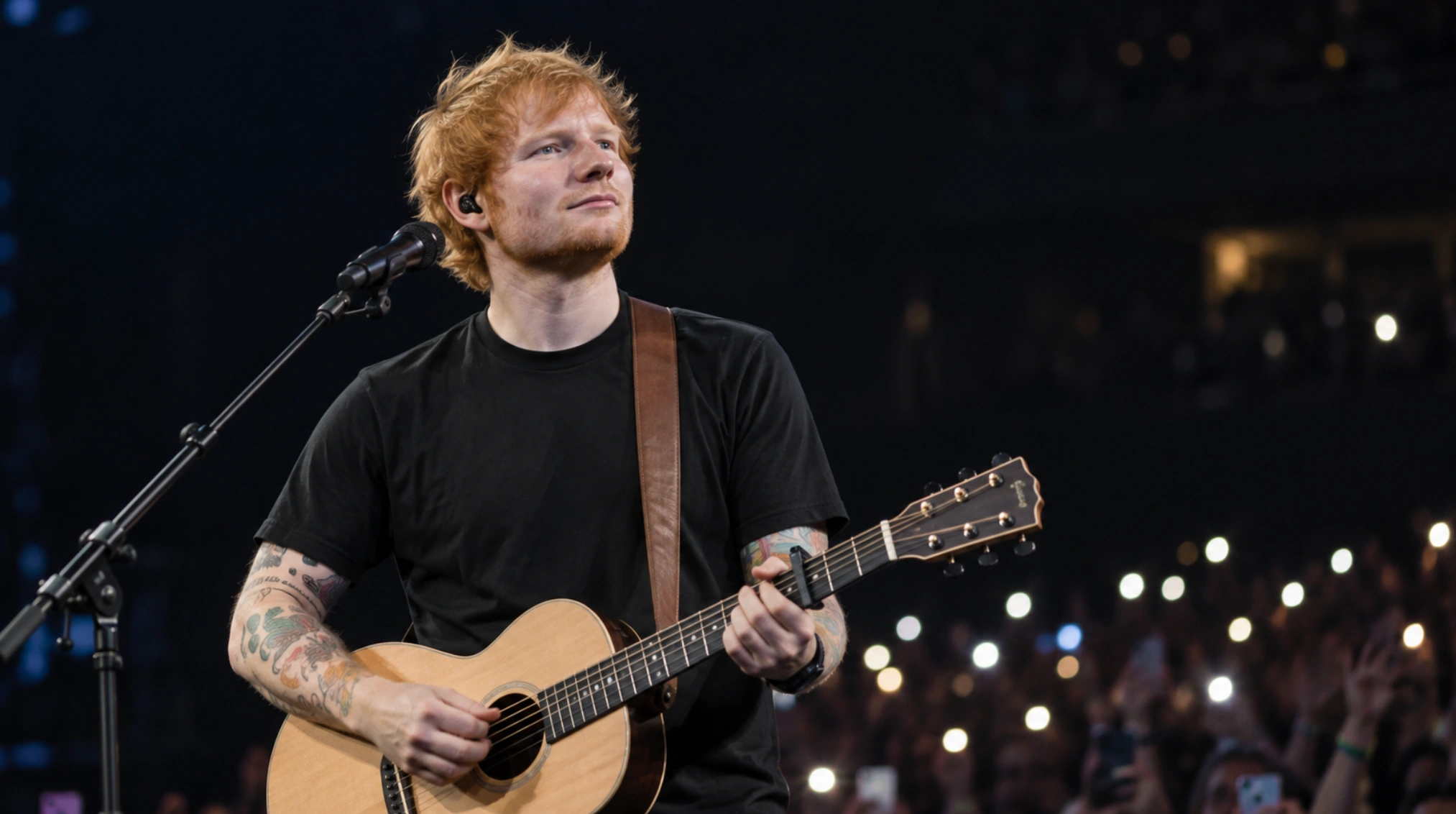
He has built his career to some extent on his special skill in taking control of stadiums by using his guitar, vocals and loop technology to compose songs live in front of audiences.
The situation with regard to Philadelphia is quite unlike the lone performance style which he is known for.
Protest expected outside stadium
The controversy is also spreading beyond the stage.
Organisations that support the Palestinians intended to hold a demonstration outside Lincoln Financial Field before the concert on Saturday.
The Philadelphia police stated that they were in contact with the venue and the event organisers regarding safety for the concertgoers, the employees, and those in the vicinity.
The fact that he is in such a position makes it uncomfortable for Sheeran, who has usually tried to keep his concerts concerned with music rather than political debate.
Ticket holders caught in the middle
Fans have also been left wondering what the dramatic changes imply for those who bought tickets when the concert had a completely different supporting act.
Because standard concert ticket conditions allow opening acts to be changed, the departure of a supporting act doesn't automatically entitle you to a refund.
Despite this, certain reports from the United States have shown that some people who bought tickets have asked for their money to be refunded after the changes were made.
As the Loop Tour proceeds through cities such as Foxborough, Atlanta, Indianapolis, Charlotte, Arlington, Hollywood and Tampa, tickets for the other US dates remain listed.
A music tour becomes a global conversation
What started as a controversy over some remarks made at a concert has now grown into a wider debate concerning freedom of expression and the duties of artists, venue owners, and promoters, as well as the question of whether large concerts should be used as platforms for political causes.
There are quite different opinions.
Those who support Macklemore and the artists who withdrew claim that musicians should have the freedom to speak publicly on humanitarian and political issues.
People believe that it is not necessarily the case that audiences who buy tickets for large concerts should be drawn into political campaigning, and that promoters and venues have duties towards their broader audiences.
He has found himself at the heart of those conflicting expectations even though he has stated that Macklemore's removal was not his decision.
New Zealand fans have already seen the Loop Tour at its best
For New Zealand viewers, the unrest connected with the US leg stands in sharp contrast to Sheeran's trip to this country earlier this year.
On 16th and 17th January, the Loop Tour held two sold-out concerts at Auckland's Go Media Stadium, then gave a sold-out performance in Wellington at Sky Stadium on 21st January, and had two sold-out shows in Christchurch on the 24th and 25th January.
The reported box-office figures indicate that about 134,000 tickets were sold at those five concerts in New Zealand, including almost 56,000 at the two events in Auckland.
Shearan has always had a good relationship with audiences in New Zealand, regularly filling some of the country's biggest venues.
For Kiwi fans who saw the Loop Tour in this country only a few months ago, the situation now developing in the United States is part of a completely different section of the same international tour.
The music will still take place in Philadelphia, but following a week during which the supporting acts vanished and a stadium tour became the subject of an international political debate, everyone will be watching to see what happens when Ed Sheeran finally steps onto the stage.
Source credit: The information was first reported by CNN, with further reporting and New Zealand-related details separately compiled by Webfit News.