Tickner was struck while batting during Saturday’s second ODI in Wellington and replaced in the playing XI by Matt Fisher.
NZ Cricket says that although Tickner has subsequently been cleared of concussion, he must observe the ICC’s mandatory seven-day stand-down from the match date because a concussion replacement was activated.
His medical clearance and his eligibility to play are therefore separate matters.
His absence should not be taken as confirmation that he remains concussed. Equally, the clearance does not remove the restriction NZC says applies to his return.
Clarke’s inclusion provides bowling cover. It does not guarantee him a place in the playing XI.
Henry’s comeback is a target, rather than a certainty
Henry was initially cleared of concussion following his collision with Devon Conway in Auckland.
After reassessment in Wellington, he was advised to aim for a return in the fourth ODI.
His inclusion in that squad gives selectors an option, but does not itself confirm that he will be ready to play.
Ferguson, meanwhile, has not fully recovered from the low-grade right-calf tear sustained during the T20I series and has been ruled out of ODIs four and five.
The distinction matters: names on a squad list do not automatically translate into available overs.
The Test preparation plan has changed
Henry and Jamieson were originally scheduled to head to the Test camp after the third ODI. Both will now stay for the fourth match at Bay Oval on Friday, 13 November.
That extends their ODI involvement until six days before the opening Test begins at the Basin Reserve on 19 November.
This is an adjustment to an existing rotation strategy. New Zealand announced split ODI squads in October, before the series began.
Coach Rob Walter explained then that the approach would allow selectors to assess white-ball depth while giving Test players additional preparation for matches carrying World Test Championship points.
The injuries have made those competing demands harder to manage.
The less obvious pressure is on the batting
Most of the latest update concerns fast bowlers. The fourth ODI also brings a substantial change to New Zealand’s batting options.
Tom Latham, Daryl Mitchell, Henry Nicholls, Glenn Phillips and Nathan Smith are scheduled to travel to Wellington on Wednesday for Test preparation.
Comparing the announced third- and fourth-match squads, nine players remain, five depart and four come in: Finn Allen, Dean Foxcroft, Mitch Hay and Henry.
Those are squad changes, rather than five confirmed changes to the playing XI.
Mitchell’s departure is particularly significant after Wellington. His 55 accounted for approximately 41 percent of New Zealand’s total of 134.
His sixth-wicket partnership with captain Mitchell Santner added 59, giving the innings substance after the early damage.
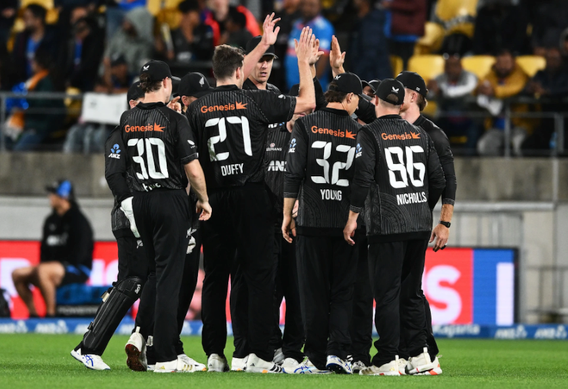
New Zealand’s attack then reduced India to 113–7 before rain ended the match. India won by four runs under DLS to take a 2–0 series lead.
Keeping experienced bowlers for another match addresses one problem. Replacing Mitchell’s batting resistance presents another.
Fresh opportunities carry immediate responsibility
Allen, Foxcroft and Hay offer alternatives for the fourth ODI. Their inclusion should not be read as a verdict on the players departing for Tests.
The more useful question is how the revised batting group will build innings and give the attack enough runs to defend.
Wellington showed that New Zealand could make a small target uncomfortable for India. It also showed how little room the bowlers had for error while defending 134.
The next batting combination needs to improve that equation.
For players coming into the squad, this is an opportunity to demonstrate more than individual ability. Building partnerships, adapting to conditions and responding to pressure will matter just as much.
What is confirmed for the remaining matches
| Match | Date and venue | Position in NZC’s update |
|---|
| Third ODI | 10 November, Seddon Park | Clarke added as bowling cover |
| Fourth ODI | 13 November, Bay Oval | Henry and Jamieson retained; five players leave for Test preparation |
| Fifth ODI | 15 November, Bay Oval | Squad still to be confirmed |
NZC says two players are set to be added across the fourth and fifth matches. Their identities were not provided in the update.
Tickner’s return should not be assumed from the calendar alone, while Henry’s intended fourth-match comeback remains dependent on his readiness.
The schedule explains the pressure. The final ODI takes place on 15 November, followed by the opening Test four days later.
New Zealand’s squad depth is being tested before the Test series even begins. The challenge is to cover the immediate absences without weakening the preparation for what follows.
Sources: NZ Cricket’s 9 November squad update; ICC reporting on the original split squads, Wellington result and tour schedule.