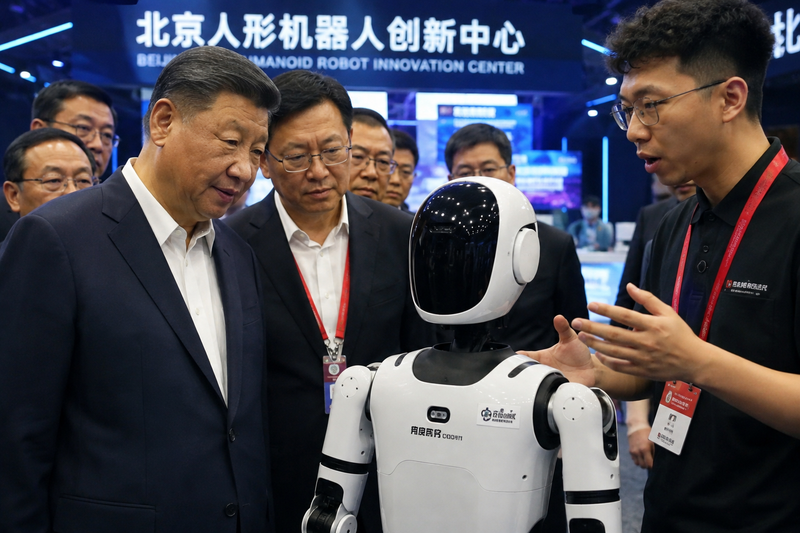
The spectacle, however, provides a striking demonstration of how quickly the technology is advancing.
Some of the fastest machines still struggle with something much more basic: stopping.
Robots have crashed into protective barriers after sprint events, while other machines have shown how difficult it can still be to handle unexpected situations.
That contrast is becoming one of the defining features of humanoid robotics.
A machine can run extraordinarily quickly but still struggle with a cable, a door handle or an object that has moved unexpectedly.
The real competition is not on the running track
For China’s robotics industry, the most important events in Beijing may not be the races.
More than 40 percent of this year’s tests require robots to perform practical tasks, with organisers moving some competitions into environments designed to resemble factories, hotels, restaurants and homes.
Robots are being tested on activities including serving food, charging electric vehicles, assembling equipment, handling objects and responding to emergency situations.
That is significant because the commercial value of humanoid robots will ultimately depend on whether they can perform useful work reliably, not whether they can win a 100-metre race.
A factory robot that can independently identify a component, pick it up, place it correctly and recover when something goes wrong is potentially far more valuable than a machine capable of producing an impressive sporting demonstration.
China is increasingly trying to close that gap.
Beijing officials have described humanoid robotics as a strategic technology and are attempting to connect competition results with real commercial applications.
The city already accounts for close to one-quarter of China’s complete humanoid robot manufacturers.
XPeng puts more than US$900 million behind robotics
The industry received another major signal this week.
Chinese electric vehicle company XPeng said its robotics business had raised more than US$900 million in its first external funding round.
The fundraising reportedly valued the robotics operation at more than US$6.3 billion, making it one of the largest funding rounds so far in China’s embodied artificial intelligence sector.
Investors included major technology and venture capital groups.
XPeng plans to use the money to improve robotic hardware, software and artificial intelligence models, collect training data and build manufacturing capacity.
The company is targeting production of about 1,000 units a month of its IRON humanoid robot by the end of 2026, with initial deployment focused on industrial and retail environments before wider commercial sales.
That is where China’s robot story starts becoming much bigger than a sporting event.
It is increasingly becoming a manufacturing story.
From electric vehicles to humanoid robots
China has several advantages that could matter in the next phase of the industry.
Humanoid robots require electric motors, batteries, sensors, cameras, computing systems, precision components and sophisticated software.
Many of those supply chains overlap with industries China has already developed at enormous scale, particularly electric vehicles, batteries, electronics and advanced manufacturing.
Companies that have spent years developing autonomous driving systems are also working with technologies that can be adapted to robotics, including computer vision, artificial intelligence and real-time decision making.
That helps explain why companies associated with cars and consumer technology are increasingly entering the robot market.
The competition is not limited to China.
American companies including Tesla are developing humanoids, while companies and research teams in Japan, South Korea and Europe are also advancing the technology.
Teams from 16 countries are competing in Beijing this week, underlining that the race is international rather than purely Chinese.
China’s robot boom in numbers
| Indicator | 2026 figure |
|---|
| Robots entered in Beijing games | 2,056 |
| Participating teams | 666 |
| Countries and regions represented | 16 |
| Competition events | 51 |
| XPeng robotics funding round | More than US$900 million |
| Reported XPeng robotics valuation | More than US$6.3 billion |
| XPeng planned monthly robot production by end-2026 | Around 1,000 |
Why overseas Chinese should watch this closely
For Chinese communities in New Zealand and elsewhere, this development is worth watching beyond the novelty of robots playing football or running at extraordinary speeds.
If humanoid robots move successfully from exhibitions into factories, warehouses, shops, hospitals and homes, they could become another major Chinese export industry.
That could create opportunities for Chinese technology companies overseas, but it could also raise difficult questions about employment, safety, regulation and competition with workers.
New Zealand has its own ageing population and persistent labour shortages in some sectors, making practical robotics potentially relevant here over the longer term.
The machines competing in Beijing still show plenty of limitations.
They fall.
They make mistakes.
Some struggle with tasks humans complete without thinking.
But the investment, manufacturing capacity and speed of development suggest the important question is no longer whether humanoid robots will become more capable.
It is how quickly they can become useful enough, reliable enough and affordable enough to leave the competition arena and enter everyday life.
Sources: Reuters, Associated Press, Xinhua, Beijing Municipal Government.