Support Webfit News

Independent journalism needs readers behind it. Help us keep Webfit News free, open and community focused.

Friday, 9 October 2026
Webfit News
SearchNewsroom
Webfit News
Search
Election 2026Have your say in the Webfit News reader pollVote in your electorateLive dashboard
News

Shackled in a New York Court, Nicolás Maduro Says He Is a “Prisoner of War”

Listen to this articleAudio accessibility
Shackled in a New York Court, Nicolás Maduro Says He Is a “Prisoner of War”
<p>shackled-maduro-prisoner-of-war-new-york-court</p>

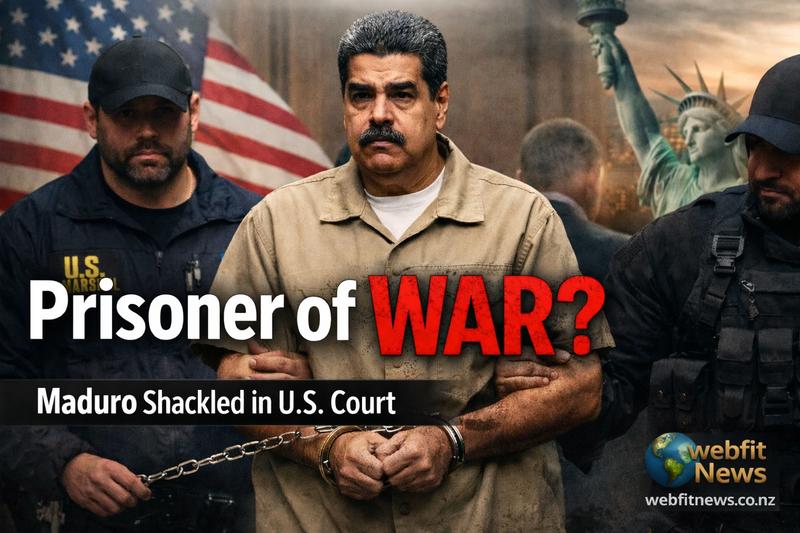
Shackled and flanked by U.S. marshals, Nicolás Maduro stood before a Manhattan courtroom and declared himself a “prisoner of war.”

It was a moment designed to project defiance. Instead, it exposed the extraordinary collision now unfolding between international politics, criminal law, and the limits of state power.

Maduro pleaded not guilty to U.S. charges linked to drug trafficking and narco-terrorism. As he was escorted through the courtroom, he accused the United States of kidnapping him and insisted he remains Venezuela’s legitimate president.

A courtroom charged with politics

This was not a routine arraignment.

Maduro appeared restrained, speaking directly to the court as supporters and critics watched closely. He rejected the authority of the proceedings and framed his detention as an act of war, not law enforcement.

His wife, Cilia Flores, also entered a not-guilty plea. According to court observers, she requested medical attention, adding another layer of tension to an already volatile hearing.

The judge scheduled the next hearing for March.

Why is this case unprecedented

The U.S. government has pursued Maduro for years, accusing him of running or protecting criminal networks tied to narcotics trafficking. What makes this case different is how it has arrived here.

Maduro was not extradited. He was captured.

That distinction has triggered an immediate global reaction. Critics argue the move violates international law and undermines long-standing rules around sovereignty. Supporters say it sends a clear signal that power no longer guarantees immunity.

At the heart of the coming legal battle is a single question that could decide everything before a trial even begins:

Is Maduro a criminal defendant, or a head of state?

The immunity fight ahead

Maduro’s legal team is expected to argue that he is protected by sovereign immunity and that the court lacks jurisdiction. U.S. prosecutors reject that premise, maintaining that he no longer holds legitimate authority and therefore does not qualify for such protection.

If the court accepts the immunity argument, the case could unravel quickly. If it does not, the trial could redefine how international leaders are treated when accused of serious crimes.

Protests and polarization outside the court

Outside the courthouse, demonstrators gathered on both sides.

Some celebrated the arrest as long-overdue accountability. Others warned it sets a dangerous precedent, one where powerful nations decide unilaterally who can be seized and tried.

The split reaction mirrors a broader global divide over whether this moment represents justice or escalation.

Why this matters beyond Venezuela

This is bigger than one man and one courtroom.

If the prosecution proceeds, it may reshape expectations around international enforcement and political immunity. If it fails, it will still leave scars on diplomatic norms and fuel claims of overreach.

Maduro called himself a prisoner of war.

The world is now watching to see whether the courtroom treats him as one, or as something far more ordinary and far more dangerous: a defendant.

World
Related

More on this story

From the newsroom

Keep reading

Back to homepage