From Ahmedabad to Auckland, Surat to Sydney and Rajkot to London, the greeting remains familiar.
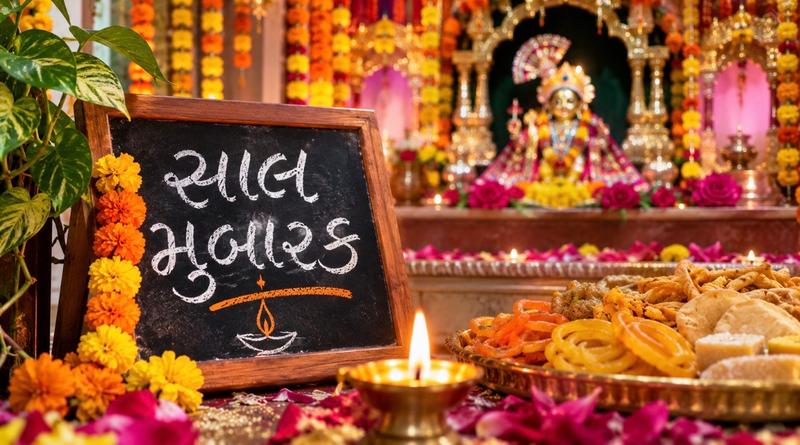
સાલ મુબારક! નૂતન વર્ષાભિનંદન!
The surroundings may have changed. The families may be scattered across continents. But the meaning behind those words has travelled with them.
A New Year That Begins With People, Not Fireworks
In many Gujarati households, New Year’s morning has its own rhythm.
The house is cleaned, the entrance decorated with rangoli, and the family prepares for prayers and visits. Some head to the temple early. Others begin by offering prayers at home before visiting relatives and neighbours.
Children put on their festive clothes, often more interested in the sweets waiting for them than the significance of the occasion.
Elders sit ready to welcome visitors, offering blessings for good health, happiness and success.
And somewhere in the kitchen, the familiar festive snacks are waiting: mathiya, chorafali, chevdo, ghughra and whatever else the family has lovingly prepared.
There may be no formal invitation. People simply visit, exchange greetings, share food and move on to the next home.
For families accustomed to these traditions, it is an ordinary part of an extraordinary day.
What makes Gujarati New Year special is not how much money is spent celebrating it, but how much importance is given to the people around us.
Why Is Gujarati New Year Celebrated After Diwali?
For those unfamiliar with the tradition, one question often comes up: why do Gujaratis celebrate New Year in October or November when most of the world celebrates it on 1 January?
The answer lies in the traditional Gujarati calendar.
Known as Bestu Varas or Nutan Varsh, Gujarati New Year begins on Kartak Sud Ekam, the first day of the bright lunar fortnight of the month of Kartak.
It marks the beginning of a new year in the Gujarati version of the Vikram Samvat calendar, which is widely used for religious and cultural purposes.
While several Indian communities celebrate their traditional New Year during March or April, Gujaratis follow a calendar in which the year begins after Diwali.
Diwali marks the end of the old year, while Bestu Varas welcomes the new one.
There is a small calendar detail worth noting this year.
Diwali was celebrated on Sunday, 8 November, but Gujarati New Year falls on Tuesday, 10 November.
The reason is the timing of the lunar calendar. The new-moon phase, known as Amavasya, was still present at sunrise on Monday, 9 November. As a result, the New Year is observed on Tuesday, when Kartak Sud Ekam is present at sunrise.
The intervening day is commonly called Padtar Divas.
This year therefore marks the beginning of Vikram Samvat 2083, even though the Gregorian calendar remains in 2026.
The Tradition of Seeking Blessings: Something Worth Preserving
Among the many customs associated with Bestu Varas, seeking blessings from elders remains one of the most meaningful.
In traditional Gujarati families, children and younger relatives greet their parents, grandparents and other elders, often touching their feet as a gesture of respect.
The response is usually a blessing for a long life, good health, happiness and prosperity.
It is a simple exchange, but it says a great deal about the values passed down through generations.
For grandparents, it is an opportunity to see the family together. For parents, it is a chance to pass on a tradition they experienced as children. For younger generations, it becomes a memory they may carry for the rest of their lives.
Of course, not every family follows the same customs, and traditions naturally change over time.
But the underlying message remains relevant.
A new year is not only about what we want to achieve. It is also about recognising the people who helped us reach where we are today.
Why Gujarati Businesses Welcome the New Year With Prayers
Gujarati culture has a long association with trade, enterprise and business.
For generations, the New Year has held particular importance for shopkeepers, traders, merchants and business families.
One of the best-known traditions is Chopda Pujan, performed around Diwali.
Historically, business owners would close their old account books and prepare new ledgers for the coming year. These books, known as chopda, were placed before Goddess Lakshmi and Lord Ganesha during prayers.
Auspicious words such as Shubh and Labh were written in the books, expressing hopes for good fortune and prosperity.
Today, the ledgers may have been replaced by computers, accounting software and digital transactions, but the tradition continues in many families.
The significance extends beyond profit.
It is a reminder that prosperity comes with responsibility, and that business success should be accompanied by honesty, gratitude and respect for those who contribute to it.
Some businesses begin their new accounting practices around Diwali, while others traditionally reopen after the festive break on Labh Pancham.
For Gujarati entrepreneurs living overseas, the celebration can also be a moment to reflect on the journey of building a business far from home.
Annakut and Lord Krishna: A Celebration of Gratitude
Bestu Varas is also closely associated with Annakut and Govardhan Puja, particularly among Vaishnav and Swaminarayan communities.
According to Hindu tradition, Lord Krishna lifted Govardhan Hill to protect the people of Vrindavan from heavy rains.
The story is remembered as a lesson in faith, humility and the importance of respecting nature.
Annakut, meaning a mountain of food, is celebrated through offerings of a wide variety of dishes to the deity.
In some temples, the offering includes the traditional Chhappan Bhog, or 56 dishes. Larger celebrations may feature hundreds of food preparations, carefully arranged before the deity.
The food is later distributed as prasad.
For devotees, the occasion is not simply about preparing an impressive display.
It is about expressing gratitude for food, livelihood, family and the blessings of the past year.
In a world where people are constantly thinking about what they still need, the tradition offers a different perspective: remember what you already have.
The Little Traditions That Make Gujarat Feel Like Home
Every Gujarati family has its own New Year memories.
For some, it is visiting the local mandir before sunrise.
For others, it is travelling from one relative’s house to another, knowing that every stop will involve another cup of tea, something to eat and a conversation that lasts longer than expected.
Some families remember the tradition of purchasing sabras, or salt, at the beginning of the year, symbolising the hope that life will be filled with flavour, happiness and good fortune.
Others remember neighbourhoods where almost every door was open and the same greeting could be heard throughout the day.
There is often a little friendly competition over whose homemade snacks taste best, which family has made the most beautiful rangoli, or who managed to visit the greatest number of relatives.
These may seem like small details.
But years later, when people move away from Gujarat, they are often the very things they miss.
Not necessarily the grand celebrations.
Just the feeling of being surrounded by familiar faces, familiar voices and a place where everyone knows you.
From Gujarat to New Zealand: Keeping the Tradition Alive
For Gujarati families living in New Zealand, the New Year can bring a mixture of celebration and nostalgia.
Back in Gujarat, the festival may mean a day filled with visitors, family gatherings and celebrations stretching from morning until evening.
In Auckland, Wellington, Hamilton or Christchurch, the same day may begin with preparing children for school, getting ready for work or checking messages from relatives in India.
The difference is real.
A family that once celebrated with grandparents, cousins, uncles and aunts under one roof may now be separated by time zones and long-distance flights.
Yet technology has made it possible to keep some of those connections alive.
A video call to parents in Ahmedabad. A family group sharing photographs from Surat. A grandparent in Rajkot reminding the grandchildren overseas to say Saal Mubarak.
For children born or raised in New Zealand, these moments can be an important introduction to their heritage.
They may speak English more comfortably than Gujarati. They may be more familiar with New Zealand school holidays than the traditional Gujarati calendar.
That does not make their connection to Gujarati culture any less meaningful.
What matters is giving them opportunities to understand it.
Tell them why the family celebrates Bestu Varas. Explain the meaning of the greeting. Take them to a temple if that is part of your tradition. Prepare a favourite family recipe. Let grandparents share stories about how New Year was celebrated when they were young.
Culture survives not only through large festivals and public celebrations, but through what families continue to practise at home.
What the Younger Generation Can Learn From Bestu Varas
Gujarati New Year carries lessons that remain relevant well beyond religion or tradition.
It teaches respect for elders, but also reminds older generations of their responsibility to guide younger family members with kindness.
It celebrates prosperity, while encouraging gratitude for what has already been achieved.
It encourages fresh beginnings, but also recognises the importance of maintaining relationships.
Perhaps most importantly, it creates a reason for families to spend time together.
For young Gujaratis growing up overseas, the festival can be a bridge between two worlds.
They can be proud New Zealanders while remaining connected to their Gujarati roots.
They can embrace modern lifestyles without feeling that every old tradition must be left behind.
And they can adapt celebrations to their own circumstances while preserving the values that made those celebrations meaningful in the first place.
The future of Gujarati culture will not depend entirely on how perfectly the next generation follows every custom.
It will depend on whether they understand why those customs mattered to the generations before them.
A Fresh Year, But Also a Chance to Look Back
Every New Year brings familiar hopes.
Better health. A successful business. Progress at work. A good education for the children. Financial stability. Peace and happiness at home.
For some families, the past year may have brought achievements worth celebrating.
For others, it may have been difficult, marked by financial pressures, illness, separation or the loss of someone close.
That is another reason the New Year can be meaningful.
It does not erase what happened during the previous year, nor does it promise that everything ahead will be easy.
But it gives people an opportunity to begin again with hope.
Perhaps this year, along with wishing someone prosperity, we can also ask how they are doing.
Perhaps we can call an elderly relative who has been waiting to hear from us.
Perhaps we can make time for a friend we have not seen in months.
And perhaps, instead of sending the same forwarded greeting to everyone, we can send a few personal words to the people who genuinely matter.
Because sometimes, the most valuable New Year gift is not something we buy.
It is the time and attention we give.
Saal Mubarak From Webfit News
As Gujarati families across New Zealand, India and the wider world welcome Vikram Samvat 2083, Webfit News extends its warmest wishes to everyone celebrating.
To the grandparents keeping family traditions alive, the parents passing those traditions on, the young people discovering their cultural identity and the families building new lives far from Gujarat, this celebration belongs to all of you.
May the coming year bring good health to your loved ones, peace to your homes, strength during difficult times and success in everything you work towards.
May businesses prosper, children achieve their dreams and families find more opportunities to come together.
And to those who are far away from home this New Year, may a familiar voice, a family photograph or a simple phone call remind you that distance does not have to weaken the bonds that matter.
A new year will bring new opportunities, new responsibilities and new challenges. But some things are worth carrying forward unchanged: our values, our relationships and the people who make life meaningful.
સાલ મુબારક! નૂતન વર્ષાભિનંદન!
વિક્રમ સંવત ૨૦૮૩ આપ સૌના જીવનમાં સુખ, શાંતિ, સમૃદ્ધિ અને સારું સ્વાસ્થ્ય લઈને આવે.
Happy Gujarati New Year 2083 to our readers, their families and the entire Gujarati community, wherever in the world they call home.
Webfit News | Connecting Communities, Celebrating Cultures