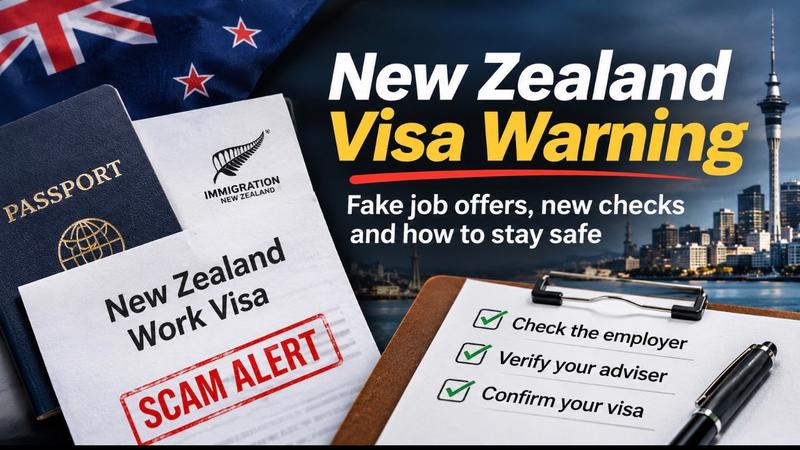
For people planning a future overseas, these are frightening possibilities. And recent developments show why they deserve serious attention.
During the past several weeks, New Zealand has seen renewed scrutiny of temporary work visa applications, reports of allegedly fabricated visas in Auckland and an important court ruling concerning payments made overseas to secure New Zealand jobs.
The developments are separate. They do not establish a single organised fraud network or suggest that most immigration applications are dishonest.
But together they expose a problem that deserves more attention: applicants are often asked to trust an entire chain of employers, recruiters, advisers and documents without independently verifying each link.
For someone investing years of savings in a move overseas, that is a risk worth understanding before any money changes hands.
What has happened, and why does it matter now?
Five developments help explain the current concern.
|
When
|
What happened
|
Why applicants should care
|
|
September 2026
|
An Auckland court found an unlicensed adviser guilty after families paid for immigration and study services that were not properly delivered
|
Paying a consultant does not prove an application has been lodged
|
|
20 October
|
INZ publicised an Employment Court decision confirming that overseas payments for New Zealand jobs are unlawful
|
Paying an agent abroad does not make a job-selling arrangement legal
|
|
30 October
|
INZ issued guidance strengthening the assessment of applicants’ genuine temporary immigration intentions
|
A real job offer alone may not satisfy all visa requirements
|
|
Mid-November
|
Reports emerged of allegedly fabricated work visas and altered English-language evidence in Auckland
|
Applicants need to verify both their visa and the documents submitted in their names
|
|
November 2026
|
Concerns continued about cross-border recruitment and immigration fraud
|
Families should verify the entire process before making major financial commitments
|
The most important distinction is between immigration policy, confirmed legal findings and allegations still under investigation.
Each has different implications.
A real job offer may not be enough
One of the most significant developments has received relatively little attention outside immigration circles.
On 30 October, Immigration New Zealand issued internal guidance to officers assessing the bona fides of work visa applicants.
The guidance followed a review of Accredited Employer Work Visa decisions.
It found that some assessments had focused heavily on whether the employer’s job offer was genuine and whether the applicant had the qualifications and experience required.
Those are important questions, but they are not the only ones.
INZ has reminded officers that they must also consider whether applicants genuinely intend to undertake the employment, follow their visa conditions and leave New Zealand if they are not granted permission to remain.
This is not a completely new rule. The bona fide requirement already existed.
The development is a renewed emphasis on applying it thoroughly, particularly when there are warning signs or unresolved questions.
What does this mean in ordinary language?
Suppose an applicant in India receives a genuine offer from an accredited New Zealand employer.
The applicant has the right qualifications, relevant experience and a signed employment agreement.
That may satisfy several important requirements.
But an immigration officer can still examine the applicant’s wider circumstances, including their immigration history, personal situation and intentions.
The officer may want to understand what the applicant plans to do if the job ends, the visa expires or there is no lawful pathway to remain in New Zealand.
An applicant who hopes to obtain residence in the future is not automatically acting improperly.
The important point is that a temporary visa does not guarantee residence. Applicants must be truthful about their plans and comply with the conditions of whichever visa they hold.
Why Indian applicants are being discussed
Awaaz reported on the guidance after speaking with immigration lawyers and INZ officials.
Auckland immigration lawyer Alastair McClymont raised concerns that Indian applicants could face greater scrutiny because of patterns in refugee and protection claims.
INZ director visa Catherine L’Estrange told Awaaz that such patterns could be considered as one factor, but should not determine a decision on their own.
The guidance itself does not name India or introduce a nationality-specific ban.
Immigration lawyer Mahafrin Variava also stressed the importance of assessing applicants individually rather than relying on assumptions about nationality, ethnicity or religion.
That distinction matters enormously.
A person’s country of origin does not establish whether their job offer is genuine, whether they will obey visa conditions or whether they have a legitimate protection claim.
What the asylum figures actually show
According to figures reported by Awaaz, New Zealand received 7,834 refugee and protection claims over the five financial years ending June 2026.
|
Nationality
|
Claims lodged
|
Share of all claims
|
|
India
|
3,015
|
38.5%
|
|
China
|
1,259
|
16.1%
|
|
Sri Lanka
|
578
|
7.4%
|
|
Other nationalities
|
2,982
|
38.1%
|
|
Total
|
7,834
|
100%
|
Percentages are rounded. Source: figures reported by Awaaz.
Indian claims peaked at 1,169 in 2023–24 before declining to 683 in 2025–26.
These figures show the number of claims lodged, not the number found fraudulent.
Seeking refugee or protected person status is a lawful process for people who meet the relevant requirements. A claim should not be treated as dishonest merely because it was unsuccessful.
Nor should the actions of some applicants be used to presume that another applicant will breach immigration conditions.
For genuine work visa applicants, the practical response is to provide clear, consistent and truthful evidence about their employment, circumstances and plans.
Read the official INZ guidance:
https://www.immigration.govt.nz/assets/inz/documents/visa-paks/30-october-2026-assessing-bona-fides-for-work-visa-applications-visa-pak-696.pdf
The Auckland fake visa allegations raise a different concern
While the new guidance concerns how applications are assessed, another story has raised questions about the people preparing them.
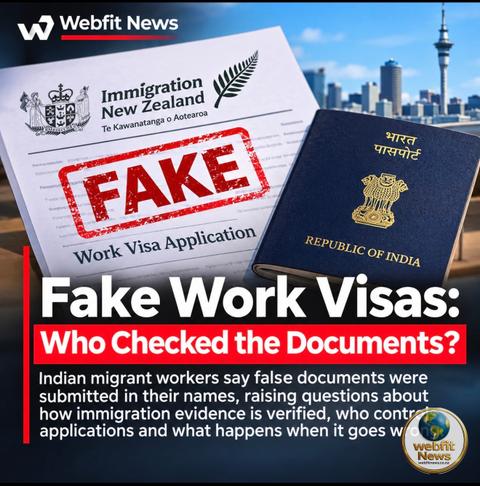
Reports published in mid-November described allegations involving an unlicensed immigration adviser in Auckland.
According to reporting by the New Zealand Herald, at least 20 migrants had complained to INZ about suspected fraudulent immigration arrangements.
Some alleged that their English-language test results had been altered without their knowledge.
Others reportedly received electronic visa documents that appeared genuine but were allegedly fabricated.
The reports concerned Accredited Employer Work Visas.
INZ confirmed that it was investigating allegations involving fake visas but declined to comment further because the investigation was active.
The allegations have not been established by a court.
That is important. People named or implicated in reporting about an ongoing investigation must not be treated as guilty before findings are made.
But the case raises a legitimate question for every visa applicant:
How do you know what your immigration adviser has actually submitted in your name?
Many applicants hand over their passports, certificates and employment documents, then wait for updates.
They may never see the completed application.
Some do not know which online account was used or what supporting evidence was attached.
That creates an obvious vulnerability.
If a document is changed, invented or submitted without the applicant’s knowledge, the applicant may discover the problem only when INZ asks questions.
And under New Zealand immigration rules, false or misleading information can have serious consequences even where the applicant says they were unaware of it.
The applicant’s knowledge and circumstances can be relevant, but ignorance does not automatically resolve the problem.
This makes checking the application itself just as important as checking the person preparing it.
This is not the first time migrants have paid for services they never received
There is a confirmed case that shows how serious these situations can become.
In September 2026, Auckland District Court found Paola Walker-Rodriguez guilty of 11 of 12 charges under the Immigration Advisers Licensing Act.
Her husband and co-defendant, Mauro Donoso Godoy, was also found guilty of one charge.
The case involved families who had paid substantial sums for study and immigration packages.
According to the Immigration Advisers Authority, some families arrived in New Zealand and discovered that student visa applications they believed were being processed had not actually been submitted.
Some also found that education fees they had paid through the intermediary had not reached the education providers.
The families had made major decisions based on assurances that turned out to be unreliable.
This case is different from the current Auckland fake visa allegations, but it demonstrates the same underlying risk.
A receipt from an agent does not prove that money reached an education provider.
An email saying an application has been submitted does not prove that INZ received it.
And an immigration consultancy’s professional appearance does not prove that the person giving advice is authorised to do so.
The official case report is available here:
https://www.iaa.govt.nz/about-us/news/unlicensed-immigration-adviser-leaves-families-tens-of-thousands-out-of-pocket/
The money question: Can someone charge you for a New Zealand job?
This is where the law is particularly clear.
In October, INZ publicised an important Employment Court decision confirming that charging a worker for a New Zealand job is unlawful even when the payment is made overseas.
The ruling also addressed payments made through intermediaries, including agents or people acting on behalf of an employer.
For years, some migrants have described arrangements where money was collected in their home country rather than New Zealand.
The explanation might sound familiar:
“The company is accredited, but you need to pay the agent in India.”
Or:
“This is not a job fee. It is a placement charge.”
The label attached to a payment does not determine whether it is lawful.
What matters is the substance of the arrangement.
What payments should raise concern?
|
Payment requested
|
What you need to know
|
|
Money to secure a job offer
|
An unlawful job premium
|
|
Employer recruitment costs passed to the worker
|
Not permitted
|
|
Money paid overseas to an employer’s agent for a job
|
Can still be unlawful
|
|
Official visa application fees
|
Legitimate when paid through authorised channels
|
|
Medical tests and police certificates
|
Legitimate where required
|
|
Document translation
|
Legitimate where genuinely needed
|
|
Licensed immigration advice
|
Professional fees may be charged lawfully
|
|
Unexplained package fee promising a job, visa and residence
|
Serious warning sign
|
Not every payment to a recruitment-related business is necessarily an unlawful job premium. The arrangement must be assessed on its facts.
But anyone asked to pay a large sum for access to an employer should obtain independent advice before proceeding.
INZ’s National Manager Risk and Verification, Aaron Smith, has said that the court decision removes uncertainty about overseas job payments.
It also places responsibility on employers to understand what recruiters and intermediaries are doing on their behalf.
Official Employment Court announcement:
https://www.immigration.govt.nz/about-us/news-centre/important-employment-court-decision-overseas-payments-for-new-zealand-jobs-are-illegal/
The biggest misconception: An accredited employer means the offer must be genuine
It does not.
An accredited employer is a business approved under New Zealand’s relevant immigration framework to recruit eligible migrant workers.
But scammers can use the names of real companies.
They can copy company logos, create convincing email signatures and reproduce genuine registration details.
An applicant may search for the business, see that it exists and assume everything is legitimate.
The missing question is whether the person offering the job actually represents that business.
Check the employer in three separate places
First: Immigration New Zealand’s accredited employer list
https://www.immigration.govt.nz/work/requirements-for-work-visas/approved-employers/accredited-employer-list/
Search using the company name or New Zealand Business Number.
Some accredited employers choose not to appear publicly, so a missing listing is a reason to investigate further, not automatic proof of fraud.
Second: The New Zealand Companies Register
https://companies-register.companiesoffice.govt.nz/
Check the legal company name, registration details and available business information.
A registered company is not necessarily accredited to employ migrant workers.
These are separate checks.
Third: Contact the employer yourself
Find the company’s contact details independently.
Do not use only the number supplied by the recruiter.
Ask the company to confirm the vacancy, the recruiter’s authority and the proposed employment arrangement.
If you are being offered a skilled role, ask to speak with the hiring manager.
A genuine employer should be able to explain the position, duties, pay, workplace and recruitment process.
An accredited company name printed on a letter is not enough.
Before sharing your passport, check who is advising you
New Zealand regulates immigration advice.
A person providing New Zealand immigration advice generally needs to be licensed by the Immigration Advisers Authority unless a legal exemption applies.
That requirement can apply to advisers operating outside New Zealand.
A business may call itself an immigration consultancy, visa agency or international recruitment specialist.
Those descriptions do not establish whether its staff can lawfully provide immigration advice.
How to check an adviser
Visit:
https://www.iaa.govt.nz/
Use the public register to search for the individual adviser’s name.
Check the licence status, number and any limitations.
A particularly important point is that individuals are licensed, not companies.
A consultancy may have an impressive website, but the person giving you immigration advice must be properly authorised.
Some professionals, including eligible New Zealand lawyers, are exempt from the immigration adviser licensing requirement.
You can check a lawyer’s professional status through:
https://www.lawsociety.org.nz/
Ask these questions before signing anything
Who will personally handle my application?
Are you licensed or exempt?
Can I see your licence details?
What exactly am I paying for?
Will I receive a written service agreement and invoices?
Will I be able to review my application before submission?
Who will have access to my passport and personal documents?
If an adviser refuses reasonable questions or pressures you to pay immediately, consider that a warning sign.
The Immigration Advisers Authority also requires licensed advisers to meet professional standards, including written agreements, fair fees and proper communication.
A visa PDF is not proof that you have a visa
This is one of the most important points for applicants overseas.
New Zealand issues electronic visas.
A genuine eVisa can be provided as an electronic approval notification.
But a PDF can also be altered.
The presence of an official-looking logo, reference number or signature does not independently prove that INZ has approved the visa.
How to verify your visa
Use Immigration New Zealand’s official Visa Verification Service:
https://www.immigration.govt.nz/work/for-employers/resources-services-and-information-to-help-employers/the-visa-verification-service/
You will need a RealMe account.
The service asks for identifying details, including your family name, passport nationality, passport number, date of birth, gender and visa start date.
The details must match the official record.
The service can confirm information such as the visa type, dates and conditions.
It does not verify pending applications or expired visas.
If the information does not match, check for entry errors and contact INZ directly.
Do not ask only the agent who supplied the document to confirm whether it is genuine.
That defeats the purpose of independent verification.
What should a genuine work visa applicant check?
For an Accredited Employer Work Visa, the applicant needs to meet the current requirements for the particular role and visa.
The employer must have the appropriate accreditation and approved job check.
The applicant must have a qualifying job offer and satisfy applicable skill, experience, health, character and other requirements.
AEWV employment is generally required to be for at least 30 hours per week.
Applicants should carefully review the employment agreement.
|
Detail
|
What to confirm
|
|
Employer
|
Correct legal business name
|
|
Job title
|
Matches the role discussed
|
|
Duties
|
Clear and consistent with the position
|
|
Workplace
|
Genuine location
|
|
Hours
|
Meets the relevant visa requirements
|
|
Pay
|
Meets applicable employment and immigration requirements
|
|
Qualifications
|
Consistent with the role
|
|
Recruitment
|
No unlawful payment for the job
|
|
Contract
|
Genuine agreement from the employer
|
|
Visa conditions
|
Understood before travel
|
Current requirements can change, so applicants should use the official visa page rather than an old social media post or a recruiter’s screenshot.
https://www.immigration.govt.nz/visas/accredited-employer-work-visa/
What if an adviser has already submitted your application?
Do not wait until a problem arises.
Ask for a complete copy of the application and supporting documents.
Review the information carefully.
Check employment dates, previous visa history, qualifications, financial evidence and any English-language test results.
If you did not provide a document, ask where it came from.
If you believe information has been submitted without your knowledge, preserve your communications with the adviser and seek independent professional advice.
You can request personal information held by INZ, including relevant immigration records.
Start through the official INZ website:
https://www.immigration.govt.nz/
Search for Request your personal information.
A request for records is useful, but it does not replace urgent legal advice where a visa deadline or immigration decision is involved.
If something feels wrong, what should you do?
The right response depends on what has happened.
If you have not paid anything
Stop and verify the employer, adviser and offer.
Do not send passport copies, bank statements or other sensitive documents to someone whose identity you cannot establish.
If you have already paid
Preserve receipts, bank records, emails, messages, contracts and screenshots.
Ask for a written explanation of the payment.
Do not send more money simply because an agent claims that an additional fee is required to release your visa.
If you suspect fraud, seek advice and report it to the appropriate authorities.
If you have received a questionable visa
Use the official Visa Verification Service.
Contact INZ independently if the record cannot be confirmed.
Do not travel on a document whose authenticity is in doubt.
If false information may have been submitted
Seek independent advice from a licensed adviser or qualified lawyer.
Keep evidence of what you supplied and what you authorised.
Do not try to repair the situation by creating further false documents.
If you are already in New Zealand
Check your current visa conditions and expiry date.
If you are being exploited at work, contact Employment New Zealand.
https://www.employment.govt.nz/
You can also contact INZ for guidance about your immigration status.
If your visa has expired or an application has been declined, obtain urgent professional advice. A complaint against an adviser does not automatically give you permission to remain or work in New Zealand.
A practical checklist before you spend your savings
For someone planning to migrate, the following checks are worth completing before making major commitments.
|
Before you…
|
Make sure you have…
|
|
Accept a job
|
Spoken directly with the genuine employer
|
|
Pay a consultant
|
Verified the individual’s licence or exemption
|
|
Sign an agreement
|
Read the full contract and understood the fees
|
|
Share documents
|
Confirmed who will receive and use them
|
|
Submit a visa application
|
Reviewed all declarations and supporting evidence
|
|
Pay official charges
|
Confirmed the payment channel and fee
|
|
Resign from your job
|
Independently confirmed your immigration position
|
|
Book flights
|
Checked the visa approval and entry conditions
|
|
Travel to New Zealand
|
Verified your visa and understood its conditions
|
|
Plan for residence
|
Checked whether you genuinely meet a current residence pathway
|
This checklist cannot guarantee visa approval or eliminate every risk.
But it can reduce the chances of making major decisions based on information that has never been independently checked.
The questions New Zealand still needs to answer
The latest developments also raise questions for the immigration system itself.
How will INZ apply its renewed bona fide guidance fairly?
The October guidance requires individual assessment. But where wider asylum-claim patterns are considered, applicants and advisers need clarity about how that information is weighed.
What happens when an applicant is unknowingly caught up in document fraud?
False evidence can affect an immigration application, but the circumstances surrounding how it was submitted matter. Clear processes are needed to distinguish deliberate dishonesty from people who may have been deceived.
How effectively are overseas recruiters being monitored?
The Employment Court decision makes the prohibition on job premiums clearer. Preventing unlawful payments, however, also depends on enforcement and oversight of intermediaries.
How can applicants know their application is progressing as represented?
The cases involving unlicensed advice demonstrate why direct access to reliable records and clear communication matter.
These are questions worth putting to INZ, the Immigration Advisers Authority and employers involved in international recruitment.
They concern the integrity of the immigration system and the protection of people who rely on it.
Official resources every applicant should save
Rather than relying on a forwarded WhatsApp message or a social media advertisement, start with the organisations responsible for the relevant rules.
|
What you need
|
Official source
|
|
Visa rules and applications
|
https://www.immigration.govt.nz/
|
|
Accredited employer verification
|
https://www.immigration.govt.nz/work/requirements-for-work-visas/approved-employers/accredited-employer-list/
|
|
Visa verification
|
https://www.immigration.govt.nz/work/for-employers/resources-services-and-information-to-help-employers/the-visa-verification-service/
|
|
Immigration adviser register and complaints
|
https://www.iaa.govt.nz/
|
|
Lawyer verification
|
https://www.lawsociety.org.nz/
|
|
Company verification
|
https://companies-register.companiesoffice.govt.nz/
|
|
Employment rights and exploitation
|
https://www.employment.govt.nz/
|
|
Online scam guidance
|
https://www.ownyouronline.govt.nz/
|
|
Immigration scam warnings
|
https://www.immigration.govt.nz/about-us/news-centre/immigration-scams/
|
Immigration New Zealand: 0508 558 855 within New Zealand, or +64 9 914 4100 from overseas.
Employment New Zealand: 0800 20 90 20.
Applicants outside New Zealand should also contact their local police or relevant fraud-reporting authority if they believe a crime has occurred in their country.
New Zealand remains an opportunity, but applicants need to know the risks
It would be wrong to conclude from these reports that New Zealand is no longer welcoming genuine migrants.
The country continues to offer lawful pathways for eligible workers, students and families.
It would also be wrong to suggest that every immigration agent is dishonest or that every application involving an Indian national is likely to face refusal.
Many advisers provide legitimate professional services, and many employers recruit responsibly.
The problem is that people considering an international move may struggle to distinguish genuine opportunities from convincing imitations.
That difficulty becomes especially dangerous when large payments, family loans and important personal documents are involved.
A job offer may be genuine, but it does not guarantee visa approval.
An employer may be accredited, but that does not prove the recruiter contacting you is authorised.
An adviser may operate from a professional office, but that does not establish their licence.
And a visa document may look authentic without matching an actual INZ record.
These are separate checks, and none should be skipped simply because another appears satisfactory.
For someone preparing to leave home and begin a new life, asking questions is not being difficult. It is being careful.
Before making a payment, verify who is receiving it and why.
Before allowing an adviser to submit an application, read what is being submitted.
Before making travel plans, independently confirm your visa.
A few checks today could prevent years of financial and immigration problems tomorrow.
Webfit News | Immigration & Public Awareness
This article is based on official Immigration New Zealand guidance, Immigration Advisers Authority announcements, court findings and published reporting by Awaaz and other New Zealand news organisations. Allegations concerning the current Auckland fake visa investigation remain under investigation and have not been established by a court.
This report provides general information, not personalised immigration or legal advice. Visa rules and eligibility requirements may change. Readers should check current official instructions and seek qualified advice for their circumstances.
INZ: 30 October guidance on bona fide work visa assessments
https://www.immigration.govt.nz/assets/inz/documents/visa-paks/30-october-2026-assessing-bona-fides-for-work-visa-applications-visa-pak-696.pdf
INZ: Employment Court decision on overseas payments for jobs
https://www.immigration.govt.nz/about-us/news-centre/important-employment-court-decision-overseas-payments-for-new-zealand-jobs-are-illegal/
IAA: Auckland unlicensed adviser court case
https://www.iaa.govt.nz/about-us/news/unlicensed-immigration-adviser-leaves-families-tens-of-thousands-out-of-pocket/
INZ: Protecting applicants from immigration scams
https://www.immigration.govt.nz/about-us/news-centre/immigration-scams/
IAA: Working with a licensed immigration adviser
https://www.iaa.govt.nz/for-migrants/working-with-a-licensed-immigration-adviser/