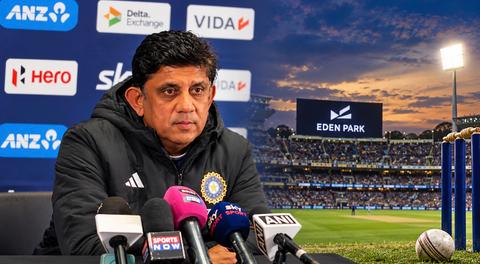
India's 3-1 ODI series victory has ended one of New Zealand cricket's proudest home records. Yet the final scoreline hides a fascinating contest: India's young bowlers delivered when its celebrated batters struggled, while the Black Caps showed enough fight to make the result far closer than it appears.
News
India Won the Series, But New Zealand Made Them Earn Every Run: A Tour That Told Two Very Different Stories
India's 3-1 ODI series victory has ended one of New Zealand cricket's proudest home records.
Listen to this articleAudio accessibility

By Webfit News | 16 November 2026
There was something unusual about India's celebrations at Bay Oval on Sunday night.
The team had just won a One-Day International series in New Zealand, something visiting sides had struggled to achieve for years. The players were smiling, the trophy was coming out, and another overseas achievement had been added to Indian cricket's growing collection.
But this was not a series India had dominated from start to finish.
Far from it.
The Black Caps had bowled India out for just 209 in the deciding match at Mount Maunganui. Two days earlier, New Zealand had beaten the visitors by a staggering 244 runs at the same ground.
And the two Indian batters many fans had travelled to see, Rohit Sharma and Virat Kohli, had endured a particularly difficult finish to the tour.
Yet India still found a way to win.
That, more than the 3-1 scoreline, is what makes this series worth examining.
It was a contest in which India's less celebrated players delivered some of the biggest moments, while New Zealand discovered both the promise and the limitations of a side still developing its depth.
A record that stood for nearly nine years
New Zealand had not lost a bilateral ODI series at home for 3,223 days.
Since their previous home series defeat, the Black Caps had put together 11 consecutive series victories in the 50-over format.
That record was not built on reputation alone.
New Zealand's conditions have repeatedly challenged visiting teams. Pitches can offer seam movement, the weather can change quickly, and the transition from afternoon sunshine to evening lights can make batting surprisingly difficult.
India arrived with a talented squad, but even they found those conditions uncomfortable.
The five-match series included a washout in Hamilton, a commanding New Zealand victory at Bay Oval and several passages in which the Black Caps appeared capable of turning the contest around.
Ultimately, India's 22-run victory in the final ODI secured a 3-1 series win and ended New Zealand's remarkable home run.
It was also India's first bilateral ODI series victory away from home under coach Gautam Gambhir.
For the Indian team, that is a significant achievement.
For New Zealand, it is a disappointing end to a proud record, but hardly evidence that the team has suddenly forgotten how to play ODI cricket.
The final match was decided by the players nobody came to watch
The crowd at Bay Oval had plenty of reasons to be excited.
Rohit Sharma and Virat Kohli were among the biggest attractions of the series. For some spectators, this may have been their last opportunity to watch the two Indian greats bat in New Zealand.
But cricket rarely follows the script supporters have in mind.
Rohit managed seven runs in the final ODI. Kohli made five.
India were struggling at 37 for three inside the powerplay.
Suddenly, the visitors were not thinking about a commanding total. They were trying to stay in the match.
Axar Patel and Ishan Kishan each scored 46, providing some stability in an innings that repeatedly threatened to collapse.
New Zealand captain Mitchell Santner took 3-47, while Jacob Duffy claimed 3-60.
India were dismissed for 209 in just 42.1 overs, leaving almost eight overs unused.
On most days, a target of 210 in a 50-over match would give the chasing team every reason to feel confident.
But this was not most days.
And India's bowlers had other plans.
Twenty-six runs that changed the evening
One of the most important moments of the final ODI came after India had already lost nine wickets.
At 183-9, New Zealand were looking at a target of 184.
Instead, Mohammed Siraj and Arshdeep Singh added 26 runs for the last wicket, taking India to 209.
Both finished unbeaten or dismissed on 14 respectively, and Arshdeep struck two sixes.
Those runs were not just entertaining. They changed the target from something comfortably below 200 to 210.
India eventually won by 22 runs.
Of course, cricket cannot be reduced to simply subtracting the winning margin from one partnership. The chase might have unfolded differently against a smaller target.
But it is difficult to ignore how valuable that final stand became.
Arshdeep later explained that the pair had discussed getting India beyond 200 so the bowlers would have something to defend.
For a player batting at No. 11, his contribution was remarkable.
And he had not yet made his biggest contribution to the match.
New Zealand were 64-1. Then everything changed.
The Black Caps began their chase cautiously.
At 64-1, they had lost only Tim Seifert and still needed 146 runs with nine wickets remaining.
There was no urgent need to attack.
Will Young and Nick Kelly had negotiated difficult early conditions, and New Zealand appeared to have a reasonable platform.
Then Arshdeep dismissed Young for 22.
Kelly followed for 24, bowled by the same man.
Mohammed Siraj removed Finn Allen for one.
Suddenly, 64-1 had become 83-4.
New Zealand had lost three wickets for 19 runs.
Michael Bracewell and Dean Foxcroft briefly steadied the innings, but both were dismissed with the total on 119.
At 119-6, the home side still needed 91 runs.
Santner fought hard, scoring 24 despite being struck on the hand, but the task was becoming increasingly difficult.
The Black Caps were eventually dismissed for 187 in 48.1 overs.
Arshdeep finished with 3-30, Siraj took 2-50, and Axar claimed 2-28.
The final margin was 22 runs.
Match details verified against the ICC scorecard and Reuters.
The captaincy decision that deserves more attention
India's stand-in captain Shreyas Iyer made one particularly interesting tactical decision.
He resisted the temptation to introduce spin early.
Instead, he continued using his seam bowlers, recognising that the surface was offering enough movement and uneven bounce to trouble New Zealand's batters.
India did not introduce spin until the 36th over.
By then, the fast bowlers had already done much of the damage.
Arshdeep, Siraj, Auqib Nabi and debutant Yash Thakur combined for seven wickets.
It was an excellent example of adapting to the conditions rather than following a familiar bowling formula.
Santner acknowledged India's approach after the match, praising the way Iyer rotated his seamers.
The Indian captain also credited his bowlers for maintaining discipline despite the difficult batting performance.
For a team looking towards the 2027 World Cup, that adaptability may prove as valuable as the series trophy itself.
The Rohit Sharma question cannot be ignored
India's victory also leaves a difficult conversation about its batting.
Rohit Sharma scored just 30 runs across four innings in the series, averaging 7.5.
At 39, he is approaching the 2027 World Cup at a stage of his career when every extended run of poor form will attract scrutiny.
His recent record, however, makes the situation more complicated than simply declaring that his best days are behind him.
Since the end of the 2025 Champions Trophy, Rohit has scored 982 ODI runs at an average of 46.76 and a strike rate of 98.89.
Those are strong numbers.
But his approach during the opening powerplay has changed.
From the beginning of the 2023 World Cup through the 2025 Champions Trophy, Rohit scored at a strike rate of 133.68 during the first ten overs.
In his subsequent 22 ODI innings, that figure dropped to 86.25.
That is a substantial decline for someone whose aggressive starts have been central to India's batting approach.
His ability has not disappeared. But the rhythm and authority of his early innings have become less consistent.
Playing international cricket in only one format, with long gaps between series, may be contributing to the challenge.
Kohli has also experienced difficult moments on this tour, although his broader recent ODI performances have been stronger.
India should not make selection decisions based on one difficult series.
But neither should a series victory prevent honest discussion about the batting order.
New Zealand lost the series, not its credibility
There is a temptation after a 3-1 defeat to focus entirely on what went wrong.
That would be unfair to the Black Caps.
New Zealand's 244-run victory in the fourth ODI demonstrated how dangerous the team can be in home conditions.
Matt Henry's six-wicket performance and Will Young's century were outstanding contributions.
Santner also led a bowling attack that repeatedly troubled India's experienced batting line-up.
In the final match, New Zealand dismissed India for 209 despite several missed catching opportunities.
Those are genuine positives.
But the batting inconsistency was costly.
In the deciding ODI, four of New Zealand's top six reached double figures without anyone passing 31.
Several batters made starts but could not turn them into substantial partnerships.
The collapse from 64-1 to 119-6 was particularly damaging.
Santner's assessment that the series was closer than the final scoreline suggests has merit.
New Zealand were competitive for long periods and produced one emphatic victory.
But India were better at converting difficult situations into wins.
That was the difference.
What the series tells us ahead of the World Cup
THE BIGGER PICTURE
| India | New Zealand |
|---|---|
| Young fast bowlers delivered under pressure | Seam attack remains dangerous at home |
| Arshdeep emerged as a match-winner | Batting partnerships need greater consistency |
| Shreyas Iyer showed tactical flexibility | Santner's all-round leadership remains valuable |
| Rohit's powerplay form raises questions | Squad depth will be tested by selection changes |
| Gurnoor Brar's nine wickets showed emerging talent | Young and Henry showed match-winning quality |
Gurnoor Brar was named Player of the Series after taking nine wickets, another encouraging sign for India's pace-bowling depth.
For New Zealand, the immediate challenge is not to abandon the approach that produced 11 consecutive home ODI series wins.
It is to identify why promising batting positions repeatedly failed to become match-winning partnerships.
Both sides will also need to consider how their squads evolve before the next major international tournaments.
The fans were part of the story too
There is another side to this tour that does not appear in the scorecards.
Across New Zealand, Indian supporters turned out in large numbers, bringing colour, noise and enthusiasm to the grounds.
At Eden Park, Wellington and Bay Oval, the atmosphere reflected the strong cricketing connection between the two countries.
For Indian families living in New Zealand, these matches were an opportunity to watch players they had followed for years.
For local cricket supporters, they offered the chance to see some of the world's most recognisable cricketers competing against the Black Caps.
And even when Rohit and Kohli failed with the bat, the excitement surrounding their appearances was unmistakable.
That is one of the strengths of international cricket in New Zealand.
The competition on the field can be fierce while the crowd brings together people with different backgrounds and loyalties.
India's players also acknowledged the support after the series.
Iyer said it was heartening to see fans supporting both teams.
A series that deserves to be remembered for more than the result
India will rightly celebrate this victory.
Winning an ODI series in New Zealand is never easy, and ending the Black Caps' long unbeaten home run makes the achievement more significant.
But the most interesting part of this series is how India won it.
Not through consistent batting dominance.
Not through centuries from its most famous players.
And certainly not through a flawless performance.
India won because different players stepped forward when the team needed them.
Axar and Kishan rescued the batting.
Siraj and Arshdeep added crucial runs at the end.
The young fast bowlers refused to let New Zealand settle.
And Shreyas Iyer trusted the conditions, even when that meant delaying his spin options until deep into the innings.
New Zealand, meanwhile, have every reason to be disappointed. Their home record is gone, and there were moments when the series could have taken a different direction.
But the Black Caps also showed enough quality to suggest that the gap between the teams was smaller than 3-1 indicates.
India won the trophy. New Zealand lost a proud record. Both teams leave with questions that could shape their future.
And perhaps that is the fairest way to remember this tour.
Not as a story of one team overwhelming another, but as a reminder that cricket is often decided by the players and moments nobody expected to matter most.
Fifth ODI at a glance
| Detail | Result |
|---|---|
| Venue | Bay Oval, Mount Maunganui |
| Date | 15 November 2026 |
| India | 209 all out (42.1 overs) |
| New Zealand | 187 all out (48.1 overs) |
| Result | India won by 22 runs |
| Series | India won 3-1 |
| Player of the Match | Arshdeep Singh |
| Player of the Series | Gurnoor Brar |
Webfit News Sports | Reporting based on official match statistics, post-match comments and independent match coverage.
Was this article useful?