<p>Why India’s “Chicken Neck” Corridor Is One of the Country’s Most Sensitive Strategic Zones</p>
India’s “Chicken Neck” is not just a dramatic geopolitical phrase. It is one of the most critical and vulnerable strategic corridors in the country.
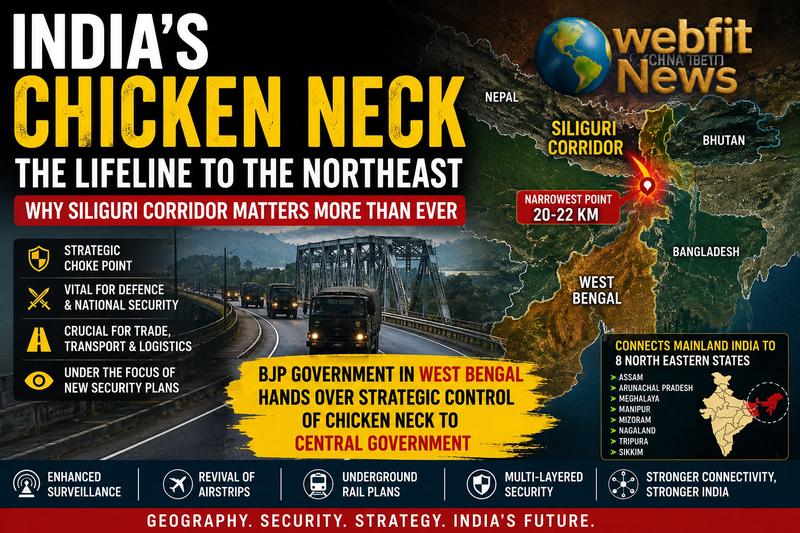
Officially known as the Siliguri Corridor, this narrow stretch of land in northern West Bengal connects mainland India to all eight northeastern states. At its narrowest point, the corridor is estimated to be only around 20-22 kilometres wide. On one side lies Nepal, on another Bhutan, while Bangladesh borders the south. China’s Tibet region is also geographically close through the Doklam and Chumbi Valley region.
Because of this unique geography, the corridor has enormous military, economic, political, and national security importance.
The Siliguri Corridor looks like a thin neck connecting the “body” of India to the northeastern region. Strategically, it behaves exactly like a bottleneck.
If this corridor were ever blocked during war, conflict, sabotage, or instability, Northeast India could become physically disconnected from mainland India’s primary transport and supply networks.
That is why defence experts often describe it as India’s most sensitive strategic choke point.
Key Facts About the Siliguri Corridor
Strategic Factor
Details
Official Name
Siliguri Corridor
Location
Northern West Bengal
Narrowest Width
Approx. 20-22 km
Connects
Mainland India to Northeast India
Nearby Countries
Nepal, Bhutan, Bangladesh, China
Strategic Importance
Military, logistics, rail, road, oil supply
Main City
Siliguri
Importance After Partition
Increased significantly after 1947
Why the Corridor Matters So Much
Nearly every major transportation route into Northeast India passes through this corridor.
This includes:
National highways
Railway networks
Fuel pipelines
Military supply routes
Internet and communication infrastructure
Trade logistics
Northeast States Dependent on This Corridor
Assam
Arunachal Pradesh
Meghalaya
Manipur
Mizoram
Nagaland
Tripura
Sikkim
Any disruption could severely impact civilian life, military movement, trade, emergency response, and economic activity.
Why Discussions Around the Chicken Neck Have Increased Recently
Following major political changes in West Bengal and increasing regional security concerns, discussions around the Siliguri Corridor have intensified across India’s strategic community.
There have been reports of:
Increased central government involvement
Enhanced defence coordination
Revival of old airstrips
Additional military preparedness
Expanded surveillance systems
Security drills in sensitive zones
Infrastructure strengthening projects
Some social media discussions claim that the West Bengal government has “handed over” the Chicken Neck to the central government. Technically, the corridor itself has not been transferred as territory.
However, strategic coordination between the state government and central agencies has reportedly increased because the corridor is considered vital for national security.
Strategic Threats India Watches Closely
India’s concern is not only military invasion.
The Siliguri Corridor sits in a highly complex geopolitical zone.
Major Security Concerns Include:
China’s growing regional influence
Border tensions near Doklam
Vulnerability during wartime
Illegal cross-border networks
Terror or sabotage risks
Supply chain disruption
Dependence on a single narrow route
Major Strategic Measures Being Discussed
India has already started strengthening the corridor aggressively.
Some reported initiatives include:
Upgrading railway infrastructure
Underground rail route planning in sensitive stretches
Military logistics expansion
Drone surveillance restrictions
Revival of abandoned wartime airstrips
Increased deployment readiness
Multi-layer border monitoring
Data Snapshot: Why the Chicken Neck Is Strategically Critical
Area
Strategic Relevance
Defence
Primary military access to Northeast
Economy
Trade and logistics gateway
Connectivity
Rail, road, telecom backbone
Energy
Fuel movement to Northeast
Diplomacy
Sensitive to China-Bangladesh dynamics
Internal Stability
Essential for national integration
Historical Importance After Partition
The Siliguri Corridor became critically important after the 1947 Partition.
Before Partition, India’s northeastern region had wider land connectivity through areas that later became East Pakistan, now Bangladesh.
Once Partition happened, the Northeast became heavily dependent on this narrow corridor for physical connectivity with the rest of India.
Since then, every Indian government has treated the corridor as a strategic national asset.
Webfit News Perspective
The Chicken Neck corridor is not simply about geography. It represents how national security, politics, infrastructure, and international diplomacy intersect in modern India.
For decades, Northeast India was viewed as geographically distant from the national mainstream. Today, that thinking is changing rapidly.
India’s Act East policy, regional trade ambitions, defence planning, and border strategy are making Northeast India increasingly important to the country’s future. Naturally, the Siliguri Corridor becomes even more critical in that equation.
At the same time, rising geopolitical tensions in Asia are forcing India to think more seriously about infrastructure resilience, alternative transport routes, and strategic preparedness.
The renewed focus on the Chicken Neck shows that modern wars and geopolitical conflicts are no longer fought only with weapons. Geography, logistics, transport corridors, data networks, and supply chains have become equally important.
And in India’s strategic map, few places matter more than the narrow strip of land known as the Chicken Neck.