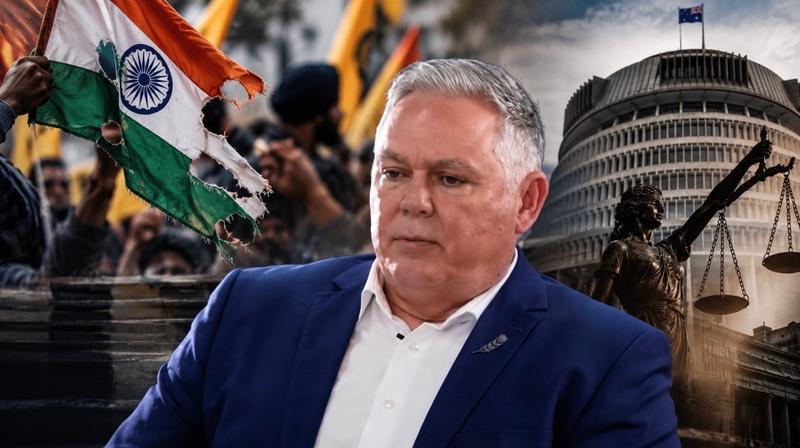
The discussion, recorded in South Auckland on 3 October, centred on Khalistan-related protests, the treatment of the Indian national flag and whether authorities apply consistent standards when demonstrations become offensive or confrontational.
The exchange has taken on added significance following Destiny Church leader Brian Tamaki’s appearance in court on 19 October, when he pleaded not guilty to three charges of inciting racial disharmony.
Yet the most important issue may be one that is easily lost when the debate becomes a contest between political personalities.
New Zealand law does not simply ask whether a protest is offensive. It asks what people actually did, whom their conduct affected and whether a specific legal threshold was crossed.
And that distinction deserves closer examination.
The Question That Put the Police Minister on the Spot
During the Unboxed discussion, a panellist challenged Mitchell over the treatment of Khalistan supporters who allegedly tear and stamp on the Indian flag during demonstrations.
The concern was straightforward.
If Brian Tamaki’s conduct involving flags deserved public condemnation, why should similar actions involving the Indian flag be treated differently?
Mitchell maintained that the same expectations applied to everyone.
“The expectation around the Khalistani protests will be exactly the same expectation around Brian Tamaki,” he said.
He defended peaceful protest as a fundamental democratic right, including when the views expressed were deeply unpopular.
The discussion became sharper when a panellist pointed to the alleged desecration of the Indian flag.
Mitchell distinguished that conduct from the allegations underlying the police investigation into Tamaki.
When pressed on whether tearing and stamping on a flag was acceptable, Mitchell rejected the suggestion that he approved of it.
He argued, however, that public offence alone does not establish a criminal offence.
That response captures a distinction many people find uncomfortable.
Something can be offensive, disrespectful or deserving of condemnation without necessarily being unlawful.
The Missing Distinction: A Flag Is Not the Same as a Person
A national flag represents identity, history and belonging.
For many Indian New Zealanders, seeing the Indian flag deliberately damaged can feel like an attack on something deeply personal.
Those feelings should not be dismissed.
But the legal question is different.
New Zealand protects freedom of expression under the New Zealand Bill of Rights Act 1990, subject to justified legal limits.
Political protest can include symbolic actions intended to shock, provoke or offend.
That does not mean every action involving a flag is automatically lawful. The surrounding circumstances still matter.
For example, damaging someone else’s property, threatening individuals or engaging in disorderly conduct may raise separate legal questions.
But deliberately damaging a flag as political expression is not necessarily equivalent to threatening a person because of their ethnicity.
The law must distinguish between an attack on a symbol and conduct directed at the rights or safety of people.
That distinction works in both directions.
People who oppose Khalistan separatism have the right to criticise it.
People who support Khalistan have the right to express their political position peacefully.
Neither side acquires a right to threaten or intimidate others because it believes its cause is justified.
What About Brian Tamaki?
Tamaki’s case has become central to the debate, but it is important not to confuse the allegations against him with the flag-related conduct discussed during Mitchell’s interview.
On 19 October, Tamaki pleaded not guilty in the Manukau District Court to three charges of inciting racial disharmony.
The charges concern alleged offending in June, including social media posts.
They were brought under section 131 of the Human Rights Act 1993.
That provision addresses certain threatening, abusive or insulting communications made with the intent to excite hostility or ill-will against groups identified by colour, race or ethnic or national origins, where the other statutory requirements are met.
It does not criminalise every offensive political or religious statement.
Tamaki disputes the allegations. He has maintained that his criticism concerned Indian Prime Minister Narendra Modi and alleged human-rights abuses in India, rather than hostility towards Indians as an ethnic or national group.
Those arguments, together with the prosecution’s evidence, are matters for the court.
Tamaki has not been convicted of these charges and is entitled to the presumption of innocence.
His case therefore cannot be used as proof that criticism of India, Indian political leaders or religious practices is automatically unlawful.
Equally, a person cannot necessarily avoid scrutiny for alleged racial hostility simply by describing their statements as political criticism.
The distinction depends on the actual words, their context, the intent alleged and the applicable law.
The Bigger Issue: What Happens When Protest Becomes Intimidation?
One of the most significant concerns raised during the Unboxed discussion was not simply the treatment of the Indian flag.
It was the possibility that people who disagree with Khalistan separatism could face threats or intimidation.
That concern deserves attention independently of the flag debate.
A peaceful demonstration outside a public venue is one thing.
Threatening someone, obstructing their lawful activities or targeting them because of their background is another.
The same principle applies when protests involve Tamaki, Destiny Church or any other movement.
The question for police should not be whether they agree with the political message.
It should be whether the conduct crosses a legal threshold requiring intervention.
There is also an important difference between a community feeling offended by a demonstration and individuals being genuinely fearful because of specific threats.
Both experiences deserve to be heard, but they do not necessarily require the same legal response.
A democracy should protect the right to express an unpopular opinion without expecting people to tolerate unlawful intimidation.
Why Consistency Matters More Than Political Allegiance
Mitchell’s position was that the same standards should apply to Khalistan protesters and Tamaki.
That is the correct principle to test.
But consistency is not demonstrated simply by condemning two groups equally.
It is demonstrated by assessing comparable conduct against comparable laws.
If one protest involves symbolic damage to a flag and another involves allegations of inciting hostility towards an ethnic group, different police responses do not automatically prove double standards.
The alleged conduct and relevant legal tests are different.
On the other hand, if credible threats or unlawful conduct are treated differently because of the political identity of those involved, that would raise legitimate questions about equal enforcement.
The challenge is to establish which situation actually exists.
That requires evidence, not just competing video clips or political accusations.
Is This Becoming an Election Issue?
With New Zealand heading towards the 2026 general election, debates involving immigration, ethnic communities, national identity and freedom of speech are likely to attract political attention.
The timing of the Unboxed exchange and Tamaki’s subsequent court appearance gives the issue obvious political significance.
However, there is not enough evidence in the material examined to conclude that the exchange was orchestrated as an election stunt.
Nor would it be reasonable to dismiss the concerns raised by Indian New Zealanders simply because the discussion occurs during an election period.
Political parties and public figures may use such controversies to reinforce their positions on law and order, community relations or free speech.
That possibility should invite scrutiny, not assumptions about motive.
The more useful questions for political leaders are practical.
Would they defend peaceful protest when the message attacks something they personally value?
Would they condemn intimidation when it comes from people whose political views they support?
And would they accept an independent police decision even when it disappoints their own supporters?
Those questions apply equally across the political spectrum.
Webfit News Analysis: The Right to Offend Is Not the Right to Threaten
The argument over the Indian flag has become a test of whether New Zealand applies its free-speech principles consistently.
But focusing exclusively on whether tearing a flag should be punished risks overlooking a more important issue.
A country can defend the right to criticise India, support Khalistan, oppose Khalistan or condemn Brian Tamaki without accepting threats against any community.
These positions are not contradictory.
They are part of the same democratic principle.
There is also a responsibility on public officials to explain these distinctions clearly.
When people see an offensive protest and are told that police may not intervene, they can understandably conclude that their concerns are being ignored.
But a decision not to prosecute particular conduct does not necessarily mean authorities endorse it.
Equally, invoking free speech should never become an excuse to dismiss credible allegations of threats or targeted hostility.
That is where public confidence depends on transparency.
People need to understand what police can investigate, what evidence is required and why different incidents may produce different legal outcomes.
For Indian New Zealanders, Khalistan supporters, Tamaki’s supporters and everyone else, the same standard should apply.
The real measure of free speech is not whether we protect the views we agree with. It is whether we protect lawful expression we strongly dislike, while drawing a firm and consistent line at unlawful conduct.
That is a harder principle to defend than a national flag.
But it is also the principle that protects everyone.
Sources and Acknowledgements
Original interview: Unboxed, political interview with Police Minister Mark Mitchell, recorded in South Auckland on 3 October 2026.
Interview support: New Zealand Indian Central Association (NZICA).
Original reporting: Ravi Bajpai, “So That Is Fine, Tearing the Indian Flag?” Police Minister Mitchell Grilled Over Free Speech, 18 October 2026.
Additional sources: Human Rights Act 1993, section 131; New Zealand Bill of Rights Act 1990; public reporting on Brian Tamaki’s Manukau District Court appearance on 19 October 2026.
Editorial Note: This article is an independent Webfit News analysis based on the supplied interview account and subsequent court reporting. It distinguishes reported allegations, political statements and legal principles. No finding of unlawful conduct is made against participants in the Khalistan-related protests. Brian Tamaki has pleaded not guilty, and his case remains before the court. The article does not suggest that the flag-related incidents form part of the charges against him.
Video Credit: Unboxed, with support from the New Zealand Indian Central Association (NZICA).
Editorial verification: The key legal distinction is supported by section 131 of the Human Rights Act, and Tamaki’s not-guilty plea was independently reported on 19 October. The interview quotations are attributed to the account you supplied; I could not independently verify the spoken audio of the attached clip.