India has dispatched its first export shipment under the new trade agreement, while New Zealand exporters gain immediate tariff relief. But who will capture the savings, and can smaller businesses compete?
By Webfit News | Auckland | 20 October 2026
India has dispatched its first export shipment under the new trade agreement, while New Zealand exporters gain immediate tariff relief.

India has dispatched its first export shipment under the new trade agreement, while New Zealand exporters gain immediate tariff relief. But who will capture the savings, and can smaller businesses compete?
By Webfit News | Auckland | 20 October 2026
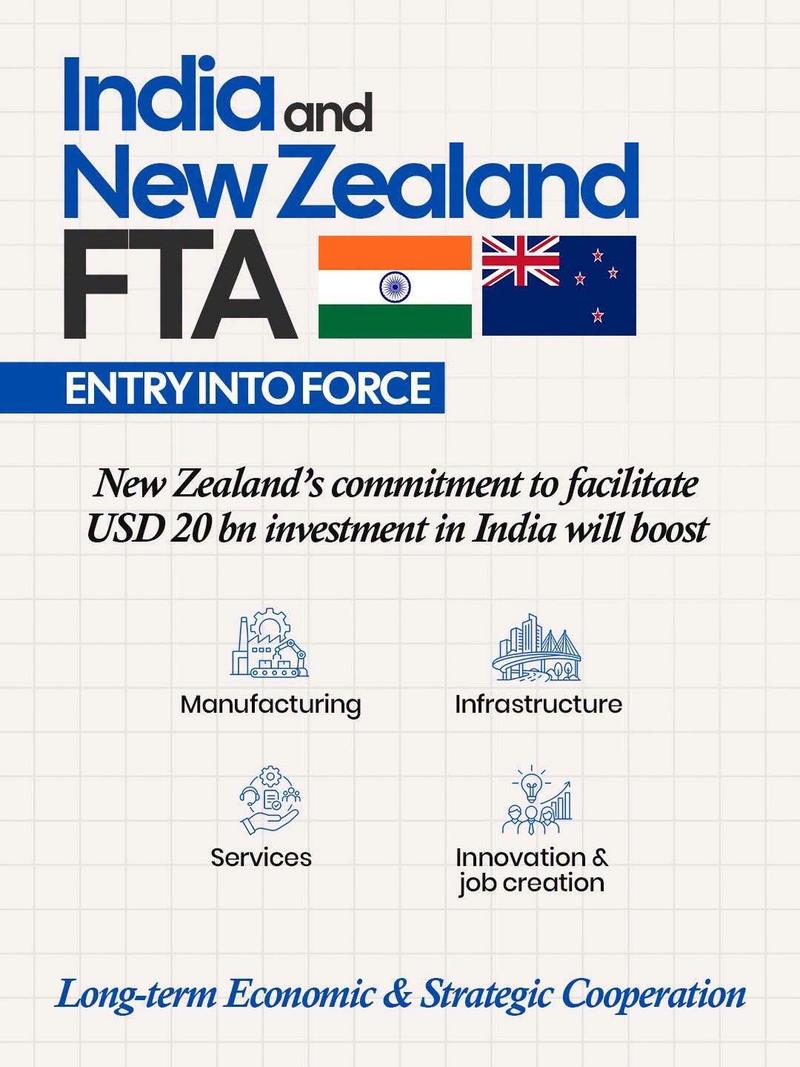
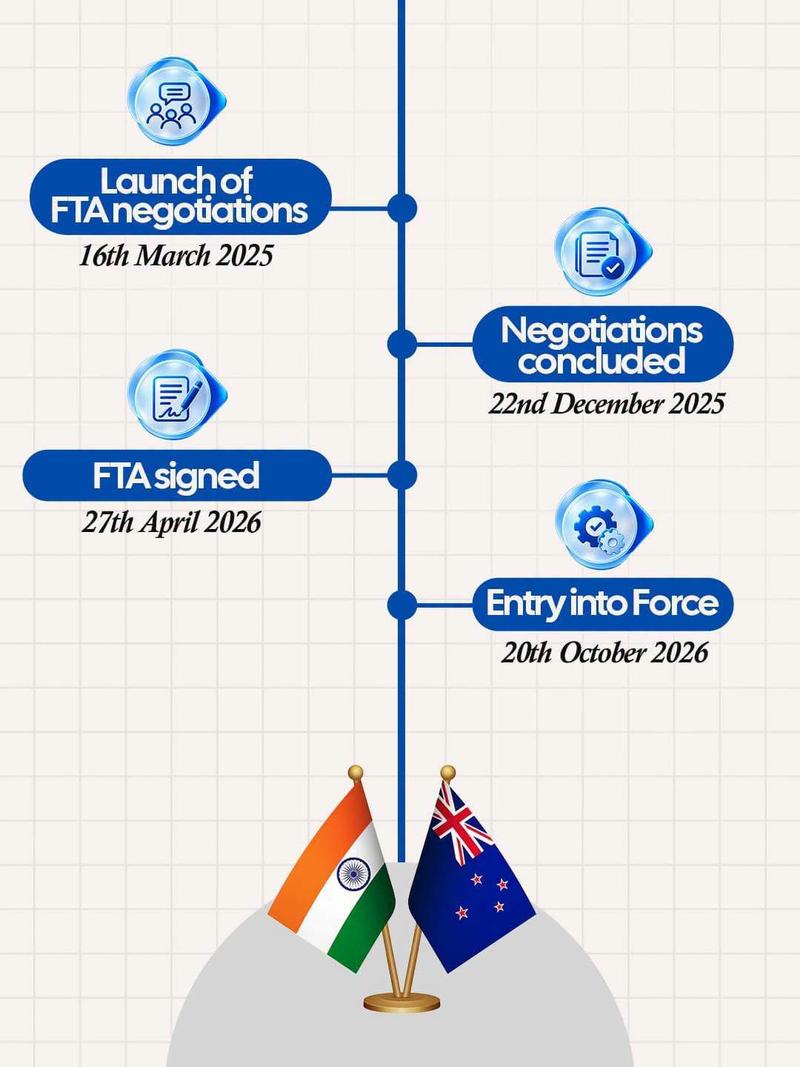
The India–New Zealand Free Trade Agreement (FTA) officially takes effect today, 20 October 2026, marking a new phase in economic relations between the two countries.
The first shipment has already been flagged off in India: a JCB 18Z mini excavator manufactured in Pune, Maharashtra, destined for New Zealand.
Indian Commerce and Industry Minister Piyush Goyal marked the occasion in New Delhi, while New Zealand Trade and Investment Minister Todd McClay joined the event virtually.
The agreement provides duty-free access for qualifying Indian exports to New Zealand and immediate tariff relief for a significant proportion of New Zealand’s exports to India.
Both governments are targeting stronger trade and investment ties, but the agreement’s economic impact will depend on what happens after the ceremonies.
What Changes From Today?
|
Area |
Key development |
|
New Zealand exports |
57% of current exports to India become tariff-free immediately |
|
Future tariff reductions |
Tariff-free coverage rises to 82% over time, with the next cuts from 1 January 2027 |
|
Indian exports |
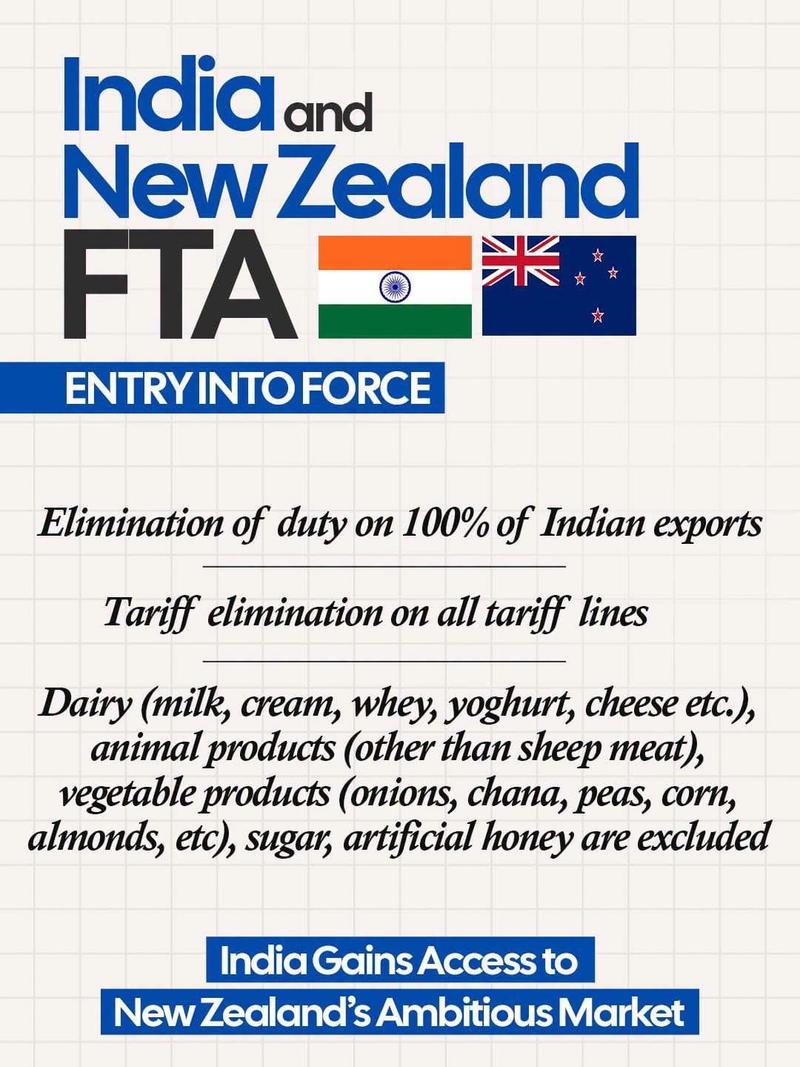
Zero-duty access across 100% of New Zealand tariff lines for eligible Indian-origin goods |
|
Wine |
Indian tariffs of up to 150% to reduce to 25% or 50% over ten years |
|
Indian market protection |
Dairy, sugar and selected agricultural products remain excluded from tariff concessions |
|
Professional mobility |
A new pathway covering up to 5,000 eligible Indian professionals |
|
Investment |
US$20 billion investment facilitation commitment over 15 years |
Important distinction: The 82% figure refers to New Zealand exports eventually becoming tariff-free. Approximately 95% of current export value is covered when partial tariff reductions are also included.
First Shipment: Why a Mini Excavator Matters
The first shipment is more than a ceremonial export.
The Maharashtra-manufactured JCB mini excavator represents India’s ambitions to expand exports of higher-value engineering and manufactured goods.
Under the agreement, qualifying Indian engineering products receive zero-duty access to New Zealand.
Other Indian sectors benefiting from tariff elimination include textiles, footwear, pharmaceuticals, electronics, chemicals and processed foods.
However, removing customs duties does not remove New Zealand’s safety, environmental, biosecurity or product-compliance requirements.
For importers, the commercial advantage will depend on the product’s eligibility, landed cost and ability to compete with existing suppliers.
What New Zealand Businesses Gain
New Zealand exporters receive immediate tariff relief on products including sheep meat, wool, coal and most forestry products.
Winemakers could see particularly significant changes.
Indian import tariffs on wine, previously as high as 150%, will progressively fall to 25% or 50% over ten years, depending on the product category.
The agreement also provides preferential arrangements for selected products such as apples, kiwifruit and honey, subject to conditions including quotas and other market-access rules.
But India has retained protections for sensitive sectors, particularly dairy.
This means the agreement does not provide unrestricted tariff-free access for New Zealand milk, cheese and other mainstream dairy products.
The outcome reflects negotiations between countries with different economic priorities, rather than an equal removal of every trade barrier.
Beyond Goods: Professionals, Students and Services
The agreement also includes provisions covering professional mobility, education and services.
According to India’s published summary:
These provisions are subject to the applicable visa conditions, eligibility criteria and New Zealand laws. They should not be interpreted as automatic work or residence rights.
The $20 Billion Figure: Commitment or Guaranteed Investment?
One of the agreement’s largest headline figures is US$20 billion over 15 years, associated with facilitating New Zealand investment into India.
The agreement also reportedly includes a mechanism to address shortfalls against the investment commitment.
However, the figure must be interpreted carefully.
It does not mean US$20 billion has already been invested, nor should it automatically be treated as a direct New Zealand taxpayer-funded payment to India.
Actual investment will depend on the agreement’s legal provisions, financing, commercial decisions and projects proceeding.
The more meaningful question is how much investment eventually materialises, which businesses participate and what measurable economic benefits follow.
The Webfit News Angle: A Tariff Can Disappear Without Prices Falling
This is perhaps the most important issue missing from many celebratory trade announcements.
When a government removes an import tariff, someone in the supply chain saves money.
But who?
Consider a hypothetical example.
A New Zealand importer previously paid $1,000 in customs duty on an eligible shipment from India.
Under the agreement, that duty falls to zero.
The importer now has a potential $1,000 saving.
That saving could be:
The removal of a tariff does not guarantee a corresponding reduction in consumer prices.
The same principle applies to New Zealand goods entering India.
An exporter may benefit from higher margins, increased competitiveness or stronger sales, but those outcomes are not automatic.
Another overlooked issue: Can small businesses afford to use the deal?
Large exporters often have dedicated customs specialists, established overseas buyers and substantial shipping volumes.
Small businesses may not.
To claim preferential treatment, goods must satisfy rules of origin and relevant documentation requirements.
For a small exporter, compliance, logistics and distribution expenses could absorb much of the tariff advantage.
A free trade agreement may give every eligible business the same legal opportunity, but not every business has the same resources to take advantage of it.
That makes practical implementation just as important as the agreement itself.
McClay acknowledged this challenge at the first-shipment event, emphasising that the agreement’s success would depend on businesses understanding and using its provisions.
Five Questions That Will Determine Whether the FTA Delivers
|
Question |
What should be measured |
|
Are exports actually growing? |
Trade volumes and values, not just tariff announcements |
|
Are consumers benefiting? |
Retail prices and competition |
|
Are smaller firms participating? |
First-time exporters and preferential tariff usage |
|
Is investment materialising? |
Verified investment against the 15-year commitment |
|
Are jobs and opportunities increasing? |
Sustainable employment, productivity and business expansion |
The two governments have expressed an ambition to double bilateral trade by 2030.
Whether that target is achieved will depend on business demand, investment, implementation and wider economic conditions.
Webfit News Analysis: The Agreement Is Signed. The Accountability Starts Now.
The India–New Zealand FTA creates genuine commercial opportunities.
Indian manufacturers gain broader access to New Zealand. Kiwi exporters receive tariff relief in selected sectors. Both countries have established arrangements intended to support services, investment and professional mobility.
But the agreement also contains exclusions, conditions and commercial uncertainties.
It would be premature to describe it as an economic success solely because it has entered into force.
Equally, the presence of protected industries does not mean the agreement lacks value.
The real test is not how much trade governments promise, but how much new trade businesses generate.
Not how much investment is announced, but how much is delivered.
And not simply whether tariffs fall, but whether the resulting benefits reach businesses, workers and consumers.
That is how this agreement should be judged in the years ahead.
Sources and Acknowledgements