From Criminal Charges to a Public Campaign
Tamaki, 68, appeared in court on 19 October, with his lawyer Ron Mansfield KC entering not guilty pleas.
The charges relate to Facebook material published in June 2026, which prosecutors allege was intended to incite racial disharmony against Indians on grounds including race and national origin.
Tamaki denies wrongdoing.
Before the hearing, he published a lengthy statement on Facebook arguing that the prosecution represented a threat to fundamental freedoms.
His central argument was that he had challenged religious beliefs and political leadership, rather than people because of their race.
He wrote:
"I have challenged RELIGION. NOT RACE."
He also argued that being offended by someone's comments does not automatically make those comments criminal.
These statements represent Tamaki's position. They are not findings made by the court.
The proceedings will determine whether the prosecution can establish the elements of the alleged offences under New Zealand law.
What the Photographs Reveal About the Day
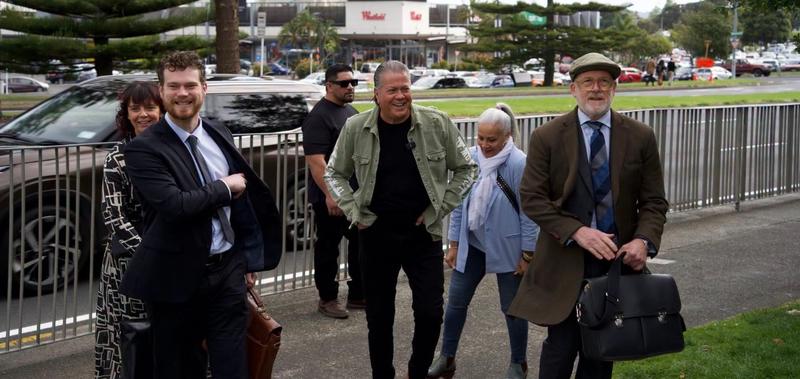
The photographs published on Tamaki's Facebook page offer a picture of how the court appearance was presented to his supporters.
One image shows Tamaki approaching the courthouse alongside his legal team, including Ron Mansfield KC.
Another shows supporters outside Manukau District Court holding signs reading "FREE SPEECH ON TRIAL" and "BRIAN TAMAKI STANDS FOR FREE SPEECH".
A further placard asks whether New Zealand has become a police state.
Those signs reflect the views of the demonstrators, not an established description of New Zealand's justice system.
Tamaki also shared images of himself speaking to supporters before entering court and responding to journalists afterwards.
In his accompanying Facebook posts, he said people had travelled from Matamata, Wellington and other parts of New Zealand to support him.
That claim has not been independently verified by Webfit News.
Nevertheless, the images establish that Tamaki's court appearance was accompanied by an organised public display of support and a consistent message centred on freedom of expression.
The Strategy Behind the Free Speech Message
The most significant feature of Tamaki's public response is the way he has framed the case.
The criminal proceedings concern specific allegations about particular statements.
Tamaki's public campaign, however, addresses a much wider audience and asks a different question: should New Zealanders fear prosecution for expressing controversial opinions?
Those two questions are related, but they are not identical.
A person can support freedom of expression while also accepting that Parliament has established criminal limits on certain forms of incitement.
Equally, a person can oppose Tamaki's religious or political views while insisting that any prosecution must satisfy the law's requirements.
By placing free speech at the centre of his public statements, Tamaki is encouraging supporters to consider the wider implications of the case rather than focusing exclusively on the alleged offences.
That is a legitimate position for a defendant to advance publicly, but it does not resolve the legal questions.
Public support cannot establish innocence, just as public criticism cannot establish guilt.
The court must reach its conclusions through evidence and law.
Tamaki Says He Does Not Know Which Posts Are Being Challenged
One of the more important developments following Monday's hearing concerns the precise Facebook material underlying the charges.
Speaking to media outside court, Tamaki said he did not know which specific posts formed the basis of the allegations.
He suspected the charges related to comments about Indian Prime Minister Narendra Modi and the treatment of Christians in India.
This raises a practical issue for the next stage of the proceedings.
The prosecution must identify the alleged offending material with sufficient particularity for the charges to be answered.
The defence will need to examine the relevant statements, their context and the prosecution's interpretation of them.
Tamaki's pre-court Facebook statement was categorical about his own interpretation of his comments.
He argued that, at most, his remarks could be characterised as religious disharmony rather than racial disharmony.
However, the distinction cannot be resolved solely by how a speaker describes their own intentions.
The prosecution will need to prove its allegations, and the defence will have an opportunity to challenge that evidence.
What Police Have Confirmed
Police have confirmed that three charges were laid under the Human Rights Act.
Detective Senior Sergeant Natalie Nelson of Counties Manukau CIB previously confirmed that officers attended an address to serve a summons.
She also explained that prosecutions of this nature require consent from the Solicitor-General.
Police have declined to discuss the specifics of the case while it is before the court.
Under section 131 of the Human Rights Act 1993, the prosecution must establish the statutory elements of inciting racial disharmony, including the relevant intent and the likelihood of hostility or ill-will towards a protected group.
The offence carries a maximum penalty of three months' imprisonment or a $7,000 fine.
These requirements mean that a controversial statement does not automatically amount to a criminal offence.
They also mean that describing a statement as religious or political expression does not automatically settle its legal status.
The exact words, surrounding circumstances and evidence of intent will matter.
A Public Protest Is Not the Same as a Courtroom Defence
Tamaki's supporters have already made their position visible.
Their signs describe the proceedings as a trial of free speech, while Tamaki has argued that the case affects the freedoms of all New Zealanders.
But there is an important distinction between the public debate and the criminal proceedings.
The public debate asks whether the prosecution is appropriate, whether the law is too restrictive and what protections should exist for controversial expression.
The criminal proceedings ask whether Tamaki committed the offences with which he has been charged.
Those questions should not be confused.
A court can determine whether an offence has been proved without resolving every wider political disagreement about free speech.
Similarly, an acquittal would not necessarily establish that all of Tamaki's statements were appropriate or beyond criticism.
It would mean the prosecution had not secured a conviction on the charges before the court.
The central issue is evidence, not the number of supporters outside the courthouse or the strength of public reaction.
The Other Side of the Conversation
The Facebook material shared by Tamaki focuses heavily on his own position and the support he received.
It does not provide the complete prosecution evidence or a response from the communities allegedly targeted by the original statements.
That is an important limitation.
The public can examine Tamaki's arguments about religious criticism and free speech while also recognising that people who believe they were targeted may have a different perspective.
Neither perspective substitutes for the evidence required in court.
For New Zealand's Indian communities, the distinction between criticism of India's government and hostility towards people of Indian origin remains relevant.
But the current proceedings should not be presented as a contest between Tamaki and the Indian community as a whole.
Indian New Zealanders hold diverse religious, political and personal views, and no single response can be presumed to represent them.
What Happens Next?
Tamaki is expected to return to court in January 2027.
The next stages will provide an opportunity for the legal arguments and evidence to be examined more closely.
Three questions will be particularly important as the case progresses:
Which exact Facebook statements form the basis of each charge?
What evidence does the prosecution rely on to establish the required intent and likelihood of racial hostility?
How will the defence challenge the prosecution's interpretation of those statements?
Those questions are more immediately relevant to the criminal proceedings than the competing slogans surrounding the case.
Tamaki remains presumed innocent unless and until proven guilty.
Beyond the Placards, the Evidence Will Decide
Monday's court appearance showed how quickly a criminal prosecution can become a public campaign.
Tamaki arrived with his legal team, addressed supporters and spoke to journalists. His social media posts presented the day as a stand for freedom of expression.
For supporters, the proceedings have become a symbol of concern about the limits of public speech.
For the justice system, however, the task is narrower and more demanding.
It must determine whether the prosecution has proved the alleged offences according to law.
That is the distinction at the heart of Monday's events: Tamaki is campaigning around a principle, but he is being prosecuted over specific alleged conduct.
The public campaign may continue well beyond the courthouse.
The criminal case will have to be decided on evidence.
And until that evidence is tested, neither the prosecution's allegations nor Tamaki's account should be mistaken for a judicial finding.
Sources and Acknowledgements
Original statements and photographs: Brian Tamaki's Facebook page, 19 October 2026.
Court proceedings and police statements: 1News and RNZ, 19 October 2026.
Primary legal source: Human Rights Act 1993, sections 131 and 132.
Editorial Note: This article is an independent Webfit News report and analysis of the 19 October court appearance, including Tamaki's publicly shared statements and photographs. Statements made by Tamaki and his supporters are attributed to them and do not represent findings by the court. The full prosecution evidence has not been independently examined by Webfit News.
Photo Courtesy: Brian Tamaki's Official Facebook Page